
CHARLOTTE — Men’s basketball in the Atlantic Coast Conference — long a dominant force in all of college athletics — hit a low point last year.
Once the unquestioned premier college basketball conference, the league received just four bids to the 68-team NCAA Tournament in 2025 — the fewest as a percentage of membership since the event expanded in 1985. Before the March Madness field was trimmed to 32, the ACC was down to one school.
“I was super restless about how we were performing in men’s basketball,” ACC Commissioner Jim Phillips told WRAL during the conference tournament last week in Charlotte. “My responsibility as the commissioner of the conference is I need to do everything I can to try to help.”
ACC teams have won 15 men’s basketball national championships since the league’s inception in 1953. North Carolina, Duke and NC State account for 13 of them, one reason that Charlotte-based conference’s struggles hit so close to home.
“If we’re going to, as a conference, revel in the fantastic success we have,” Phillips said, “ … then we have to take responsibility when things aren’t going as well.”
It’s been a multiyear process, but the moves Phillips and the league’s members made — including this year’s reduction of conference games from 20 to 18, at the cost of some key rivalries, and increased investment from university administrators and athletic directors — have paid off.
When this year’s bracket is revealed Sunday evening, the ACC could receive eight bids — its best showing since 2018, when nine of the league’s 15 members played in the event.
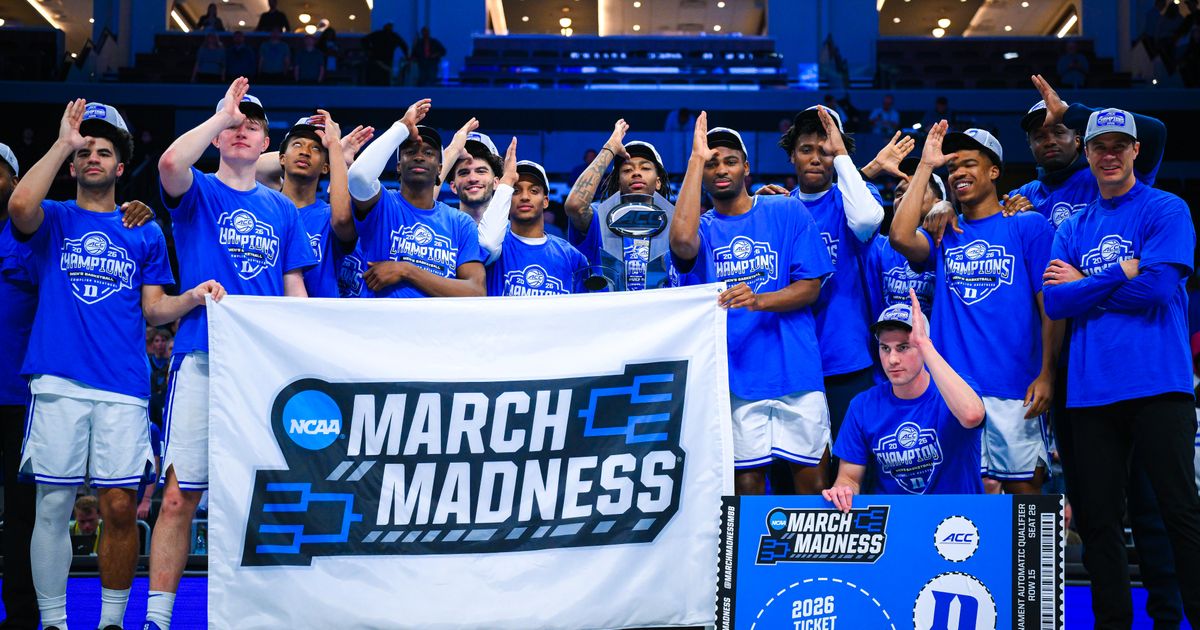
“There’s no question the league is elevated,” said Duke coach Jon Scheyer, whose top-ranked Blue Devils claimed a second straight ACC title Saturday night. “There’s no question, right? I mean the metrics will tell you that. The number of teams we’re going to get in the tournament will tell you that.”
In an era of constant change across college sports with soaring costs amid direct revenue sharing with athletes, many of the league’s members invested or reinvested in men’s basketball, one of two revenue-generating sports on most campuses.
“There’s no question that there was a renewed commitment,” said Clemson’s Brad Brownell, the longest tenured ACC coach. “We spoke about it as coaches in the league, obviously. Jim Phillips spent time with us. We’ve talked to our administrators about it, how important basketball is in this conference, the history and tradition of the league. I think we all understand that and want to do our part in upholding that.
“Certainly this year, I think, our teams have done that. We’ve scheduled better, we’ve had more success in the nonconference, and universities have put more into their basketball again.”
New coaches, new investment
The league placed just five of its 15 teams in the tournament in 2022, 2023 and 2024 — setting off alarm bells. The lack of NCAA Tournament bids became a full-fledged crisis for the now 18-team league in 2025.
The league met with bracket analysts and metric gurus to better educate it on crafting schedules to enhance teams’ chances of earning tournament bids. It sought to revamp how the league’s dedicated television network promotes men’s basketball and how best to program around games. It developed success and viewership initiatives to reward teams that deliver on the court and bring in TV ratings. It convinced television partner ESPN to allow a move from 20 conference games to 18.
But the league office isn’t the ultimate decision-maker on campuses, where budgets and priorities have to be set.
“The biggest group that deserves credit are the presidents and chancellors and athletic directors that invested in men’s basketball at a higher level than they had been,” Phillips said. “That, to me, has been the cornerstone of resurgence.”
Four ACC schools made coaching moves in the offseason — and all four have had instant success. Virginia, Miami, NC State and Florida State went a combined 24-56 in ACC play last season.
This year, the four teams combined went 50-22 in the league during the regular season. All finished in the top eight of the conference. Virginia, Miami and NC State are certainly headed to the NCAA Tournament. Florida State is likely out, but the Seminoles won 10 of their final 13 games under coach Luke Loucks.
Those quick turnaround may have caught the attention of others near the bottom of the league standings. Syracuse, Georgia Tech and Boston College fired their coaches after the season.
The new hires brought a needed infusion of coaching talent for a league that has seen several Hall of Fame coaches leave in recent years. Mike Krzyzewski (Duke), Roy Williams (North Carolina), Jim Boeheim (Syracuse) and Tony Bennett (Virginia) all won national titles. Others like Jim Larranaga (Miami), Leonard Hamilton (Florida State) and Mike Brey (Notre Dame) have enjoyed a high level of success.
“No matter who you hire to replace them, you can’t substitute what they’ve meant to the league, their experience, all of that,” Phillips said.
The old guard left as college sports was evolving. Athletes now can be paid directly by their universities in addition to outside income players can earn from name, image and likeness agreements.
ACC teams paid an estimated average of $8.2 million for their rosters this season counting revenue sharing and third-party NIL agreements, The Athletic reported. That’s in line with other power conferences, which range from $8 million in the Big East to $9.7 million in the SEC.
“There’s been renewed commitment by some schools, which is what it takes,” Brownell said. “Administrations have to get involved in this new college world order that we’re in.”
Public records outline how some schools distribute their allowed $20.5 million in direct revenue sharing. North Carolina shared $7 million with men’s basketball. NC State shared $4 million. Florida State’s Loucks said his team received just $1.2 million in direct revenue sharing.
“I knew that going into the job, and I took it anyway because I knew I could fund-raise,” Loucks said. “And our administration has done a really, really good job partnering with us to help this grow. But I believe $1.2 million [revenue] share would be the absolute bottom in Power-4 basketball — and not just bottom in the ACC.”
In the ACC, the difference between the largest budget and the smallest was more than $10 million this season, The Athletic reported. Louks, a former Florida State player, said top teams in the league are spending up to five times more than the Seminoles. The former NBA assistant coach compared it to what happens in the pros.
“Whether you spend $15 million or $6 million, once the ball tips up, it really doesn’t matter,” Louiks said. “You’ve got to be competitive. It doesn’t matter if the guy next to you makes twice as much, three times as much, that’s how professional basketball is. All these guys are going to be rookies next year. They’re going to be playing against [Los Angeles Lakers star] Luka Doncic, making $60 million. No one cares. Still got to guard him.”
Nonconference success
The most sweeping change the ACC made in the offseason was to reduce the number of conference games from 20 to 18 to allow more scheduling flexibility — a schedule tweak designed to strengthen the chances of earning those coveted NCAA Tournament berths. The reduction required conversations with ESPN, which had a contract for 20 league games per school. Fewer conference games could mean less programming for the television giant, which owns all of the ACC’s television rights.
“They were willing to go to 18, but there were certain parameters,” Phillips said of ESPN. “Make sure that we play really high-level games. Take advantage of those two [openings] and create matchups like Duke-Michigan. That would normally be a conference game on a Saturday night.”
Duke’s Feb. 23 nonconference neutral-site game with Michigan, a battle of two of the top-ranked teams in the nation at the time, was ESPN’s most-watched college basketball game in seven years. It averaged 4.3 million viewers. The two regular-season meetings between Duke and North Carolina were the second- and third-most watched games of the season, showing the continued relevance of ACC basketball.
The schedule change was not without cost. North Carolina and NC State played just once in the regular season for the first time in more than 100 years as the league and ESPN sought to maximize big games.
The reduction in conference games also was driven by math. Additional nonconference games offered a chance to boost the ACC’s overall winning percentage, which plays into the metrics that the selection committee evaluates. The SEC has played an 18-game conference schedule for more than a decade. The Big 12, like the ACC, went from 20 games to 18 this year.
North Carolina athletics director Bubba Cunningham, the chairman of the NCAA selection committee last season, said the key is to win 80% of nonconference games league-wide. That elevates the opportunities for high-quality wins during league play and, importantly, provides less chances for harmful losses.
In 2024-25, the league went 130-69 (.653) in regular-season nonconference games, including a miserable 20-55 against fellow power conference opponents. The ACC was an unfathomably bad 5-31 against the Southeastern Conference, which placed a record 14 teams in the NCAA Tournament.
The ACC reversed its fortunes this year. Teams went 179-55 (.765 winning percentage) in nonconference games — its best winning percentage out of league since the 2018-19 season. The league went 41-39 against other power conference opponents in the regular season, including 15-17 against the SEC.
As a result, at the end of the regular season, 13 of 18 teams are ranked in the top 70 of the NET Rankings, propping up the number of high-quality — or “Quad 1” — games that are such a pivotal part of the NCAA selection process. As of Friday, ACC teams had 78 Quad 1 NET wins, including 20 in nonconference games.
ACC teams had just 36 Quad 1 NET wins in 2024-25.
NET is a ranking of all 365 NCAA Division I men’s basketball teams. Games are classified as Quad 1, Quad 2, Quad 3 and Quad 4 based on the opponent and location of the game. Quad 1 and Quad 2 victories are helpful to teams’ tournament resumes, while Quad 3 and Quad 4 losses are detrimental.
Duke is No. 1 in the NET and 17-2 in Quad 1 games, paving the way for, perhaps, the No. 1 overall seed in the tournament.
Deeper in the field, NC State’s tournament case is buoyed by its 11 Quad 1 and Quad 2 wins.
With so many ACC teams ranked high in the NET, even losses don’t hurt as bad. NC State lost at Notre Dame, which didn’t qualify for the 15-team ACC Tournament. But the Irish posted solid out-of-league wins against TCU and Missouri and, as a result, NC State’s late-season defeat in South Bend was a Quad 2 loss, not a ranking destroyer.
“People come on the road and play us here. It’s probably a Quad 2, even though we’ve lost a bunch of games in league play,” Notre Dame’s coach, Micah Shrewsberry, said in late February. “Even teams at the bottom of the league, at least they’re not crushing you when you go and play those teams.”
Sunday should be a good day for the league. The best Selection Sunday this decade.
Duke is a national title favorite, giving the league a chance to have a team play deep into the tournament. It is the program everyone is chasing in terms of resources, alignment and success.
Regular season and tournament runner-up Virginia under first-year coach Ryan Odom pushed the Blue Devils on Saturday night and could make a deep run itself. The ACC’s improved depth gives it a chance to send multiple teams to the tournament’s second weekend.
“The rising tide [raises] all of our programs,” Phillips said. “Because people understand in the league: If you can win an ACC championship, you can win a national championship.”