
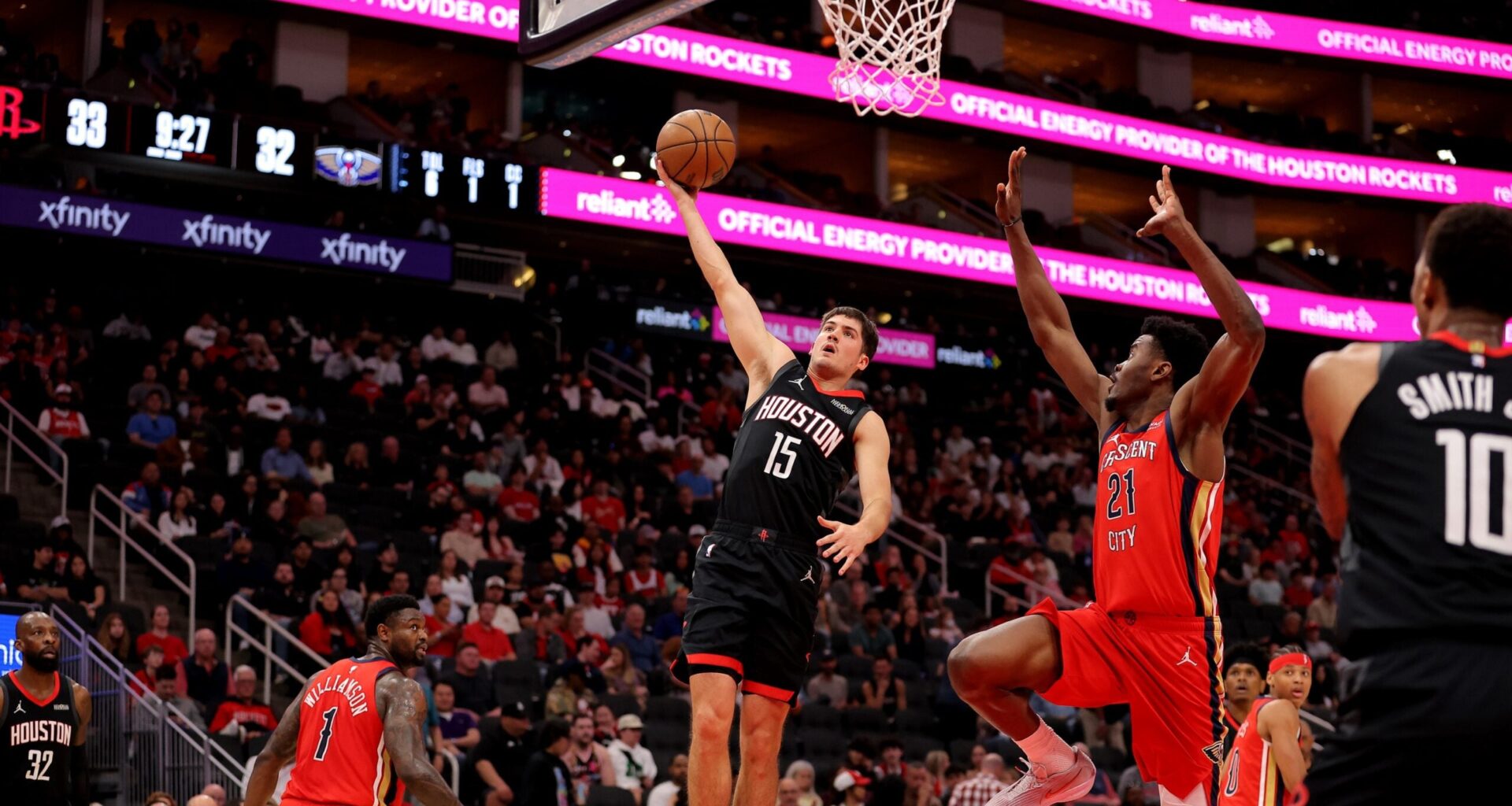
The Rockets emerged victorious from their last outing versus the New Orleans Pelicans on Friday night. They did so while missing their starting center and (albeit commonly lambasted) All-Star, Alperen Sengun. Notably, even missing the centerpiece of their offense, the Rockets declined to start sophomore sharpshooter Reed Sheppard. Why do the Rockets insist on keeping Sheppard on the shelf?
Why The Houston Rockets Bring Reed Sheppard Off The Bench
Houston’s win over the Pelicans certainly wasn’t pretty. The team started Dorian Finney-Smith, who scored 0 points in over 26 minutes. The Rockets (and Finney-Smith in particular) also wound up benefiting from some questionable officiating down the stretch (though the NBA Last Two Minute refereeing report doubled down on the no-calls). Despite the starting “snub”, however, Sheppard played well in the game. He scored 18 points on 5 for 11 shooting from distance.
Sheppard’s New Orleans outing was just the latest in what has been a strong 2025-26 sophomore campaign. He’s averaging 13.5 points, 2.8 rebounds, 3.2 assists, 1.4 steals, and, impressively for a six-foot-two guard, 0.7 blocks per game. Undoubtedly, the most important numbers for Sheppard, though, are that he is shooting 39.0% on 6.8 three-point attempts per game. He’s also shooting 42.8% from the field and 79.7% from the free-throw line.
Sheppard’s Most Important Skill
Sheppard’s 2.7 made threes per game leads the team. Each one is desperately needed for a squad that ranks fifth-lowest in three-point makes overall. It’s also a huge improvement on his 2024-25 performance as a rookie. Last year, Sheppard shot just 33.8% from three. While that was on only 2.7 attempts per game, his per-36-minute three-point attempts weren’t much lower. Sheppard took 7.8 three per 36 minutes in 2024-25, and 9.4 in 2025-26.
It’s no surprise that Sheppard shot a lot of threes when he was out there. He was billed as a sharpshooter in the draft, after all, shooting 52.1% from three in college. To many, it seemed like a disaster, then, when his shot initially failed to convert against NBA-level defense and athleticism. But with a three-point percentage jump of 5.2%, Sheppard has allayed those fears in 2025-26.
Impact
Sheppard’s newfound confidence from deep is translating to his impact nicely. He’s third on the team in plus/minus per 36 minutes at +4.5. Steven Adams, a key figure in Houston’s attempted rebound revolution, was at over double that with +9.6 before his season-ending injury. The only still available player ahead of Sheppard is backup center Clint Capela at +4.8. Meanwhile, Capela has played 563 of his 747.4 minutes this season with Sheppard on the floor, at a per-36 plus/minus of +7.8.
So Sheppard is demonstrably one of Houston’s highest-impact players. He also plays at a position of need, with Houston missing its starting point guard, Fred VanVleet, all season due to injury. Even so, Sheppard has started just 10 games all season.
How the Rockets Are Putting It to Use
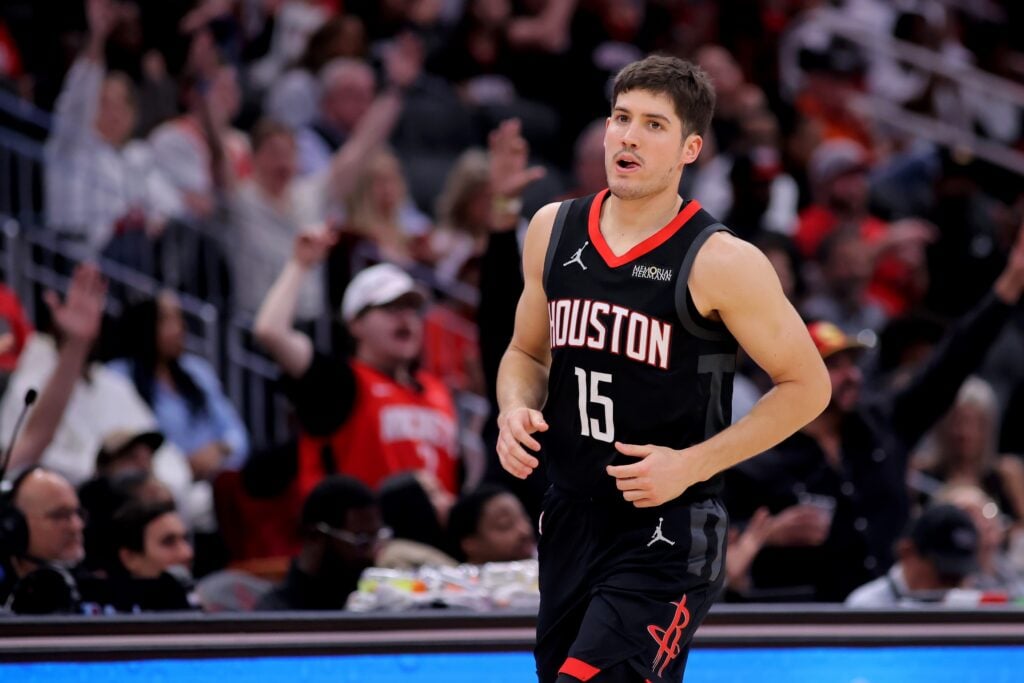 Mar 13, 2026; Houston, Texas, USA; Houston Rockets guard Reed Sheppard (15) reacts after a made basket against the New Orleans Pelicans during the fourth quarter at Toyota Center. Mandatory Credit: Erik Williams-Imagn Images
But not starting in year two is still a big improvement from barely playing at all in year one. In fact, Sheppard is seeing a prominent role as Houston’s de facto sixth man. It’s a role that makes sense on a Rockets roster that lacks much juice on offense. Astronomical athlete Amen Thompson is certainly a more electrifying prospect than Sheppard overall, but his offensive shortcomings are frequently exposed. Only really Sheppard, Sengun, and the mercurial mercenary Kevin Durant are offensive creators. Accordingly, they are the team’s top three players in usage percentage.
However, with that high usage rate comes a lot of defensive attention. If any one of the three is left out there on their own, it’s too easy for the defense to lock in on them. Starting all three makes it more difficult to ensure that at least two of them can share the floor together. The very best sixth men typically average starter minutes, though. Sheppard is only averaging 25.9 minutes per game.
Even Udoka Sees It
Rockets head coach Ime Udoka isn’t blind to Sheppard’s improvement. Over the last ten games, Sheppard’s minutes have risen to 33.2 per game. The Rockets are 6-4 over that stretch, with some less-than-stellar play at times. Nonetheless, Sheppard has been a solid +3.4 per game. That’s significantly dragged down by a -26 in a 36-point blowout loss to the Denver Nuggets, as well (Sheppard certainly didn’t help by going 1 for 9 from three).
Ultimately, it may be that, as an undersized, offensively oriented guard, Sheppard is never going to rise too high on an Ime Udoka depth chart. Udoka’s preferred offensive strategy is to put his five best defenders out on the floor and hope they can fluke their way into more baskets than they give up. But the six-foot-nothing VanVleet’s 35.2 minutes per game last season can be a source of inspiration to the young Sheppard. If the Rockets aren’t going to read the room on Reed’s improvement, then he’ll just have to acknowledge he still has room to grow.
© Erik Williams-Imagn Images