
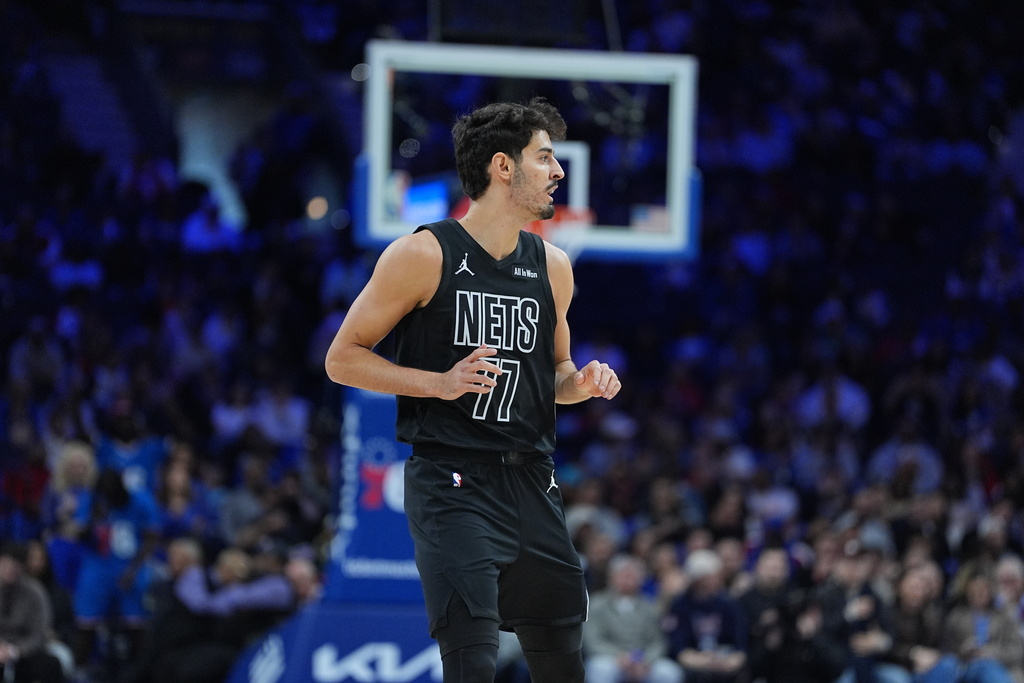
Ben Saraf had circled Monday night for months, and for a few minutes at Barclays Center, it looked exactly like what he’d imagined.
There was Deni Avdija across the way in a Portland uniform, an All-Star forward from back home, and there was Saraf, a 19-year-old rookie still trying to carve out his place. The Nets lost to the Portland Trail Blazers 114-95, but Saraf turned the night into his most complete NBA showing anyway, finishing with a career-high 15 points on 5-for-10 shooting, four assists, four steals and four turnovers in just over 23 minutes off the bench.
“It was great,” Saraf said of facing Avdija. “I was waiting for this game a long time. He’s a great dude, a great friend of mine, especially with Danny Wolf, too. Like, three Jews at the same time on the court was something very special.”
For the Nets, that moment landed at the right time. Saraf’s rookie season has been choppy, even by the standards of a rebuilding team that’s been cycling through young players all year. He opened the season as Brooklyn’s starting point guard, then was essentially phased out of the rotation after five games and sent down to the G League for multiple stints. While fellow rookies Egor Dëmin, Drake Powell, Danny Wolf and Nolan Traoré have appeared in 52, 51, 54 and 45 games, Saraf has played 32.
Now, with Dëmin out for the remainder of the season, the 26th overall pick has finally gotten the runway he’s been missing. Brooklyn’s season is lost, but Saraf’s minutes have become meaningful again, and his recent stretch has looked like a player catching up to his own talent.
On the season, Saraf is averaging 5.8 points, 1.5 rebounds and 3.1 assists while shooting 38% from the field and 22% from 3-point range. Those numbers still reflect the early instability. The more revealing sample is what he’s done lately.
Saraf has appeared in every game since Feb. 27, and the gradual improvement has been hard to miss. He’s reached double figures as a scorer in four straight contests, averaging 11.8 points, 1.8 rebounds and 4.8 assists per game during that span. He’s also shooting 53.1% from the field in those four games, even as the 3-point shot remains virtually nonexistent.
The growth has come with a consistent caveat. Saraf is averaging 3.0 turnovers per game in that same four-game stretch. The assist totals are trending up, but the ball security hasn’t arrived yet, which is why Monday’s line managed to feel both encouraging and unfinished at the same time.
Fernández sees it clearly. He believes Saraf can be a high-level defender, praising the way he sizes up the ball, pressures it and competes one-on-one. But Fernández also wants more focus away from the play. Saraf has heard the same message and has been blunt about where he wants to improve.
“I feel like in one-on-one defense I’m doing a pretty good job,” Saraf said. “I think the next step for me is the off-ball defense, be aware all the time, where the other players are, do the rotation, driveways. This is the next step for me defensively.”
Offensively, the coach’s ask has been just as direct. Play off two. Make the simple read. Don’t chase a difficult mid-range attempt just because the defense invites it. Against physical on-ball defenders and a rim protector, Fernández wants the second side, the extra touch, the patient possession that creates a clean shot instead of a contested one. He also wants Saraf to reduce the giveaways that fuel runs the other way.
Saraf has been owning that part, too. He’s explained that many of his turnovers have come from the same places, passes off one leg, drives into the paint without control, committing to a decision too early, or trying something too fancy when the simple option is there.
The interesting part is that Saraf’s arc has looked different when he’s been able to stack games in one role. In 15 appearances with Long Island, including 14 starts, he averaged 15.4 points, 3.5 rebounds and 4.7 assists. The production was heavier, the responsibilities were clearer and rhythm followed. Brooklyn’s late-season rotation has started to give him something closer to that, and the last four games have shown the early benefits.
That made Monday’s Avdija matchup feel like more than a cool moment. It was a checkpoint. Saraf showing he can pressure the ball, get into scoring chances, create for teammates and still leave room for the next step. He’s been more comfortable, too, as he’s settled into life in New York and the pace of the league.
“I think maybe I kind of got used to it,” Saraf said. “I did the adjustments as a person living in New York, also as a player on the court, so I kind of got used to everything. So, I think I feel more comfortable, with more confidence here, so it’s a good thing.”
And when Saraf wanted to explain what’s still holding him back, he didn’t point to anything complicated. He pointed to control.
“I feel like the last couple of months it was a lot of passes off one leg, that I’m getting into the rim with no control, or someone taking a charge, or I’m turning over the ball because I’m committed to the play already,” Saraf said. “Sometimes I’m just trying maybe too fancy or dangerous passes. I try to reduce those.”