
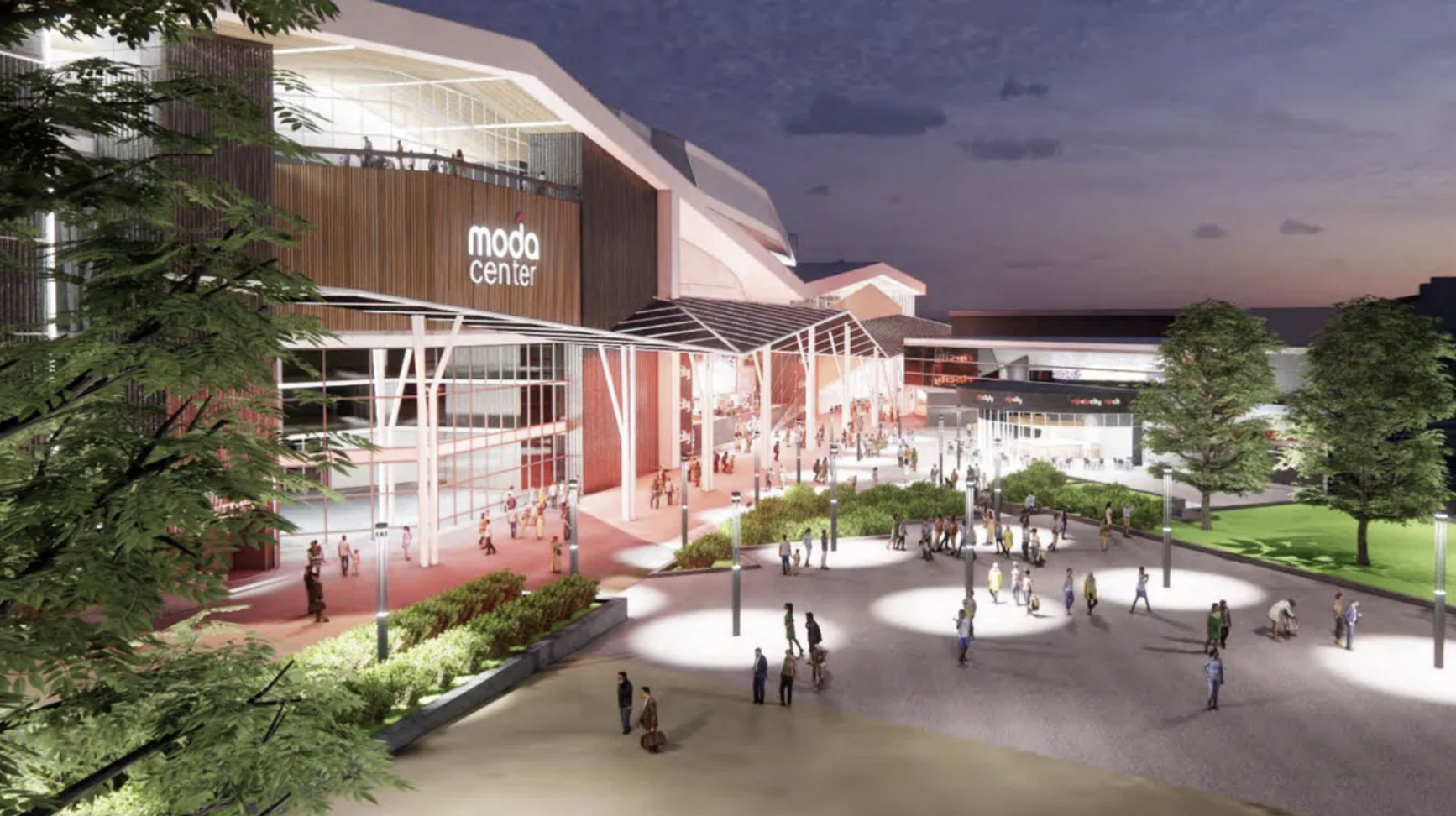
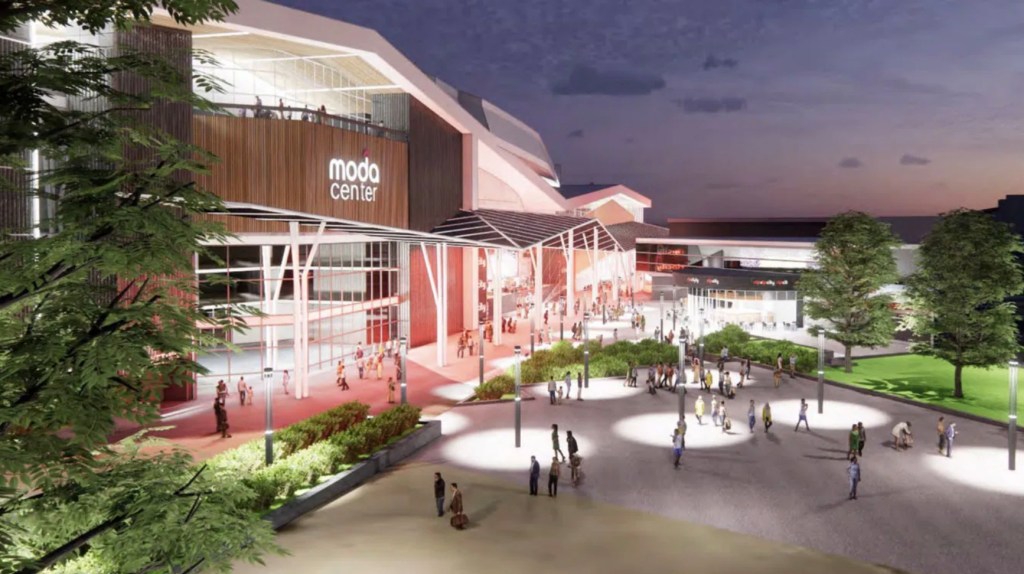
 An architectural rendering of a possible new look for the Moda Center, which has proposed a $600 million upgrade. Image: Our New Moda Center.

Column by Brian Libby
Architecture
For a venue that state and local governments have been asked to spend hundreds of millions of dollars upgrading, we know very little about the Moda Center’s proposed renovation. That’s important not only because the proposed $600 million project is essentially a quid-pro-quo to keep the anchor-tenant Portland Trail Blazers from moving to another city, but also because precisely no one loves the Moda Center.
Opened in 1995, the arena has always appeared to have been designed by Fred Flintstone: a rounded stony edifice with few windows. Bankrolled by the Trail Blazers’ previous owner, the late Paul Allen, the approximately 20,000-seat Rose Garden (as it was originally known) was a means to an end: satisfying the professed need for a larger-capacity, higher revenue-producing location for Blazer games than their original home, Memorial Coliseum. In a certain sense, the Moda Center has always been a candidate for upgraded design.
Which is to say nothing of the 30-acre Rose Quarter property the arena is part of: an unequivocal urban-planning disaster. Surrounded by hideous parking garages, it’s essentially devoid of human activity on non-event days, despite being a centrally located transit node along a major thoroughfare. The Rose Quarter needs radical reconstructive surgery even more than the arena.
Eschewing aspiration for fear
The Trail Blazers and their PR team could have rolled out a proposed Moda Center rebuild the right way. They could have empowered their design team to take a holistic approach to architecture, district planning and landscape design. Then they could have trusted the designers to talk openly about solutions and inspirations. Together, they could have spoken aspirationally, thereby building excitement and buy-in.
Instead, the team has essentially done the opposite. The carrot has been eschewed for the stick. An aggressive public relations campaign started with a gag order on the architects, then sought state funding with fear tactics.
The scant few renderings of a potential Moda Center redesign released so far tell us very little: that there might be a bar overlooking the court, for example, or that some awnings and seating might be added outside. But what says far more than the renderings is how few of them there are, and how any additional information about the design is verboten.
What becomes clear is that there most likely is no design. After all, the Blazers took this same approach some 15 years ago, when proposing the Jumptown neighborhood at the Rose Quarter, which wasn’t necessarily a bad idea so much as they were selling it with a few artist’s renderings before any real design had taken place.
An offer we can’t refuse
To be fair, the lobbying-intensive, short-on-specifics, implied-threat approach has been at least initially successful.
First, media began sounding the alarm. “I hope I’m wrong,” the headline for Bill Oram’s February 9 Oregonian sports column went, “but this is why I fear the Trail Blazers could be as good as gone.”
It’s not just empty rhetoric, either. The Moda Center is one of the NBA’s oldest arenas, and if Portland and Oregon were to falter on providing public funding, any number of other cities would seemingly be happy to cut in as the Trail Blazers’ dance partner. Here in the Pacific Northwest, we have already seen Seattleites lose their beloved SuperSonics, after an unsuccessful 2007 campaign to secure public funding for a new arena led owner Clay Bennett to move the team to Oklahoma City and rebrand as the Thunder (now the defending NBA champions). Blazer fans don’t want to be struck by the same lightning.
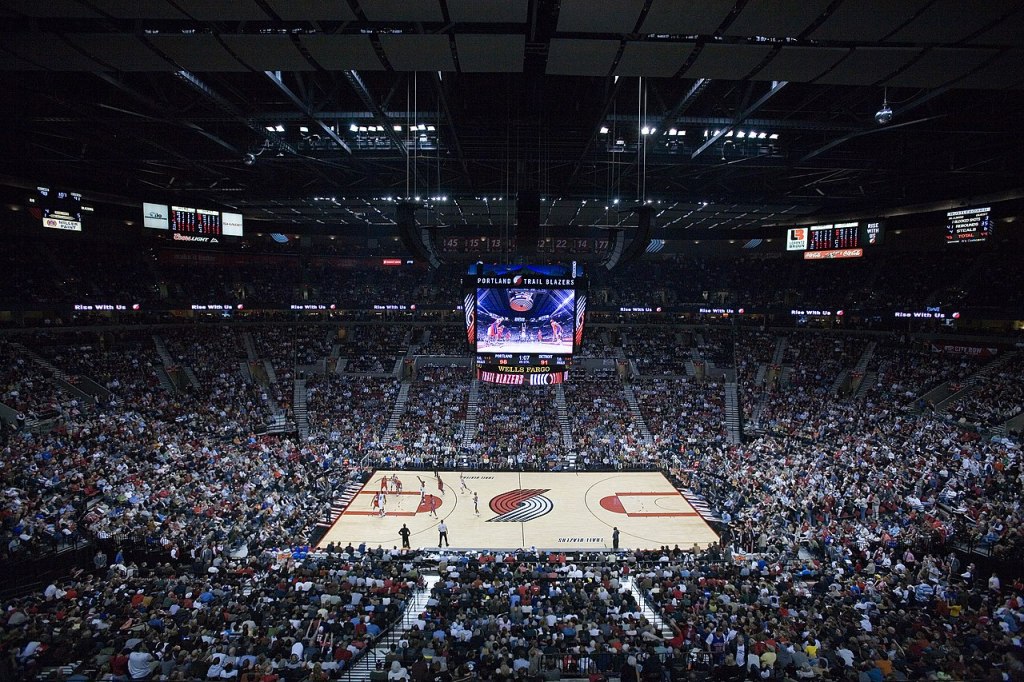 A packed house during a Portland Trail Blazers game. Photo: Cacophony / Wikimedia Commons.
The team’s new ownership group, led by Tom Dundon, has never publicly demanded a Moda Center renovation, or public money for it. But representatives have indicated this acquiescence is essentially mandatory to keep the team in Portland. Dundon, who owns the National Hockey League’s Carolina Hurricanes and is based in Dallas, has no ties to this city or region. Oram’s column quoted an unnamed government source saying the new Blazers owner seemed to give off “Clay Bennett vibes.”
And to be honest, I have felt a bit worried, too. On the wall of my office as I write this, s a framed copy of The Oregonian from June 6, 1977, the day after the Blazers won the championship. Below that is a framed autographed photo of Clyde Drexler gliding to the basket.
The implied threat that the Blazers could take their ball and decamp for Kansas City or Louisville or Las Vegas leaves the leaders of Oregon’s much-beloved NBA franchise appearing, at least for my money, a little too much like Mario Puzo protagonists. It wouldn’t be a stretch to imagine a decision-maker in a pinstriped suit, sitting at a restaurant table with checkered tablecloth and a bottle of chianti, saying, “We know you love the Trail Blazers. It’d be a real shame if you lost them.”
All of which prompted lawmakers — at least those in Salem — to take action. In early March, just a few weeks after Oram’s column, a bipartisan group of state legislators and senators approved a bill establishing the framework for $365 million in bond funding for the 30-year-old arena’s renovation.

It still may not be enough, because the City of Portland is also being lobbied to contribute, and this City Council, despite Mayor Keith Wilson’s advocacy, has sounded a voice of relative skepticism. After all, there are plenty of pressing funding needs, such as affordable housing and essential services for the needy. And as Jim Redden reported in a March 2 ArtsWatch article, city-owned downtown Portland arts centers already need $336 million in deferred maintenance.
“My bar is high on this and I’m not an easy mark on a shiny pitch deck thin on substance,” Councilor Mitch Green wrote in a series of Bluesky posts on March 13. “My principles have always been that public investments need to yield clear public benefits. My support for a public funding package will be based on the economic merit and value proposition to the public, not pledges made ahead of negotiation.”
“I love Rip City,” Green added, “and that’s why I believe we have the juice to negotiate from a position of pride and strength.”
Contemplating a Moda Center redesign
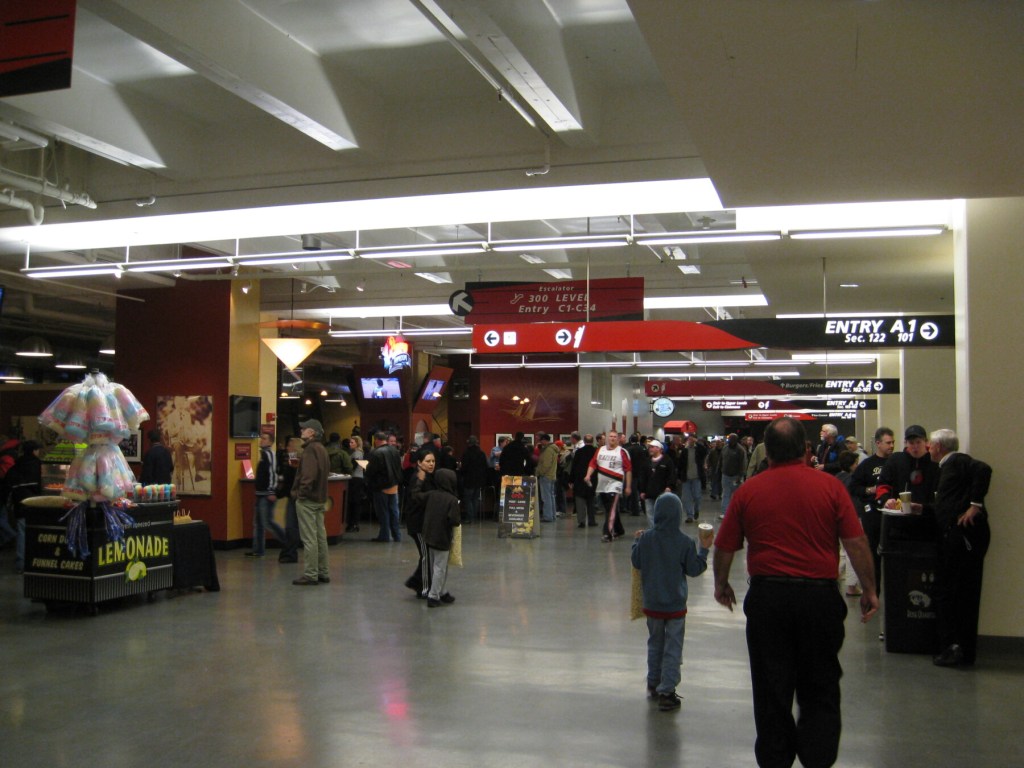 The concourse inside Moda Center on a game day. Photo: Wikimedia Commons
This is not to question the need for a Moda Center renovation. There is much room for improvement in the fan and player experience. And while renderings have been scant, The New Moda Center website devoted to promoting government funding for the project provides at least some talk about priorities, without showing how they would look or be manifested.
First comes a stated goal of authenticity, “a venue that is unmistakably Portland.” That would certainly be a departure, because nothing at all about the original Moda Center (designed by Ellerbe Beckett, now AECOM) seemed local or authentic. Maybe it’s like the adage about advertising: that what you brag about in your slogan is often what poker players call a “tell,” projecting precisely what you lack. If you say your food is fresh, you’re concerned about a perceived lack of freshness.
The Moda Center in its present form not only doesn’t feel authentically Portland, but you can scarcely even see Portland from this building, because it’s largely windowless. That’s a huge contrast with Memorial Coliseum, the Blazers’ original home, informally known as “The Glass Palace,” which still stands next door and was recently renovated. (In full disclosure, I co-founded the Friends of Memorial Coliseum in 2009.)
The website next promises improved fan experience, promising that a reimagined Moda Center will delight ticket holders “the moment they arrive, with welcoming entrances, transformed concourses, and vibrant social gathering spaces that keep everyone connected to the action.” It speaks of upgraded seating, enhanced lighting, and modern audio and video systems that “will create a more immersive experience, while improved back-of-house infrastructure will help continue to support global tours and iconic performances.”
Finally, the site touches upon sustainability, which actually does have credibility, because in 2018 the Moda Center, upon an earlier and more modest renovation, received a top-level Platinum LEED (Leadership in Energy and Environmental Design) rating from the US Green Building Council.
Increasingly, though, sustainability means something different than it used to. For much of the LEED rating system’s history since inception in 1998, the focus has been energy efficiency: utilizing a tight, Thermos-like thermal building envelope to save power. Now the sustainability focus is on alternative energy and low-carbon materials. Could a future Moda Center be topped with solar panels? Could it incorporate mass timber? The latter choice, utilizing Oregon wood, would help the arena achieve its stated authentic-and-local goal.
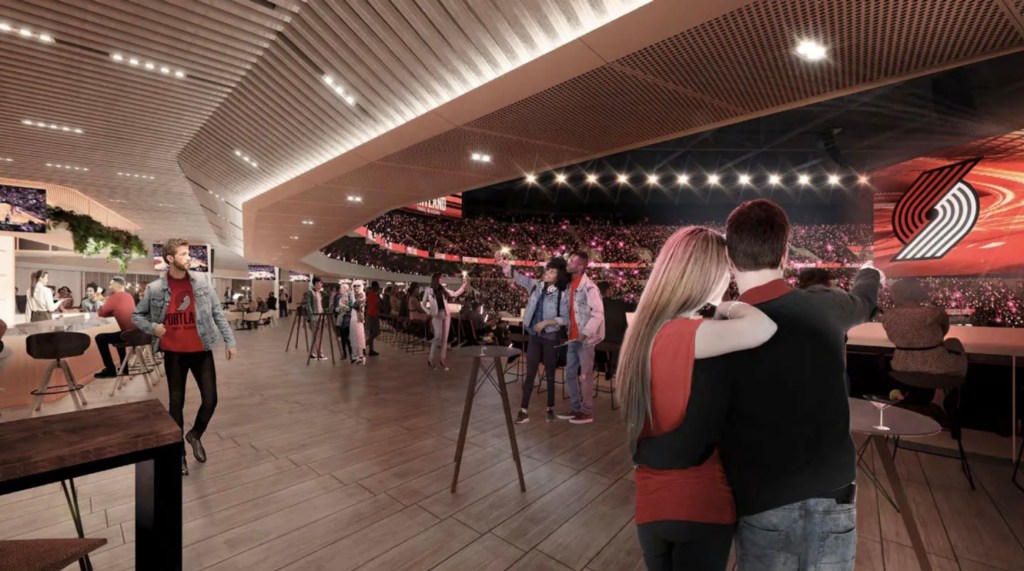 Rendering of a Moda Center audience area looking out on the action. Image: Our New Moda Center.
One of those few Moda Center renderings released to the public did point to an unmistakable trend in sports arena and stadium design: creating a wider variety of spaces looking directly onto the action. Instead of just seats and skyboxes, today’s arenas increasingly have bars, eateries and clubs with views of games being played. I can already picture a Damian Daiquiri or a Walton Whiskey available as you mingle with your back to the game, yours for only $23.95 plus tip.
The trio of renderings released to the public also show an arena with more glass at its perimeter, and awnings stretching out to create new outdoor spaces. This indeed would be a step in the right direction, addressing the Moda Center’s lack of transparency, and helping to activate the Rose Quarter’s outdoor plazas.
Dollars for the Quarter
Ultimately, the Rose Quarter needs more than a few outdoor bars and tables. But in the broader context of the NBA and other pro sports leagues and what they’ve done, the Blazers would not be out of place taking a more ambitious role as a developer of the real estate surrounding the Moda Center and Memorial Coliseum. Many of today’s stadium and arena projects are anchors for broader neighborhood-building ventures, however corporate they may be.
Too often in the past, sports venues were islands, surrounded by seas of surface parking lots. Today the Rose Quarter is no better, with parking garages that suck the life out of the district and the streetscapes around them.
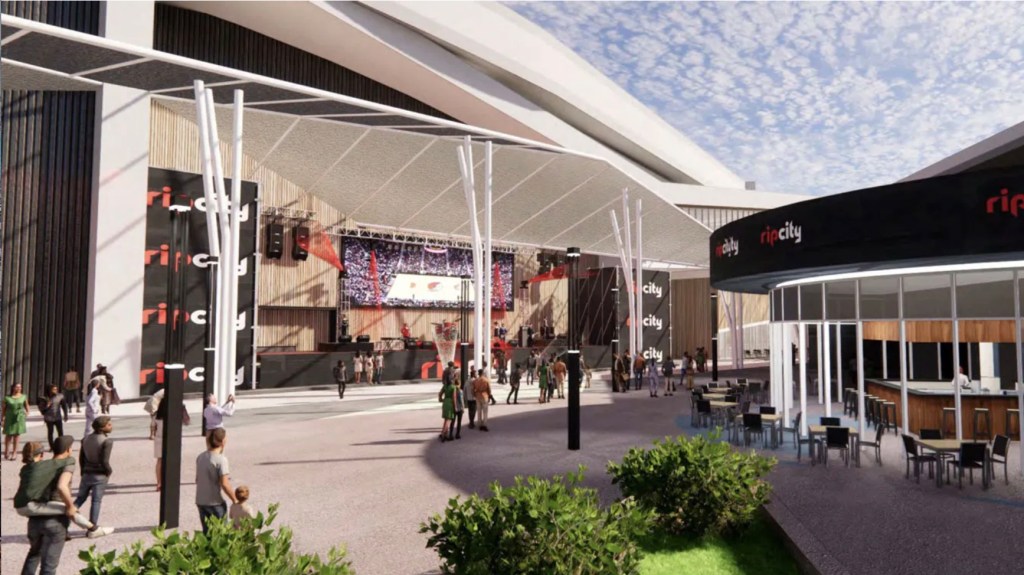 Rendering of a possible vision of the plaza pedestrian spaces outside the Moda Center. Image: Our New Moda Center.
The property’s northern edge sits along North Broadway and a streetcar line, just beside the Broadway Bridge leading to the Pearl District and Old Town. In the future, this land is destined to become mixed-use and high-density, as part of the reborn Albina, a historically Black neighborhood decimated in the past by a combination of Interstate 5, Emmanuel Hospital, and the Coliseum’s construction. Today, with hundreds of millions of dollars from the Phil Knight-funded 1803 Fund and great leadership from visionaries like Rukaiyah Adams and Winta Yohannes, the new Albina, which is already seeing its first residential buildings completed along Broadway, gives the Rose Quarter a jump-start on the kind of placemaking it needs.

If the team and its development partners were willing to make a real investment, the Moda Center’s garages could be placed underground and new buildings could be constructed at the Rose Quarter: namely (given the post-pandemic decline in office demand) high-density housing and hotels. The same approach could be applied to the awful One Center Court building at the district’s southwest corner, essentially a hybrid of building and garage, including offices for the team and a series of failed retail venues facing the Moda Center. With a higher-density building and parking underground to allow buildings and plaza to take up more space, a better urban vibrance might be possible.
Yet before any such building plans come together, the Blazers and their partners need to back up and create a real master plan. Even if they make a progressive move like putting parking underground, this can’t be a piecemeal approach.
In the past, Trail Blazers brass have expressed a desire to collaborate with the Albina Vision Trust and its leadership. I hope it’s more than talk, because the team could learn something from its neighbors: How to think holistically about place-making, with many stakeholders informing the process; how to speak aspirationally while acting inclusively; and how to act with integrity.
The hypothetical architect
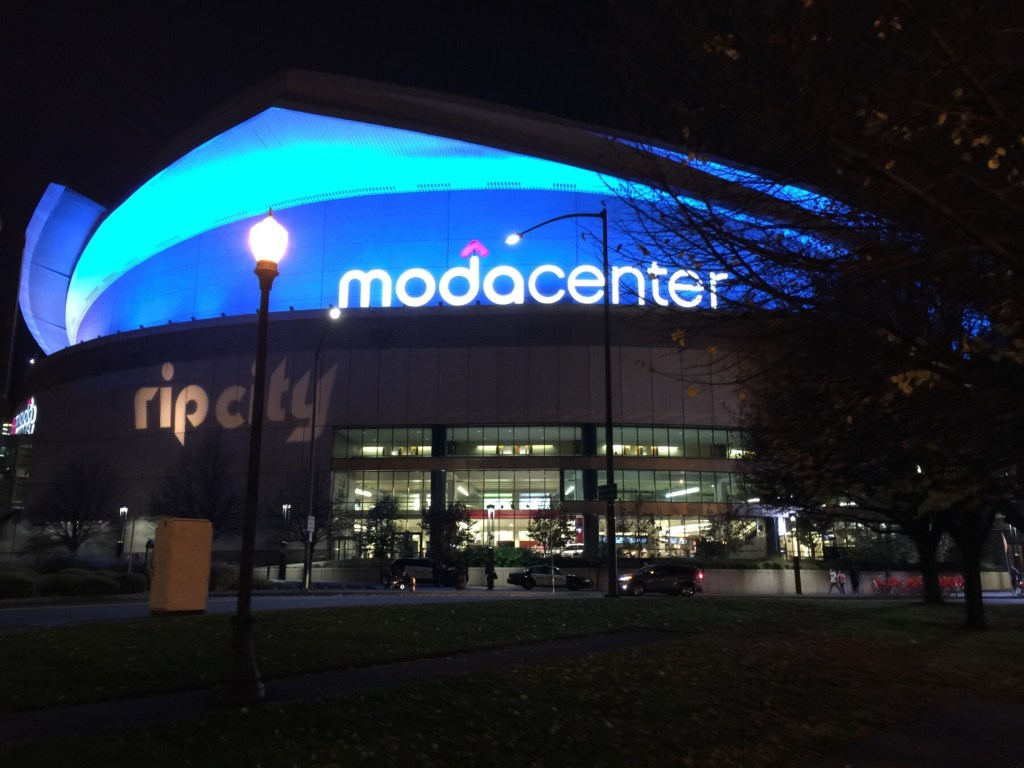 Nightime view of the Moda Center’s exterior, which could take on a different look after the proposed $600 million remodel. Photo: Parker Knight / Wikimedia Commons, 2016.
Whenever I encounter news of a major architecture project, I want to know not just what’s being designed but who is designing it. The good news is that Populous, the firm that seems to be commissioned for a Moda Center redesign, is very capable, and possesses a local connection. But I of course say “seems to be” because although Populous is listed as a partner on the Blazers’ New Moda Center website, the only thing the firm has said in response to my queries was that they can’t talk.
Populous is America’s premiere designer of professional sports venues, if not the world’s. Based in Kansas City, the firm has designed dozens of significant stadiums for teams in professional football, soccer, hockey, basketball, and even cricket. The NFL’s latest stadium, opening this fall for the Buffalo Bills, is a Populous design. One of the last big pro football palaces, Mercedes-Benz Stadium in Atlanta, was designed by the firm. All of London’s prominent recent stadiums, from Wembley to Tottenham Hotspur (where the NFL’s annual games are usually staged), are courtesy of Populous When the Philadelphia 76ers open a new arena in 2031, it too will be from this firm. Even the instantly-iconic Sphere in Las Vegas is a Populous design.
At the same time, Populous now operates a Portland office, and its lead architect, Jeff Yrazabal, has been part of the design teams generating all of the recent Oregon stadium designs: the new Hayward Field at the University of Oregon in Eugene, the renovated Reser Stadium for Oregon State University in Corvallis, and even the Hillsboro Hops’ new home. It’s reminiscent of how the internationally renowned Chicago architecture firm Skidmore, Owings and Merrill used to operate a Portland office, which designed Memorial Coliseum, several downtown office buildings including the US Bancorp Tower (“Big Pink”), and Autzen Stadium in Eugene.
Victory from defeat?
Basketball, particularly in the NBA, is a game of runs. The Blazers in their history have been on both sides of this equation. The team tragically gave up a 13-point fourth quarter lead in Game 7 of the 2000 Western Conference Finals (and a probable second world championship) to Kobe Bryant, Shaquille O’Neal and the Los Angeles Lakers. But in the 2011 playoffs against the Dallas Mavericks, Brandon Roy led a heroic comeback from 18 points down.
In other words, it’s not too late for the Moda Center and Rose Quarter to be substantially redesigned, and to do it well, in a way that not only keeps the Trail Blazers in town for another generation but contributes positively to the North Broadway neighborhood and the central city. It’s not realistic to make the Moda Center an aesthetically arresting gem, but it can be more than a few more bars, bells and whistles.
Conversely, it’s also still possible that some combination of greed, secretiveness, blatant corporate-welfare requests and outside interests could rob this city of its original and (if you go by the supremacy of the three largest sports leagues) only true major league sports team. It’s also possible that even if the Blazers stay, the renovation will be a missed opportunity in terms of quality placemaking. Even for $600 million, we could very possibly get a token renovation that doesn’t substantially move the design needle, especially in terms of exterior appearance. And it’s perhaps even probable that they won’t fix the broader, deeper Rose Quarter problems at all.
It’s not really my place to say whether local governments should invest in the Moda Center. But I do think the public is owed more information, more of a vision: a real design to contemplate instead of just a few visuals that may not even be tied to any real blueprints. The team wants us to make a leap of faith, and to some degree that is possible. Yet there’s no reason not to go beyond empty PR rhetoric or implied threats: no reason not to truly engage in a design dialogue, driven by a belief in and an ambition about what’s possible.
The arena formerly known as the Rose Garden can bloom or it can remain a thorny problem. But either way, the best results have to be cultivated.