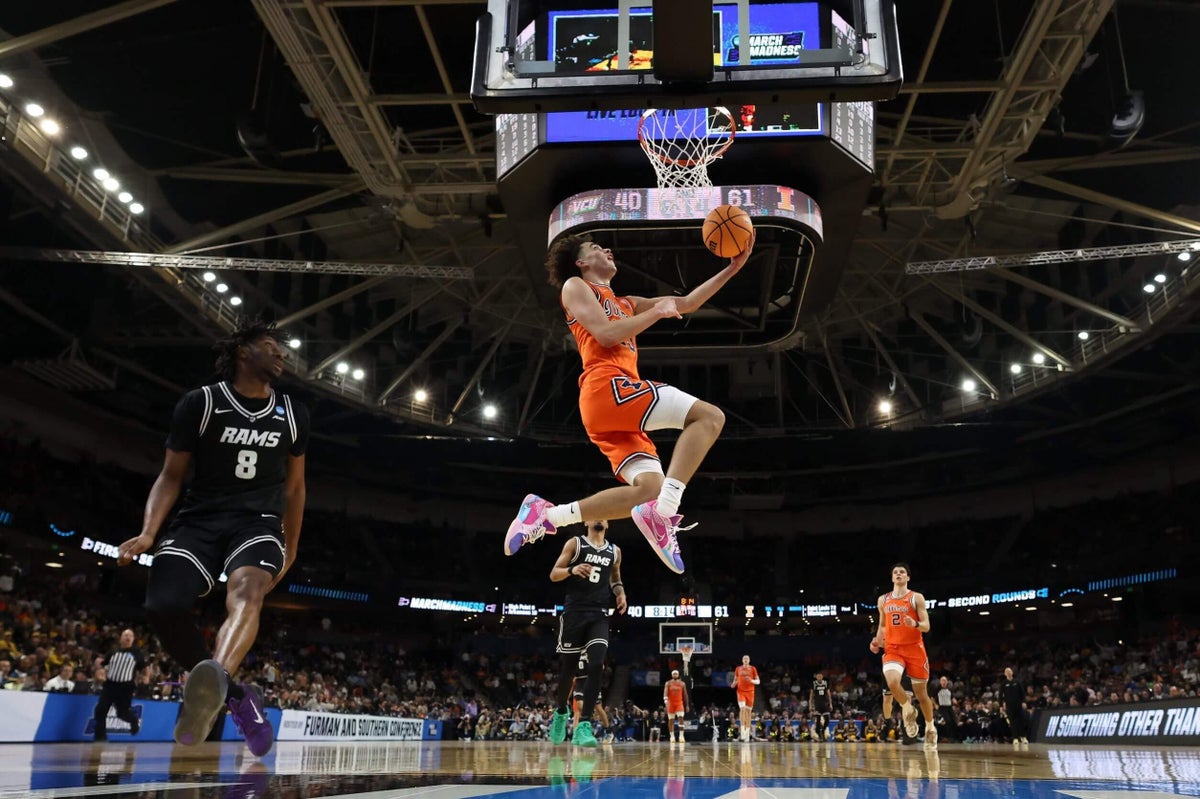
PORTLAND, Ore. — John Calipari had, as usual, wandered off topic.
Asked about mid-major basketball programs’ scheduling frustrations, and what can be done to fix a system in which teams from power conferences aren’t incentivized to play them, the second-year Arkansas coach detoured into a story about when he was coaching at UMass in the early 1990s. Briefly, he got back on track, crediting No. 12 seed High Point, his NCAA Tournament second-round opponent out of the Big South, for its commitment to being competitive.
“It proves my point that coaches win games, administrations win championships,” Calipari said. “They commit to it. Now, the coach has to be a good steward and has to make good decisions. But he can’t do any of that if there’s not enough support.”
Calipari reiterated that sentiment Saturday night after the fourth-seeded Razorbacks squeaked by the Cinderella-aspiring Panthers, 94-88, behind 36 points from freshman All-American Darius Acuff Jr.
Calipari might as well have been channeling famous lyrics from the ’90s, which express a universal truth that still rings accurate today in college sports: It’s all about the Benjamins, baby.
And The Athletic tracked down the receipts to prove it.
The 16 teams still alive in the 2026 NCAA Tournament have all committed big bucks to men’s basketball, led by overall top seed Duke, which spent more than $25.2 million on men’s basketball in 2023-24, according to the latest (and most complete) publicly available data. That doesn’t include the Blue Devils’ name, image and likeness spending — essentially Duke’s roster budget — which schools don’t have to reveal publicly.
Before we dig in further, a few more caveats: Schools and programs crunch numbers differently. Budgets fluctuate year-to-year, especially in an ever-evolving pay-to-play era (and even more when a new coach shows up on campus). Numbers can be squishy — and some are missing altogether, particularly with private schools. Still, the U.S. Department of Education database, plus the USA Today coaches’ compensation database, private schools’ 990 tax forms and NCAA financial reports give us a good idea of how schools invest in hoops. Direct revenue sharing with athletes, which started July 1, isn’t included in this data.
Another good comparison point to keep in mind: High Point, the school Calipari praised for being all in, which beat fifth-seeded Wisconsin out of the Big Ten in the first round, spent just $4.1 million on men’s basketball.
Duke’s spending is an outlier — on average, the Sweet 16 schools spent around $15.5 million on men’s basketball. The Blue Devils’ expenses were second nationally behind only Kentucky ($30.9 million).
Other Sweet 16 teams ranked in the top 20 nationally for expenses include Illinois (No. 8), UConn (No. 9) and Michigan State (No. 13).
St. John’s, at No. 16, just outspends No. 17 Arizona ($16.65 million to $16.32 million), especially notable given that the Big East television contract is reported to be somewhere in the $80 million range and the Big 12’s media deal — which, granted, includes football — is closer to $380 million. Michigan comes in at No. 20, spending $15.74 million.
In terms of return on investment, there’s an argument to be made that no one is getting a bigger, or better, bang for their buck than Houston.
Kelvin Sampson has taken UH to eight straight NCAA Tournaments, reaching the national championship game last season and playing in the 2021 Final Four.
That’s a remarkable run considering UH spends just over $12.5 million on basketball, one of the lowest amounts of all the Sweet 16 schools — it ranks No. 43 nationally, in fact. The only Sweet 16 programs that spent less were Nebraska, Iowa and Iowa State. In February, Sampson lamented UH’s finances and their impact on his ability to sign more top prospects, saying the Cougars athletic department was “very poor.”
The most recent NCAA financial reports detail where the gap shows up. For instance, Illinois spent more than twice as much on travel ($2.3 million) compared with Houston ($1.1 million), while lapping the Cougars in recruiting ($903,000 to $391,000), assistant coaching salaries ($2.9 million to $1.7 million) and general game-day expenses ($930,000 to $425,000).
Iowa State’s $9.8 million in reported expenses was last among remaining teams and ranked 72nd nationally, about the same as Memphis, Virginia Tech and Seton Hall. To put that in context, UConn spent more than that ($11.4 million) on salaries for its coaching staff last season.
What Sweet 16 teams spend
TeamExpenses
$25.247M
$18.970M
$18.906M
$17.106M
$16.650M
$16.317M
$15.739M
$15.327M
$15.116M
$15.025M
$14.123M
$12.906M
$12.552M
$12.206M
$11.425M
$9.808M
Source: U.S. Department of Education (submitted for 2023-24)
Half of Sweet 16 ranks in top 16 nationally in revenue
Salaries take up the biggest chunk of school expenses; this year, the three highest-paid coaches still dancing are UConn’s Danny Hurley ($8.375 million), Michigan State’s Tom Izzo ($7.2 million) and Calipari ($7 million). Duke’s Jon Scheyer is believed to have moved into that $7 million range, per industry speculation, after getting a major extension and raise in October. As a private school, Duke doesn’t have to say.
Two coaches also have the distinction of having lifetime contracts — Izzo and Tennessee’s Rick Barnes — which means they can (theoretically) coach at their current school as long as they want.
Oh and about the only double-digit seed to make the Sweet 16: Eleventh-seeded Texas might seem like a Cinderella on the surface, at least considering that it started in the First Four, but it’s one of the richest schools in the country with the biggest enrollment in the Sweet 16. The Longhorns are paying first-year coach Sean Miller $4.8 million this season and spent more than $15 million on basketball.
And speaking of blue bloods: Duke spends a lot of money because it makes even more.
Though Sweet 16 schools average just under $22 million each in revenue, Duke’s unusual in that realm, too. The Blue Devils reported an eye-popping $44.8 million revenue, which was No. 1 nationally and $8.5 million ahead of second-place Illinois.
How much Sweet 16 teams bring in
TeamRevenue
$44.792M
$36.201M
$26.804M
$25.733M
$22.984M
$22.721M
$21.283M
$20.950M
$18.906M
$17.488M
$17.306M
$16.903M
$16.650M
$16.317M
$13.860M
$12.552M
Source: U.S. Department of Education (submitted for 2023-24)
Six of the other Sweet 16 teams also ranked in the top 16 in revenue, which comes from the likes of ticket sales, media rights and booster donations: No. 7 Tennessee, No. 8 Michigan State, No. 11 Texas, No. 12 Arkansas, No. 13 Alabama and No. 16 Michigan. Houston was the lowest nationally at No. 62, between Wake Forest and Texas A&M.
The ratios are comparable in the other biggest revenue sport. In both years of the 12-team College Football Playoff, half the field ranked in the top 14 in revenue.
Roster costs unknown
What players are actually making, including with NIL, is trickier.
Direct revenue sharing with athletes kicked in on July 1, which means coaches and collectives got creative in how — and when — they paid their rosters. As long as NIL checks were cashed by the end of June, it was perfectly legal for collectives to promise, and pay, players big money via NIL and then also get them cash from revenue sharing.
The combination of revenue share and front-loaded NIL deals led one assistant to describe this season to The Athletic as “the money-dump year,” saying “we will never see these numbers again.”
Most high-majors expected to opt in and distribute the full $20.5 million to athletes, but the exact breakdown of which sport got how much won’t be publicly known for a while, if ever (numerous high-major coaches told The Athletic last summer they expected to receive $4 million-$5 million rev-share from their athletic departments). Schools are getting creative to find ways to keep paying their athletes more than the cap.
Still, most coaches don’t want to broadcast what they’re spending on their roster. Kentucky’s Mark Pope all but confirming the Wildcats’ $22 million payroll this season was unusual, and after UK lost in the second round, has put him under fire.
One concrete number comes from public record requests to more than 70 public schools, looking for revenue-sharing breakdowns and budgets. UConn returned documents to The Athletic showing the Huskies paid their athletes $11.6 million from July through December last year. But that’s split among UConn’s 24 sports and all 536 athletes (the school did not say how).
How much Sweet 16 coaches make
TeamCoachSalary
Dan Hurley
$8.375M
Tom Izzo
$7.2M
John Calipari
$7M
Jon Scheyer
$7M*
Rick Barnes
$6M
Nate Oats
$5.51M
Kelvin Sampson
$5.5M
Tommy Lloyd
$5.1M
Fred Hoiberg
$5M
Matt Painter
$4.97M
Sean Miller
$4.8M
Dusty May
$4.6M
Brad Underwood
$4.4M
T.J. Otzelberger
$4M
Ben McCollum
$3.35M
Rick Pitino
$2.436M
Sources: Contracts, reports, tax records, USA Today coaches compensation database
*Duke is a private school; based on published reports and industry speculation
Before his second-round game against Alabama, Texas Tech coach Grant McCasland was asked about the lack of true Cinderellas and mid-majors able to make significant runs during the tournament. McCasland, who spent six years at North Texas, was blunt.
“There’s just only so many teams that have the best players, and the best players are usually on the teams with the most money,” McCasland said. Last offseason, Texas Tech All-American JT Toppin got $4 million to come back to Lubbock, believed to be the highest amount for any returning college hoops player.
Tax returns of NIL collectives offer other broad, imperfect clues. Iowa State’s We Will Collective reported $5.5 million in revenue in 2024. That was ahead of Purdue ($4.8 million) and Iowa ($4.1 million). Texas’ NIL collective dwarfed all three at $16.5 million.
The expenses and revenue were not broken down by sport, so we don’t know how much went to football or other sports.
Bottom line: Much like exponentially rising costs and revenues in college football, it’s clear you have to spend money to make money — and to make the Sweet 16.
So when the title team cuts down nets in Indianapolis, that athletic director — whether it’s Duke’s Nina King, UConn’s David Benedict, Illinois’ Josh Whitman or one of the other 13 — can feel good knowing they earned their championship ring, too.
Calipari said so.