
While the Mavericks navigate their way through the final games of the season, positioning themselves for the draft lottery, all eyes will be on the NCAA Tournament Sweet 16. And lucky for us we’re not just getting solid teams facing off against one another, but premium head-to-head matchups against top draft talent.
The two late games Thursday will feature lottery rated guards against each other. Arizona’s Brayden Burries squares up against Arkansas’ Darius Acuff. Burries remains a player quietly rising to the back of the top ten in this draft class, but Acuff might be the hottest and most divisive name in college basketball.
Just ahead of those two in most draft circles is Houston’s Kingston Flemings and Illinois’ Keaton Wagler. Two freshman guards with vastly different styles of play. If both show up on the biggest stage they’ve met, this could turn into a blockbuster performance. But each player has questions about their game, areas of development that NBA scouts and executives will surely be looking for Thursday. For two players that have each shared top five rankings in this class, this is what the guard-hungry Mavericks will watch for.
Both players enter Thursday’s matchup as near locks to be in the top ten of this summer’s NBA draft. The depth of talent in this class, particularly at guard, leaves some mystery about how team’s will view each player. That’s what makes a game like Thursday’s so intriguing. While college basketball makes a habit of scheduling premier non-conference bouts, we haven’t had a look at top ten players facing off like this on a stage this large this season.
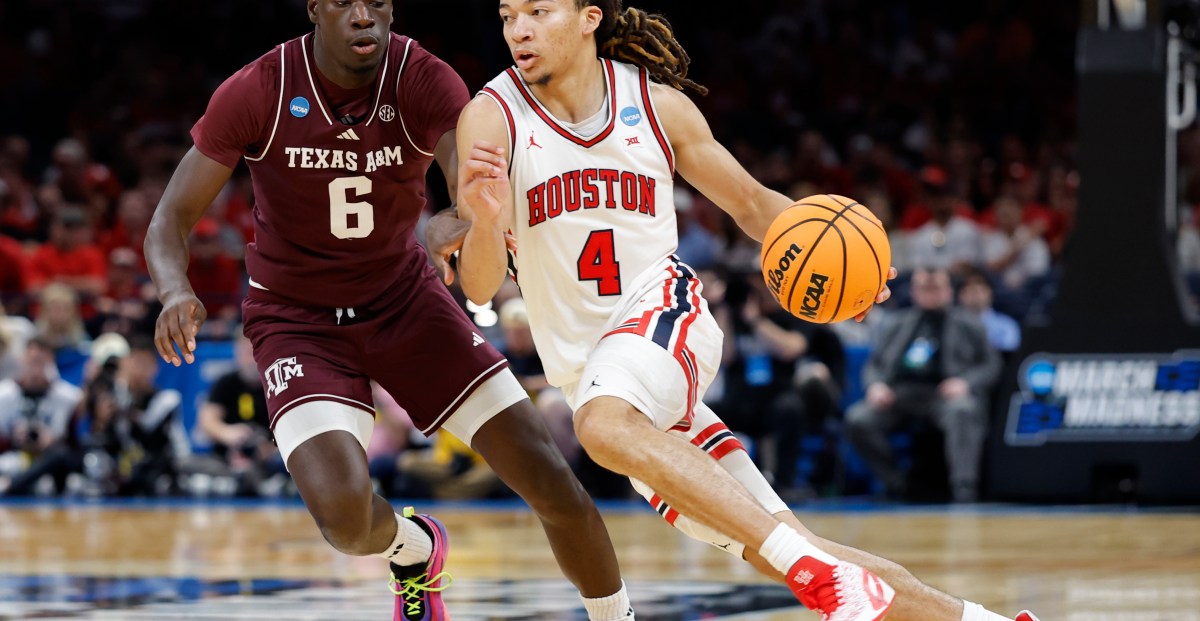
For Kingston Flemings, the 6’4 freshman from San Antonio, his route to Houston was a consensus top 20 player in the class. What jumped out immediately to me the first time watching Flemings at Houston in the fall was his blistering downhill speed. He’s likely the fastest player in the class and leverages it so well, open floor or half court. Flemings does not fear the big moment. He had several this season, sealing wins with clutch plays on a team full of backcourt veterans. His demeanor is that of a veteran, and his 16.2 points, 4.0 rebounds, and 5.2 assists (just 1.8 turnovers) per game this season speaks to the versatility of what he can provide.
Keaton Wagler’s path to this moment is the most unexpected in the game. No player has surprised more, with recruiting rankings not even mentioning the 6’6 sharpshooter’s name, well outside any top 100. But that did not deter this guard from Kansas. He processes defenses in elite ways, has the smoothest looking three-point shot in the class and has shown he can play both on and off the ball for Illinois this season. He has one of the best three-point and free-throw rates of any guard at the top of the class and plays with a shiftiness off ball screens that will translate to the next level. His 17.8 points, 4.9 rebounds, 4.4 assists (1.8 turnovers) per game while connecting on 40.8-percent from three is impressive. And while some of his production slowed at the end of the regular season he has re-engaged his level of play in the tournament.
What Flemings needs to show
Flemings has two weaknesses in his game that draft circles focus on, and it’s the opposite of Wagler: his three-point and free-throw rate. He shot 39-percent from deep this season, but the volume leaves much to be desired. His catch-and-shoot numbers are encouraging, and highlight that he can be an impactful perimeter shooter.
For as dynamic an athlete Flemings is, he prefers midrange jumpers over flat out attacking the rim. He doesn’t only rely on his speed to beat opponents, a positive, but he does not leverage his speed to pull defenders out of position.
When Flemings steps into his three he looks comfortable and confident. There are valid questions about his form, things that will likely require a longer process of development. But shooting from deep is not his reflex, not in Houston’s offense at least. Both of these measurements, which rank last among the top guards of the class, are likely impacted by Houston’s roster and scheme. One game won’t quiet the questions about this part of Flemings’ game. But showing his poise and ability Thursday in taking the threes given and generating contact in the lane would be of note.
What Wagler needs to show
Wagler’s willingness to chuck is known. He attempted nearly double the amount of threes Flemings has this season. Given his size and style, Wagler will project into either guard position in the NBA. It won’t be surprising if he at least starts his career as a secondary initiator. That’s because while Wagler has shiftiness and excellent footwork he lacks any real explosiveness. He also has not responded well to aggressive perimeter defense out of the pick-and-roll.
And this is where Thursday’s game becomes most intriguing. Houston’s defense is aggressive, perhaps more physical than any other team remaining. The platoon of guards that will jump to Wagler and disrupt rhythm will be the chess match to watch. Can Wagler, who generates contact well if he can get through traffic, get to the line to offset that aggression? Will Wagler act more as the off-guard trying to find rhythm in catch-and-shoot situations? His game is below the rim, so a showing of athleticism in the paint isn’t likely. So how he navigates the physicality could speak best to how his game will translate at the next level.