
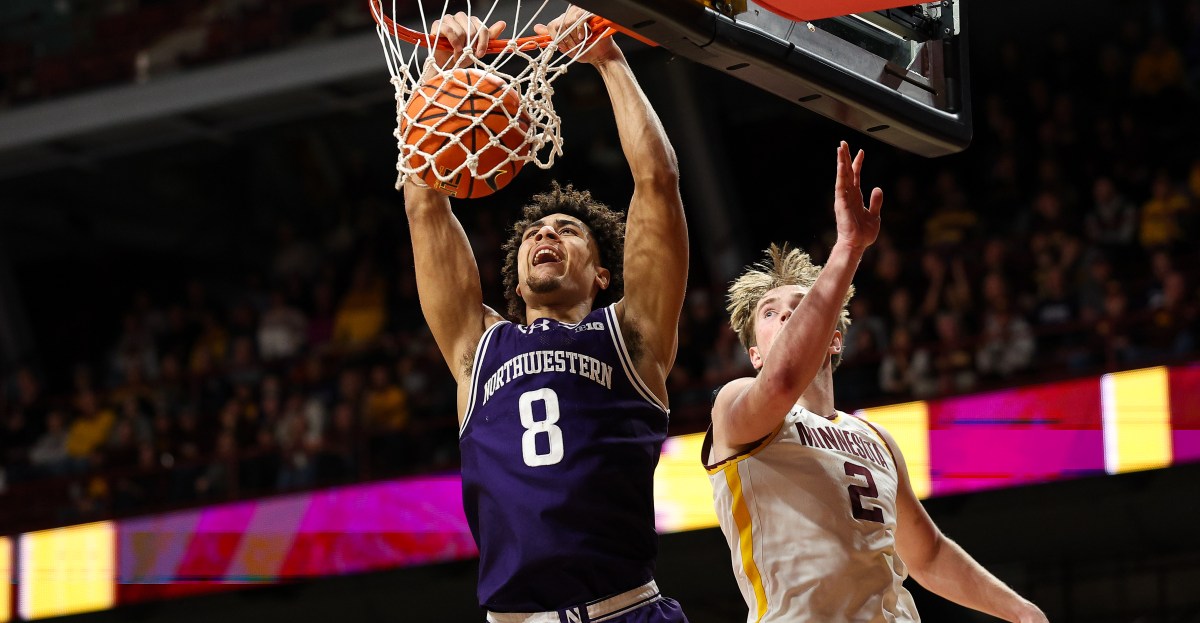
As we move forward with more men’s basketball player reviews, it’s now time to analyze the season of Tre Singleton, the 6-foot-8 freshman forward from Jeffersonville, Ind.
Northwestern fans had high hopes for Singleton entering the season. Graduating from Jeffersonville High School, Singleton brought a strong four-star profile (per 247 Sports) to headline Chris Collins’ 2025 recruiting class. Singleton was touted as a strong, “high-volume” rebounder, with versatile defensive capabilities and strong “game instincts.”
In his first season as a Northwestern Wildcat, Singleton was able to immediately step into a role as an impact player by maximizing these same strengths that were highlighted throughout his recruitment. Even in the Big Ten, Singleton’s 6-foot-8, 215 pound wide-shouldered frame stands out regardless of who he’s matched up with on the floor. Singleton’s strength is amongst the best in the conference, and it allowed him to take a variety of different matchups on the defensive end and always impact the game as the Wildcats’ best rebounder. Singleton finished with a 1.90 defensive Bayesian performance rating on EvanMiya.com, second on Northwestern and top 50 in the Big Ten.
As one of the Wildcats’ best defenders, Singleton quickly became an anchor in the rotation. The Jeffersonville native started 31 of 34 games for Collins’ squad this season, averaging 7.6 points on 47.7% shooting from the field, 16.7% from three and 73.8% from the free throw line. Meanwhile, he was second to Nick Martinelli in rebounding — grabbing 4.8 boards per game — and third on the team in blocks, averaging 0.6 per game. His season was highlighted by the three-game stretch in late January against UCLA, Penn State and Washington. Singleton had double-digit scoring totals in each of these games, while really taking over against the Nittany Lions, with 17 points and a season-high 18 rebounds.
While Singleton became a massive part of Northwestern’s rotation this year, he wasn’t really a “star” during his first year in Evanston.
On the offensive end, especially, Singleton left much to be desired. Singleton hasn’t shown the same ability to consistently use his strength effectively on the offensive end as he has shown on the defensive end as a rebounder and paint defender. Occasionally, Singleton is able to exploit mismatches, but he wasn’t really able to use his skills alone to consistently impact Northwestern’s offense. In isolation situations, he often didn’t have the speed or footwork to beat more athletic defenders. Moreover, he didn’t buy himself any additional space in the paint by shooting the ball well, finishing the year with sub-50% efficiency from the field and 16.7% shooting from distance. Singleton’s 0.69 offensive Bayesian performance rating ranked eighth on the team and dragged down his overall rating on EvanMiya.com to 2.59 — seventh on the team.
Additionally, though Singleton excelled as one of Northwestern’s best defenders, it wasn’t like he was taking over games. He certainly showed flashes of the capability to do so, like in the aforementioned Penn State game where he pulled down 18 rebounds. However, in order to become a Brooks Barnhizer or Pete Nance type of star forward for the Wildcats, Singleton will need to add some speed on the defensive end to keep up with the Big Ten’s more athletic forwards.
Singleton’s freshman year with the Wildcats showed why he was a highly-regarded recruit, as he quickly became a key piece in Collins’ rotation. His strength, rebounding, and defensive versatility stood out in the Big Ten, helping him start most of the season and anchor the Wildcats’ defense, even if his offensive production remained limited.
Next season, his growth will depend on improving his scoring efficiency and offensive skill set. If he can expand his shooting and become more dynamic offensively while maintaining his defensive impact, he has the potential to become one of the leaders of the post-Nick Martinelli era of Northwestern basketball.