
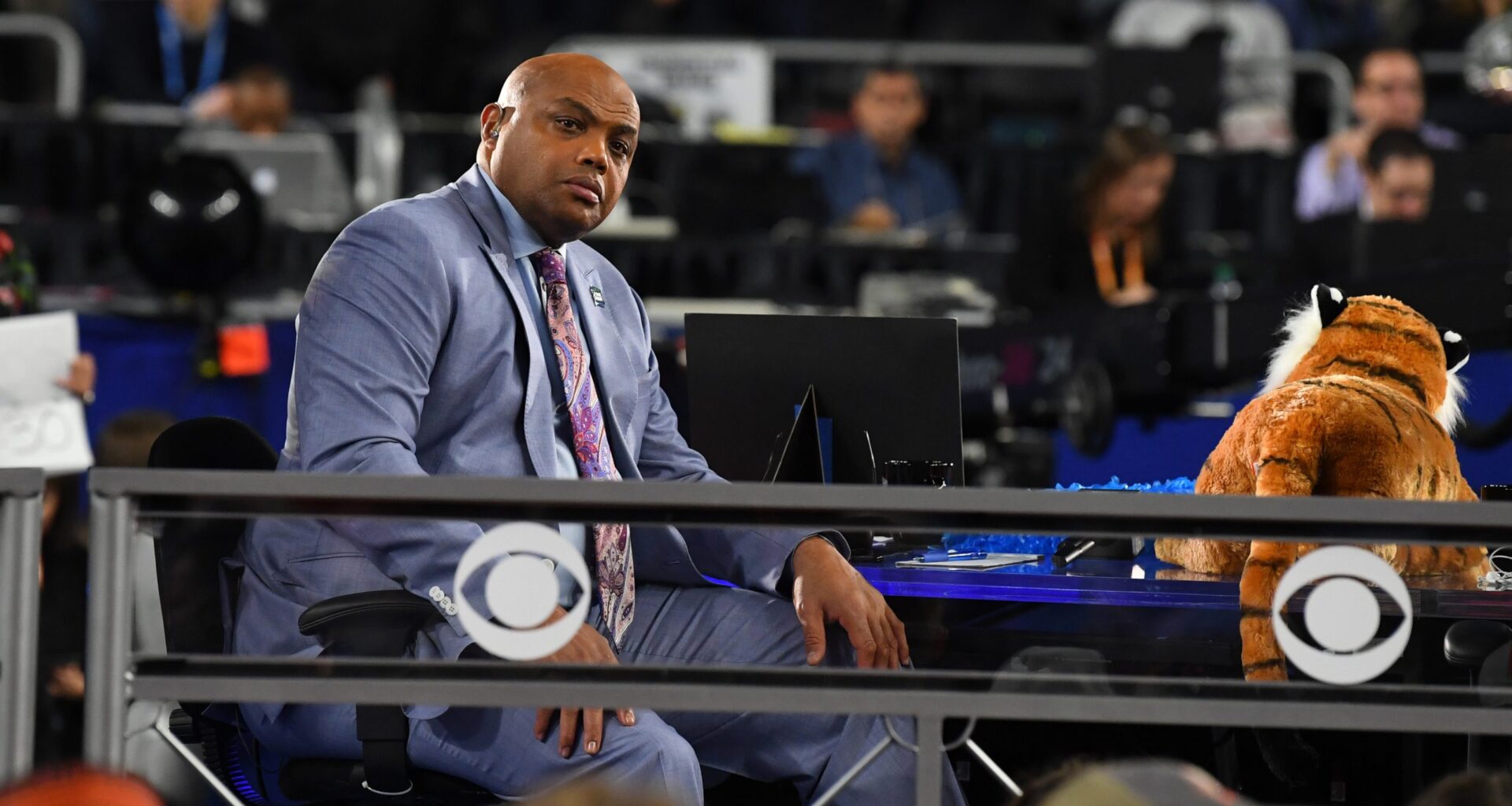
It may be a footnote on a day long remembered for UConn’s stunning win over Duke, but could Sunday have marked the last time TNT’s Kenny Smith and Charles Barkley appeared in Studio 43 at the CBS Broadcast Center?
It is hard to believe just how long Smith and Barkley have been moonlighting as college basketball analysts. This year marks the 15th NCAA men’s basketball tournament the pair have worked in the studio (it would have been the 16th if not for the COVID cancellation in 2020), and the 14th they have worked as part of a blended studio team in CBS Sports’ New York studios (the exception coming in the COVID-altered 2021 tournament, when they stayed in TNT’s Atlanta studios until the Final Four).
Smith and Barkley have now spent more than half of their broadcasting careers — 28 years for Smith, who debuted on TNT in 1998, and 26 for Barkley, who joined TNT in 2000 — talking college basketball for three weeks every March and April. Barkley’s NCAA tournament broadcasting career is now approaching the length of his NBA playing career (1984-2000).
More than a decade ago in 2013, this writer argued that it was time for Barkley and Smith — who by that point had done tournament games for three years — to move on from their March Madness roles. The argument then was that the TNT and CBS studio environments were simply far too different for the two to be successful.
TNT’s conversational, borderline improvisational style has been the standard for sports studio shows over the past quarter-century, and has even been modeled in some ways by CBS on its soccer coverage. The CBS college basketball studio has long been traditional, by-the-numbers fare. CBS has over the years incorporated some colorful segments into its tournament studio in an apparent attempt to replicate the TNT feel, but those often come off as forced — particularly this year’s segments with “Old Ball,” a basketball puppet that has made the rounds in recent months.
The best TNT segments are the ones that were not planned in advance and spin up organically as part of the conversation. Barkley and Smith sometimes bring some of that spontaneity, but primarily in exchanges with each other. In Sunday’s final studio segment during halftime of UConn-Duke, Barkley slyly asked if Smith had made the Final Four while playing with Michael Jordan at North Carolina. Smith noted that he had not, but shot back by asking whether Barkley had ever won a tournament game (he hadn’t).
Try to imagine a similar exchange between Barkley or Smith and Clark Kellogg. The fit with the CBS talent is still not nearly as comfortable.
Easily the most memorable studio moment in the blended CBS-TNT studio came three years ago, when Barkley said that he used to shower in his uniform after games — prompting an uproarious reaction from Kellogg and some quick-witted improv by the late Greg Gumbel. Those moments have been few and far between, and especially so since Gumbel last worked the tournament in 2023.
Gumbel was not always a perfect fit with Barkley and Smith, but his particular style — at a remove but never aloof — made him a quality ‘straight man.’ And any time Gumbel was not working, TNT’s Ernie Johnson was there instead, serving as perhaps the perfect ‘substitute teacher,’ helping to replicate at least some of the TNT dynamic.
Gumbel’s death in 2024 would be hard for any network property to overcome. Few hosts had ever been as identified with a single event as Gumbel was with March Madness. While nobody could quite fill those shoes, Johnson was as good a choice as any — but this year, he scaled his tournament role back to just the Final Four.
That has left the CBS studios in the hands of Nate Burleson and Adam Zucker. Both are capable, but lack the authority that Gumbel had and Johnson still provides.
Burleson, who in a few short years has become one of the faces of both CBS Sports and its news division, is naturally smooth, but sometimes comes off as overly polished. When he tried to be part of the jocularity early in the tournament, it came off as inauthentic. He appeared to tone that down in week two, but instead came off as bland. It is unfair to expect him to perfectly strike that balance given these are his first few weeks hosting college basketball, but CBS is the one that gave him such a prominent assignment.
And without the steady captain, the CBS studio has been less able to steer around some longstanding issues. Barkley, no shrinking violet on NBA coverage, rarely has anything to offer on tournament coverage other than generic appreciation — far from the bold and colorful statements for which he is known. He may enjoy the tournament, but clearly does not feel the same passion about it as he does with the NBA, for better or worse.
Smith missed most of the first week due to illness, and as has been the case for most of his tournament tenure, has occupied an ill-defined role. On TNT’s NBA studio, Smith is the analyst who actually breaks down the game while Barkley and Shaquille O’Neal entertain. On CBS, that role quite obviously belongs to Kellogg. So, what is Smith’s role? To break down the game like Kellogg or bring some TNT-style levity?
Perhaps the biggest problem is that CBS, in the course of incorporating the TNT talent, has not otherwise developed its studio roster. Kellogg and Seth Davis remain the stalwarts, but they rarely work together during March Madness. Renee Montgomery and Bruce Pearl filled the vacancies left by Wally Szczerbiak (who moved to game analysis) and Jay Wright (who left in the offseason). The TNT crutch has given CBS the ability to avoid making the more extensive changes that might have otherwise occurred by now. There is an element of ‘if ain’t broke, don’t fix it,’ but that can turn into stagnancy.
Change would seem to be coming. This season may be the last, or perhaps the second-to-last, in which CBS and TNT Sports must unite their separate sports divisions for tournament coverage. Paramount’s agreement to acquire Warner Bros. Discovery would combine CBS and TNT under the same umbrella if approved unaltered, and depending on the extent of the resulting ‘efficiencies,’ it would result in Barkley, Smith and the rest of the TNT crew being part of the Paramount family with Kellogg, Burleson and company.
Perhaps that means even more involvement of the TNT studio crew, or the opposite.
The CBS-TNT March Madness coverage has always been a partnership with give and take. The CBS studio was always likely to include TNT personnel, and vice versa. (It is after all a joint production.) But if Paramount owns all of it, there is no more pressure to include talent from one network or another. The goal can be to just put together the best studio show, maybe even one that is consistent throughout the season and not just cobbled together in March. Given the generational change taking place — Gumbel’s passing, Johnson’s reduced role, and Barkley’s frequent flirtations with retirement — there may be no better time for a change.
“The sensible move for CBS would be to go back to what works — Gumbel in the studio with Greg Anthony and Seth Davis,” was the conclusion of the 2013 article referenced previously. In present-day terms, that would mean Zucker, Kellogg and Davis. CBS would probably be better served this time around moving into a new era with a complete overhaul, perhaps save for Kellogg, who as the most senior member of the studio crew has more than earned the right to keep his role.
As a model, CBS could even use TNT — which this year created its first dedicated college basketball studio team, consisting of Adam Lefkoe, Jamal Mashburn, Jalen Rose and Pearl. If TNT can do it, CBS should certainly have a studio crew of its own that takes viewers all the way through the ‘road to the Final Four.
Perhaps it could lean more into ‘whiparound’ coverage when there are multiple concurrent games during the opening weekend, an area where tournament coverage is surprisingly lacking. (There is a TNT-produced whiparound studio show on the first weekend of the tournament, but it is only on the March Madness Live app.) After all, what viewers associated most with pre-TNT tournament coverage was the cut-in from “Greg Gumbel in New York” to a last-second finish in another game.
One way or another, few could seriously argue that the best possible college basketball studio team CBS could put together is the one that it is currently using. It is not so much bad television as it is something less than the sum of its parts. And for one of the biggest events in sports, it is hard to see how that is good enough.