
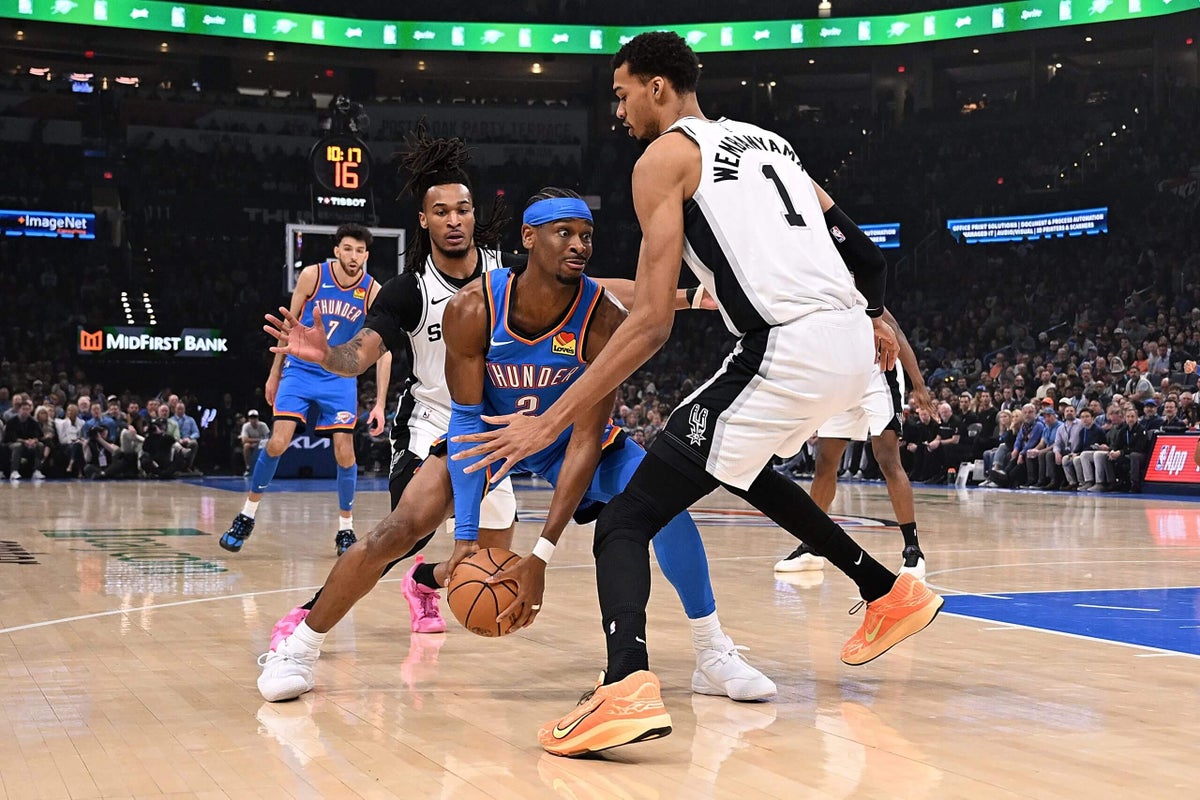
Voting for NBA awards produces a special type of anxiety.
You might feel confident in one part of the ballot. You might know that Shai Gilgeous-Alexander is your Most Valuable Player or that Victor Wembanyama is your Defensive Player of the Year. But then, you have to fill out the rest of the list, which isn’t always so simple.
In some cases, you may spend a season watching games, studying statistics and picking the brains of the NBA’s intelligentsia, yet still come away perplexed. A race is too close. Or the variables are too unknown. You could close your eyes, pick one candidate and feel just as assured in your vote. Such was the case last season, for example, in the historic MVP race between Gilgeous-Alexander and Nikola Jokić.
Now, it’s that time of year again. We voters are prepping. Here are the awards I am stressing the most about as the regular season comes to a close:
Fifth place for MVP
The top four for MVP are obvious, even if the order will deviate for many. Gilgeous-Alexander is the MVP favorite, and rightfully so. After winning the award last season, he’s arguably been even better in 2025-26.
Don’t overlook that he was shooting better than 60 percent on 2-pointers heading into Monday night’s action. As a high-usage guard. That doesn’t happen.
I will likely place Wembanyama lower on my ballot than the average voter does, mostly because of playing time. Aggregate production matters, and Wembanyama has played 400 to 500 fewer minutes than Gilgeous-Alexander, Jokić or Luka Dončić have.
But then, the bewilderment arrives. What should I do with fifth place?
This spot could have belonged to the Detroit Pistons’ Cade Cunningham, but the point guard is out with a collapsed lung and will likely become ineligible for postseason awards, falling short of the required 65 games played. And so, we’re left with flawed candidates.
In some ways, Jaylen Brown has carried the surprise Boston Celtics. In other ways, the numbers don’t back that up. Boston has been a dominant team with Brown off the court this season and a mere good one when he’s there. The Cleveland Cavaliers’ Donovan Mitchell was on a scoring binge for much of the season but has skidded a bit lately — and his Cavs have underperformed expectations enough that they revamped their core midseason. The Minnesota Timberwolves’ Anthony Edwards could barely slide into eligibility but has been an occasional participant in the Wolves’ inconsistency. The LA Clippers’ Kawhi Leonard has had possibly the best individual season of this bunch, but his team is also in eighth place, and his franchise is amidst an investigation of his alleged actions.
If there were no 65-game rule, Cunningham would be the intuitive choice. But another direction now appears necessary.
Sixth Man of the Year
If it weren’t for injuries, this could have been the season of reserve big men. Finally, after years of instant-offense types dominating the sixth man award, the stereotype was about to blow up.
Isaiah Stewart, the NBA’s best off-the-bench defender, would have had a case to win if he played enough. But Stewart dealt with injuries. Then, he got suspended for seven games after leaving the bench during a brawl. Then, another injury came.
Opponents are shooting only 43 percent on dunks and layups when Stewart is the closest defender, according to Second Spectrum. That percentage wouldn’t just lead the league if he qualified; it would be the lowest percentage for any player since Second Spectrum began tracking data in 2013-14. The Detroit Pistons are bullies. And Stewart, even if he comes off the bench, takes the lead. But even though the 65-game rule doesn’t apply to Sixth Man of the Year, he won’t play enough to justify a spot on the ballot.
Other centers could have made niche Sixth Man cases. Steven Adams and Mitchell Robinson are the game’s two greatest rebounders. The Houston Rockets’ and New York Knicks’ offenses are dependent on their second chances. But Adams hurt his ankle. Robinson has been on a resting plan all season. They have combined to play as many minutes as the other main candidates for Sixth Man have individually.
And so, we won’t get an all-center Sixth Man ballot, though the Timberwolves’ Naz Reid remains a candidate.
In all likelihood, my ballot will come down to Reid and two others: the Miami Heat’s Jaime Jaquez and the San Antonio Spurs’ Keldon Johnson.
Jaquez has unlocked Miami to a degree this season. The Heat want to play fast; well, they throttle when Jaquez is on the court. He’s a driver, an attacker and a ball-mover. But his jump shot can go flat, which is not the same for Johnson, who has been an impressive scorer all year. His 60 percent effective field-goal percentage makes him the most efficient of this trio — far above Jaquez and even Reid, a 3-point sniper.
All three have helped their teams. Only one can win the award.
Third Team All-NBA
All-NBA becoming position-less now — compared to the previous format of two guards, two forwards and a center — has made the conversation around it less interesting. Until not long ago, you could name a few forwards, then debate who should be fifth, sixth and seventh on your list. You could do the same with guards. Now, figuring out the bottom part of the All-NBA ballot requires listing off double-digit surefire members.
So, here are my 13 locks (in no particular order), assuming those who are on pace to qualify actually do so: Dončić, Gilgeous-Alexander, Jokic, Wembanyama, Mitchell, Brown, Edwards, Leonard, Tyrese Maxey, Jalen Brunson, Kevin Durant, Jalen Johnson and Jamal Murray.
Two spots remain. And the types of candidates here vary.
On one side are the compilers. The Portland Trail Blazers’ Deni Avdija would be in that category. Devin Booker has propped up a better-than-expected Phoenix Suns attack. James Harden keeps getting teammates open and has shot the lights out in Cleveland. Alperen Şengün and Karl-Anthony Towns are walking 20-point double-doubles.
But there are also the ones who are better than their counting stats would imply.
Would the Thunder finishing with the NBA’s top record make them deserving of a second guy? If so, Chet Holmgren, who should be on anyone’s Defensive Player of the Year ballot, could get there. Jalen Duren has a case for one of the final spots, as well. And let’s not leave out Derrick White, whose shooting numbers are a disaster but has been the league’s best perimeter defender this season, somehow protects the rim as a point guard and is Boston’s top ball-mover.
Second and third for Coach of the Year
The closest I am to being locked in on a vote is with Coach of the Year. I struggle to imagine choosing anyone other than Boston’s Joe Mazzulla — not just because the Celtics are shockingly second in the Eastern Conference but also because of how they have arrived there. This team is analytics-forward in a non-cookie-cutter way. Just watch: Come next season, other organizations will start to copy parts of the Celtics’ philosophies, especially their dedication to the offensive boards, where they crash the glass with more enthusiasm than anyone. They do it from unconventional angles, too.
But the rest of the ballot has me uncertain.
Coach of the Year is often a difficult choice for me, because outsiders can obtain the least amount of information about it. The most valuable parts of coaching aren’t timeout usage or substitution patterns; they’re aspects of people management that we can’t see. Now, add in that this season’s pool of candidates is strong.
J.B. Bickerstaff has vaulted the Pistons from a group that lost 28 consecutive games the season before he arrived to 44 wins last season to a chance at 60 in 2025-26. The leap from a mid-tier playoff team to a top-tier one is the most difficult to make. Bickerstaff has helped the Pistons there, all while fostering a tough-minded identity.
In some ways, the Spurs’ Mitch Johnson is in an easy situation. Anyone would love to coach Wembanyama. In other ways, his job isn’t so simple. San Antonio’s three-point-guard situation was supposed to clog its rotation. Instead, Johnson has turned it into a strength. He’s got bench pieces, like Johnson, buying in. He’s not afraid to sit a veteran, such as Harrison Barnes, who started the season on fire but has fizzled in the second half. The Spurs are ahead of schedule, pacing to win more than 60 games. And he’s doing it as the man who took over for Gregg Popovich, which is no easy task.
History says Mazzulla, Bickerstaff and Johnson should probably be the three names on the ballot. Since 2000, every Coach of the Year winner has come from either a 50-win team or a top-four seed.
And yet, rookie head coach Jordan Ott has a strong argument here. Phoenix flipped its culture upon Ott’s entry. The Suns are now a physical, gritty team obsessed with winning the possession game. The Toronto Raptors’ Darko Rajaković deserves a nod, too, after forming a top-10 defense with a group that lost its starting center for much of the season.