
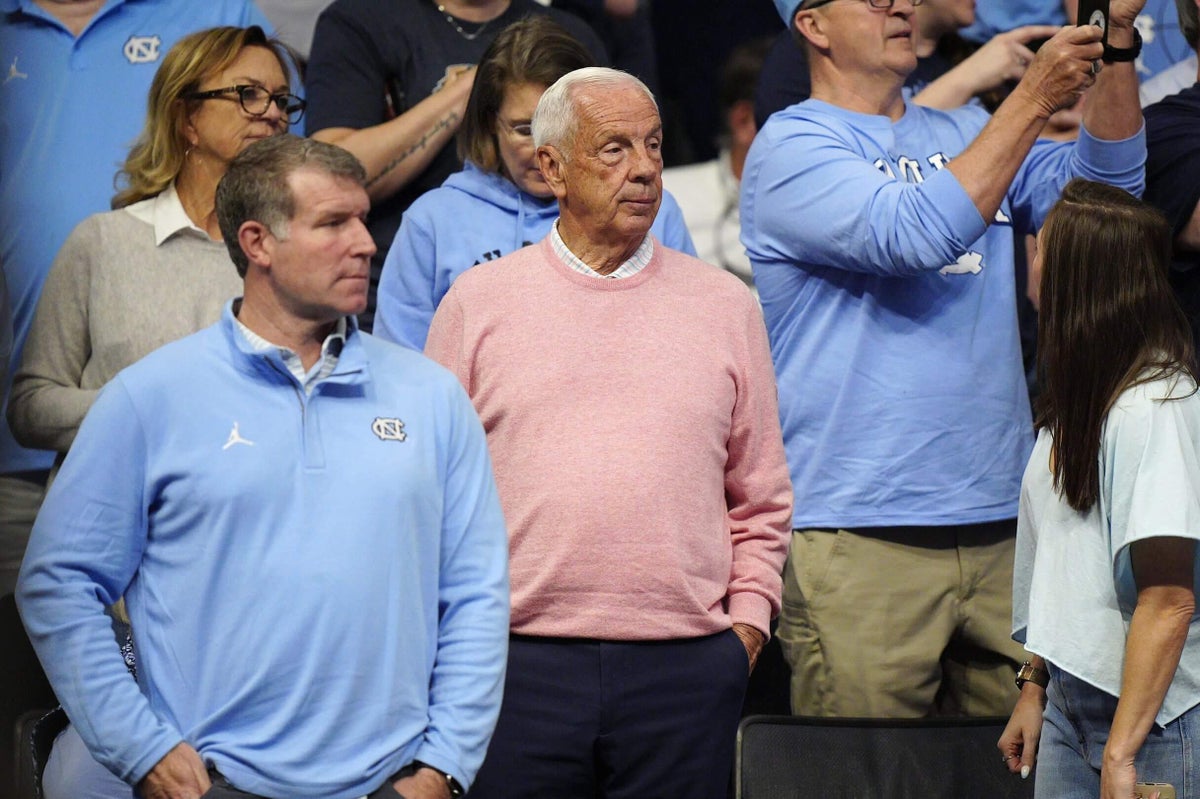
After firing Hubert Davis last week, UNC officially needs a new men’s basketball coach.
But for the first time in nearly 75 years, there is no “in the family” option to fill the void. A proud coaching lineage that began with Frank McGuire — and became a full-fledged coaching tree under the legendary Dean Smith — no longer has branches sturdy enough to prop up a program with six NCAA championships, the most recent of which came in 2017.
It is a major break in tradition, yes, but one being welcomed by many Tar Heels who just want UNC to continue plying its true family business: winning. Too little of that, and too much inconsistency during a time of upheaval in the sport, has spurred the blood blue to willingly accept putting results over roots.
“For us to do right by the Carolina family, we have to make sure we get the best candidate possible,” incoming athletic director Steve Newmark said on a school-sponsored podcast. “The one who can lead us for years to come, and have us competing for national championships on an annual basis.”
Two of the Tar Heels’ top candidates to replace Davis, according to multiple program and industry sources, are Arizona coach Tommy Lloyd and Chicago Bulls coach Billy Donovan, neither of whom has Carolina DNA. Either of them — or any other external option, like Michigan’s Dusty May or Iowa’s Ben McCollum — will have to be accepted, despite not having the baby blue lineage that started with McGuire’s Chapel Hill tenure in 1952, and moved from Smith to Bill Guthridge, then to Matt Doherty and Roy Williams, and eventually to Davis.
In some ways, Davis was fated to be the last link in that chain. While Guthridge and Doherty lasted only three seasons apiece, perhaps signaling to the outside world that North Carolina’s staying power had wobbled, there was always Williams — the UNC alum, longtime Smith assistant and then-Kansas coach — waiting in the wings.
The natural heir to the Tar Heels’ throne.
And Williams, clearly, was more than worth UNC’s wait for him to come home. Three national titles in 18 seasons, compared with two for Smith in nearly double the time. Leading the program through an academic scandal and Smith’s eventual passing in February 2015, past Kendall Marshall’s broken wrist and Kris Jenkins’ buzzer-beating 3.
Along the way, Williams became the Carolina family’s new patriarch.
But no coaching tree has unlimited branches — and for all of Williams’ success, few other former Tar Heels emerged as viable inheritors during the twilight of his tenure. Jerry Stackhouse flamed out at Vanderbilt. Success at UNC-Greensboro made Wes Miller appealing, but not quite ready. King Rice had staying power at Monmouth, but no NCAA Tournament wins.
Which caused Williams, and UNC, to look internally. To his bench. To the closest, best option. To Davis, who played for Smith.
At the time of his hiring in 2021, Davis was best known for his NBA and ESPN days, even after nearly a decade on Williams’ bench. But while the former star UNC guard dutifully wore a Dean Smith pin and waxed poetic about Smith’s influence on his life, he never grabbed the program by the throat the way Williams had.
Yes, the Carolina family stayed in place — but only for as long as Davis’ tenure would last. With five seasons, 179 games and one miraculous March Madness run.
“The notion of hiring within the family, that’s not gonna happen,” former UNC All-American Brendan Haywood said in an Instagram video. “We have nobody that’s currently coaching in college or the NBA that’s doing an elite-level job, that can come take over and get Carolina where it needs to be.”
That’s why many in and around UNC are finally OK with breaking a line that ties back to the post-WWII era. (Lloyd, at least, has a Carolina tie, albeit once removed; his mentor, Gonzaga’s Mark Few, is one of Williams’ longtime friends, and multiple UNC sources say that connection has made Lloyd something of a favorite in Tar Heels circles.)
One source briefed on UNC’s search, granted anonymity in exchange for their candor, said that given the choice of getting a winner or stretching for a family hire, there was no question which door the program should pick.
“Everyone would choose, we’ve got to be competitive,” the source said. “Let’s go win.”
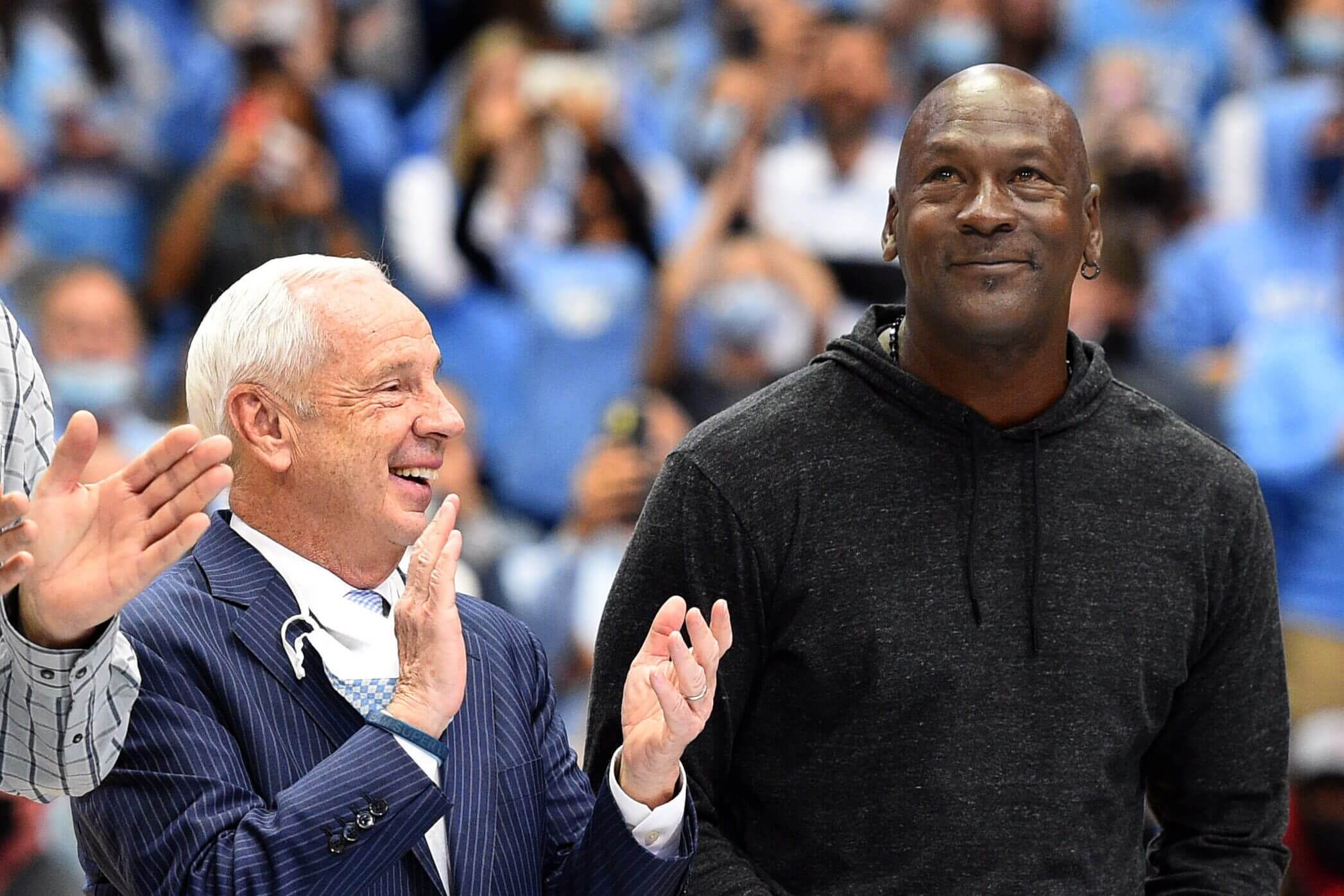
What role does Michael Jordan (right) play at UNC today? His spokesperson said he trusts UNC’s leadership to make the right hire. (Bob Donnan / USA Today)
UNC’s chosen candidate may not have to kiss the ring, per se, but those who have come through Chapel Hill will still want to see reverence for the place’s past — and proof of future staying power. Kenny ‘The Jet’ Smith, a former UNC All-American turned basketball commentator, said on CBS that the next coach should want to retire at North Carolina, providing stability in an era with less of it than ever before. The school is serious enough about that sentiment that it’s consulting with former players, coaches and administrators on the hire. Williams has not publicly addressed the topic.
The new coach will also be expected to quickly play a role in one of the family’s most important — and contentious — ongoing debates: Where the men’s basketball team should play. After 40 years of wear and tear, UNC is considering whether it should remain in (and renovate) the Dean Smith Center, or whether the program is best-served in the future by building new at another site. Over the weekend, North Carolina announced it is “suspending ongoing discussions” about the arena until after a new coach “has had time to acclimate to the program.”
All of which is to say, the new coach will be asked to do more than simply coach.
Really, UNC wants someone who can appreciate and lean into its history, welcome back former players, learn what made it one of college basketball’s winningest programs — but also modernize it, as Williams did upon his hiring in 2003, in a way that sets the program up for generations to come.
Another question, then: Where is the school’s most-famous (and richest) basketball product in all this? What does Michael Jordan think?
According to two program sources, Jordan was informed by school leadership that Davis was not going to be retained — just as he was informed in 2021 that Davis was going to be hired, before the move was made official. Jordan has contributed financially to UNC’s men’s basketball program in recent seasons, the sources added, although to what extent is uncertain.
A spokesperson for Jordan declined an interview request from The Athletic, saying: “We trust the UNC leadership will make the right decision.”
Which, as of now, means ending the line that grew to national prominence under Smith, the coach under whom Jordan won the 1982 national championship.
“You’d have to be stupid not to embrace the Carolina family,” said another source briefed on UNC’s search. “If he embraces the Carolina family — doesn’t have to wear a Dean Smith pin (like Hubert did) — but acknowledges Roy, acknowledges the history, (is) seen with the former players, seeks their advice … then I think our community is primed to respond.”
To be clear: Primed to re$pond.
One of the key reasons Davis was ultimately let go, sources say, is that financial support for next season’s team fell off dramatically in the wake of UNC’s first-round NCAA Tournament loss to VCU. It would have been difficult for Davis to build a winner next season were he retained — especially considering this season’s roster, which went one-and-done in the Big Dance, cost roughly $16 million in combined revenue-sharing and NIL dollars, according to a source familiar with negotiations.
Newmark emphasized on the school’s podcast that “we’d be blind” to ignore the fundraising element with any of the school’s coaching candidates.
“We want to make sure that we have a leader who understands that part of the job is trying to manage the financial component of running a basketball program,” Newmark said, “and somebody who is engaged and able to energize our fan base.”
UNC, of course, is far from the first college basketball program to face this familial dilemma, even if its roots go deeper than most. It’s as widespread a mindset — with as widespread results — as the game itself. You have Michigan State’s Tom Izzo and Purdue’s Matt Painter, who took their respective torches from Jud Heathcote and Gene Keady and ran with them. Or, more recently, Jon Scheyer at Duke, who took the machine Mike Krzyzewski built and adapted it to the modern era.
But for every successful inheritance, there are seemingly three failures. Adrian Autry at Syracuse. Kyle Neptune at Villanova. And to some extent, Davis, too.
On and on and on.
In a different era, perhaps that strategy was more sound. When relationships, and the school logo, and history still mattered to an untold degree. But in this era — when NIL and revenue-sharing and the transfer portal reign supreme — is tradition still a difference-maker or a potential albatross, one that prevents schools from casting the widest net possible?
This ongoing NCAA Tournament has only emphasized that sentiment. Look no further than Iowa’s Ben McCollum, who bided his time in Division II before taking the Hawkeyes to the Elite Eight in his first season in Iowa City. Or Dusty May, who parlayed his success at Florida Atlantic, of all places, into the Michigan job — and who already has the Wolverines operating as one of the sport’s best programs, in only his second season.
Not to say that there’s no place in the modern era for history and tradition.
Rather, that actual X’s and O’s coaching — and the requisite investment to recruit necessary talent — has never been more important.
“The landscape continues to change in collegiate athletics,” Newmark said, “so we need to have somebody who is adept and understands that, and will be able to navigate that.”
Between the lack of “family” candidates and larger dynamics at play, North Carolina has finally realized it must enter the modern era, rather than relying solely on its legendary laundry.
So, yes, the family may end here. But not the family business.
“The Carolina family,” the first program source said, “just wants to win.”