
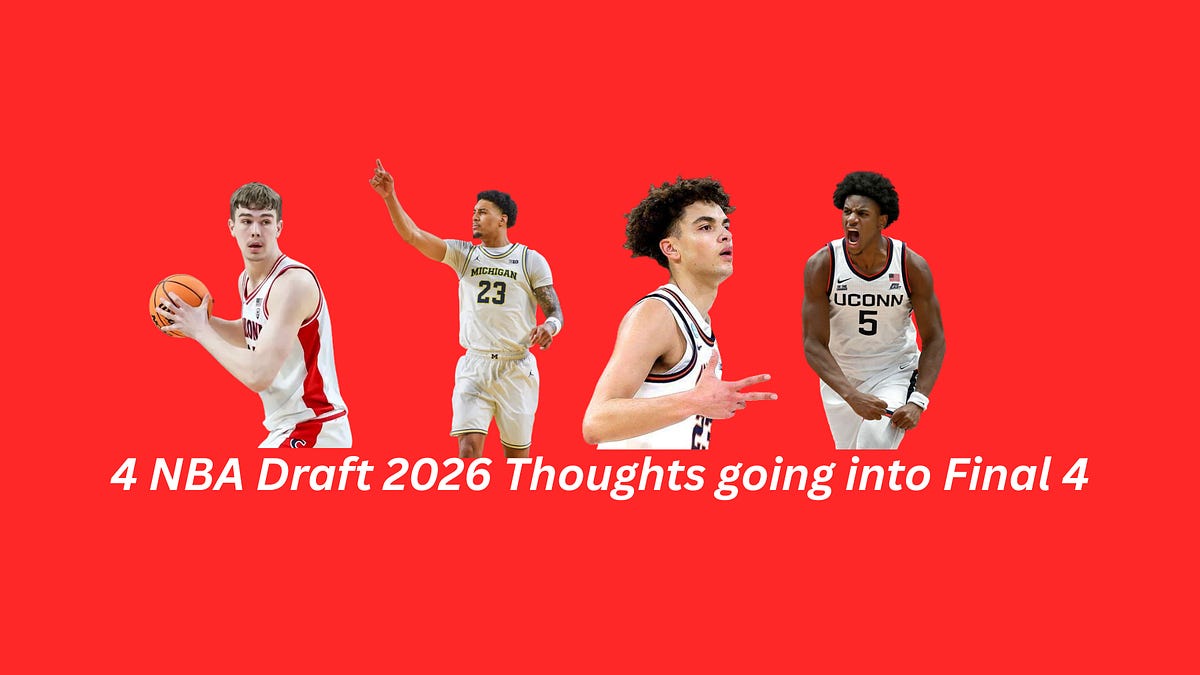
The Final 4 is this weekend, and March Madness has provided a lot of pop — with Braylon Mullins’ deep-three game-winner serving as the icing on the cake to regional play.
The field is set: Arizona versus Michigan and Illinois versus Connecticut. Each team has an insane amount of intrigue heading into Final 4 weekend.
Arizona has assembled a deep team that’s been one of the most consistent squads all season.
Michigan has a gigantic, cohesive frontcourt of players who may be in the NBA next season.
Illinois has arguably the best story with any freshman prospect in recent memory, while serving as the model for international scouting.
Connecticut has a chance to win their third national championship in four years with a head coach whose explosive, exciting personality resembles a modern-day Bobby Knight.
It’s bound to be great hoops. As we enter the Final 4, I gather my thoughts on the four remaining teams based on what we’ve learned this tournament — and how it relates to the 2026 NBA Draft.
Throughout the season, I’ve maintained that Kingston Flemings is my PG1. However, without a slant at the “incumbent” by the way, there’s a new PG1: Keaton Wagler.
The Illini freshman has taken one of the most dramatic leaps of any freshman prospect in the one-and-done era. As the Fighting Illini enter the Final 4, Wagler has showcased real chops as a primary ball-handler.
Since taking over primary playmaking responsibilities in the middle of the season due to Kylan Boswell’s injury, Wagler’s production and potential as a primary ball-handler have popped significantly.
His performance against Houston doesn’t pop off the page with his counting stats. However, his composure and poise stood out, as he navigated blitzes well to keep the offense flowing.
A lot is made about his driving. With his subpar athleticism and strength, he will have to offset these deficiencies at the moment. His main trait to increase the margin of error is his ability to draw fouls. At the same time, he has counters with his soft outside shooting touch and his footwork.
Offense aside, he had a concerted effort to rev up his motor and intensity defensively — exhibited through his rotations and rebounding. The hope is he can string together more positive defensive plays as he puts on more mass.
I plan on writing about this specific topic with Wagler deeper into the cycle, closer to the draft. Shining brightly in last weekend’s play, he blends production and projection better than just about anyone else in this draft class. A major component of this belief is how he stacks his playmaking, composure, shooting touch, and skill with his size.
Lendeborg passed a major test with transferring from UAB to Michigan: he can fit virtually any role.
He can guard virtually every position on the floor. His ability to guard smaller players and his willingness to take the assignment of the guy on the other team have intrigued me. His length and lateral quickness serve as a foundation to become an effective stopper.
Lendeborg is also a versatile passer. He’s great at making reads off the dribble, a useful skill off drives and short rolls. He can throw skip passes to the weak side if he draws two defenders. Not as flashy, but he is willing to make the extra pass.
In a league predicated around pace, he’s an absolute freight train in transition. The threat of the finish and pass is potent.
His three-point jumper is still more adequate than anything, but he’s also shown more willingness — which adds to his presence from the perimeter. He’s done so while not tanking his efficiency. While shooting is loosely tied as a swing skill for many prospects, it’s genuinely the case for Lendeberg.
If the shooting is pretty real for Lendeborg, he’s a player whose weaknesses are minimal. Telling from his experience with Michigan, he will be able to plug and play into any role his NBA team needs him to.
Arizona is the deepest team remaining in terms of future NBA players. Last weekend, they all flashed their NBA upside to a real degree.
Brayden Burries is the main riser for Arizona. He was more solid than anything else. He acts more as a pseudo-primary or secondary next to Jaden Bradley. He needs to polish his handle a bit but is still steady in his role. He’s a decent shooter. Last weekend, his intrigue lay in his defense. He’s a sound defender that’s a great help defender — shining more in dig-and-contest situations. He’s aggressive defending drivers at their hip. He has the size and defensive tools to be a positive team defender.
Koa Peat has his flaws with his shooting and subpar athleticism as a 6’7” power forward. However, his strength and polish offer a two-way foundation for him to become a viable rotation player in the league. While his below-rim finishing can be a hindrance, he has flashed smooth fakes and a soft touch several feet away from the basket.
Motiejus Krivas can become a real NBA anchor. He’s a massive deterrent that can alter shots at the rim, although he can use some mass to absorb contact. His technique in the pick-and-roll is divine — he can shift his attention from the ball-handler to the roller when backpedaling against the drive.
Ivan Kharchenkov has enamored me. He’s a huge 3 that crashes the glass, takes on the toughest assignment, and can make the right read. He lunges himself to the basket on finishes. He has to improve his screen navigation a bit — mainly with getting skinnier — but his ability to chase Braden Smith around all over screens moved me to a significant degree. If he returns to school with an improved jump shot, he might be a top-10 prospect for the 2027 Draft.
Jaden Bradley is an absolute dawg with his defensive tenacity and driving pressure. He needs to trim the mid-range jumpers from his shot diet. It wouldn’t be shocking if he’s productive by his rookie or sophomore year.
This Arizona starting lineup is loaded and can make waves over the Final 4/National Championship long weekend.
Every March Madness brings a riser. Tarris Reed should be that guy this year.
He moves like a grizzly bear defensively. I wouldn’t say he’s switchable, but he’s not stiff defending in space — more effective when guarding 4’s or 5’s when they’re near the slot. He’s also a stocks machine, more notably annihilating shots at the rim. Whether it’s as a starter or a backup, he can be a formidable anchor for a defense.
Offensively, he’s powerful yet smooth — highlighted in his footwork in the post. He’s also a smart big man with his screening and his passing. Amplified by his passing prowess, his intersection of screening, passing, and play-finishing make him a seamless fit for an NBA system.
He checks so many boxes for the modern 5. He finishes shots effectively, gobbles rebounds, protects the paint, makes smart reads, sets good screens, and thrives in different schemes — all while possessing a powerful frame. What more can you ask for out of the 5?
Reed has set the tone for UConn with his physicality, and that will be imperative for their national championship chances — and his NBA draft stock.
If you choose to support my Substack, SubTsakalidis — aka “SubTsak” — follow this link to my Allie’s Allies St. Jude fundraiser page. If you choose to subscribe, all proceeds will go towards St. Jude Children’s Research Hospital.
Follow me on X and Bluesky. Subscribe to my YouTube channel, SubTsakalidis Scouting.