
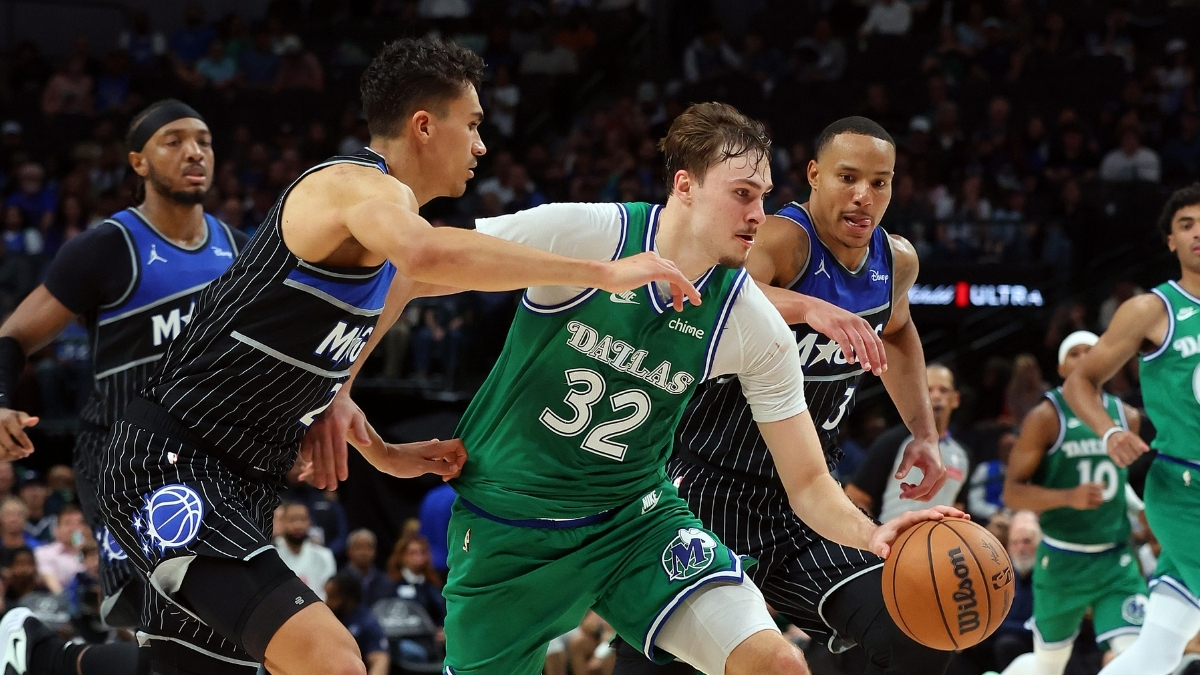
DALLAS — Most nights at American Airlines Center, before the arena fills and the lights come up, two players share the floor during pregame warmups without much fanfare. One is 19 years old and averaging 20.8 points, 6.6 rebounds, and 4.5 assists across 65 games as the centerpiece of a franchise rebuild. The other is in his 14th NBA season, a three-time All-Star and a champion, working through the same deliberate routine he has refined over a decade and a half of professional basketball.
Cooper Flagg and Khris Middleton do not always need to exchange words for something to be transferred. The habits are visible. The preparation is on display. And for a teenager trying to learn what it means to be a professional scorer at the highest level, simply being in that space — watching how a veteran of Middleton’s caliber approaches his body and his craft before the opening tip — carries its own instruction.
“I’ve learned a lot from Khris,” Flagg said after a March overtime loss to Golden State. “He’s a professional scorer and has been around the league for a long time. I’m trying to take parts of that side of the game from him and learn in those aspects. He has a lot to teach me, so I’m excited to be able to learn from him.”
Middleton has watched that process up close since arriving via trade at the deadline, and his read on what Flagg brings to the floor every night — despite being the primary target on every opponent’s scouting report — cuts to the core of what makes the rookie so difficult to contain.
“Knowing that he’s the number one guy on most scouting reports and gets the most attention, he still finds a way to be effective each game,” Middleton told Dallas Hoops Journal. “Just his versatility and his will.”
The Work Behind the Work
Dallas acquired Middleton at the trade deadline in the Anthony Davis deal, and the two found an easy rhythm almost immediately. Before a late-March game against the Warriors, Flagg and Middleton were spotted working on post-ups during shootaround at the Mavericks’ practice facility — one of the many instances throughout the season where the veteran has taken a hands-on role in the rookie’s development.
Head coach Jason Kidd offered a window into what was actually being drilled.
“They were just talking about the pressure and knowing how to release pressure,” Kidd said. “Khris has given him some of his wisdom on what he has used to be successful down there in the post. For Khris, his wisdom — he’s a champion, he’s played the game at the highest level. For him to spend time with Cooper and help him as he goes forward.”
Middleton has made a career out of the details that do not show up in highlights — reading help defenders, creating contact at the right moment, knowing when to go and when to wait. Those are precisely the skills that Flagg, at 6-foot-9 with the frame to bully smaller defenders on any switch, is positioned to absorb and weaponize as his game matures.
“He’s a student of the game,” Middleton told Dallas Hoops Journal. “He wants to be great. He watches, he pays attention, he asks questions — that’s what all great players do. They observe, ask questions, and then go out there and play as hard as they can.”
Opening Up the Floor
The most visible area of Middleton’s influence has been Flagg’s three-point shot — or more precisely, his willingness to use it. Flagg entered this season shooting 29.3% from three on just 3.5 attempts per game, numbers that reflect both selectivity and inconsistency from deep. The reluctance to pull the trigger has been a recurring point of emphasis from the veterans around him all season.
“Once he starts letting it fly and knocking those shots down, it’s going to open up so much more for him,” Middleton told Dallas Hoops Journal. “Defenses know once he gets to the paint, he’s a handful to deal with. So once he gets a consistent three-ball like he’s working on, it’s going to make him even better.”
Kidd has connected that development directly to Middleton’s mentorship and framed it not just as an offensive upgrade but as a matter of long-term sustainability.
“He didn’t hesitate. He was super aggressive,” Kidd told Dallas Hoops Journal, reflecting on Flagg’s shooting in Thursday’s performance against Orlando. “That’s something we’ve talked about — him looking to shoot the three more. He loves to drive, we all know that, but this is the next step. The attempts matter — you’re going to make some and miss some. It also helps take some wear and tear off his body so he’s not getting hit as much inside.”
Brandon Williams, who plays alongside Flagg every night and has been one of the most vocal advocates for him taking more threes, credited Middleton specifically for helping Flagg identify and attack his spots.
“Just finding his spots on the floor — where he likes the ball,” Williams told Dallas Hoops Journal. “He’s picking his spots, knowing when to shoot, where to get it, and he’s being more demanding — telling us where he wants it. And Khris Middleton has done a great job trying to coach him, showing him how to get to those spots. Having a vet like that is huge.”
Middleton also put into words what makes Flagg such a difficult matchup when all of those elements come together — and what the ceiling looks like when his three-point threat becomes reliable.
“Just his size and versatility,” Middleton told Dallas Hoops Journal. “To be 6’9″, 6’10”, whatever he is, and handle the ball all over the court — that’s a nightmare matchup. He does a great job of being aggressive and putting defenses in tough positions.”
The Proof of Concept
It showed up in the most visible way possible on Thursday night against the Orlando Magic. Flagg fired nine three-point attempts — nearly double his previous single-game high of five — and converted six, a career best. He finished with 51 points on 19-of-30 shooting, becoming the first teenager in NBA history to reach that scoring mark in a single game.
The six made threes were not incidental. They were the product of a season’s worth of encouragement, shootaround reps, and pregame conversations that pushed Flagg toward trusting a weapon he had been reluctant to deploy consistently.
“Me and P.J. were telling him to shoot the ball,” Williams said. “He turns down a lot of them, but shooting the three is only going to open his game a lot more.”
Flagg acknowledged his own growth, pointing specifically to the pull-up jumper as the area where he has made the most tangible strides.
“Tonight, I felt really confident off the dribble — pulling up and attacking mismatches,” Flagg told Dallas Hoops Journal. “That’s definitely been an area of growth for me this year, just trusting my pull-up and my off-the-dribble game.”
Flagg has also leaned on the veteran presence around him throughout a season that has tested this roster in nearly every way — through injuries, a franchise-record home losing streak, and the weight of carrying a 24-53 team while everyone watches to see what he will become.
“I just lean on my teammates, the guys who have had long careers and been in the league a long time,” Flagg said after a late-season overtime loss to the Clippers. “They’ve helped keep me sane through this entire process, for sure.”
What It Looks Like Going Forward
Sixty-five games in, the numbers tell part of the story. Flagg is averaging 20.8 points, 6.6 rebounds, and 4.5 assists while shooting 47.2% from the field and going to the line at 81.6%. He has hit double figures in 57 of those 65 games.
The three-point shot remains the one area where the production has not yet caught up to the potential, but Thursday offered a glimpse of what it looks like when it does.
Five games remain. The shootarounds, the shared pregame floor time, the conversations about releasing pressure and knowing when to go — none of that shows up in a stat line. But it is accumulating, and the player it is building is becoming harder to stop every night.