
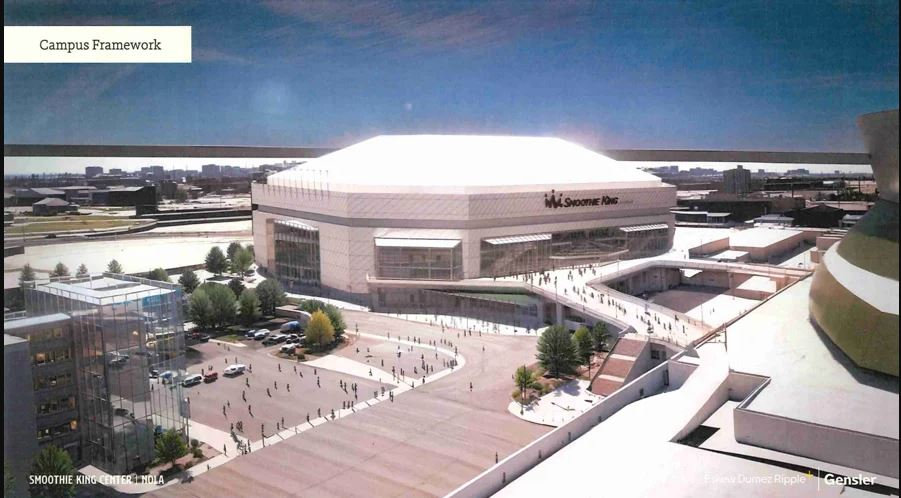

Courtesy of the Louisiana Stadium and Exposition District (LSED)
The New Orleans Pelicans are facing significant developments regarding their home arena as they move closer to the 2029 lease expiration with the state of Louisiana. Discussions around renovations or potential new constructions have become increasingly vital in maintaining the Pelicans in New Orleans, especially considering the current condition of the Smoothie King Center, which is showing signs of age.
Photo Courtesy of Matt Colville, Stadium Journey
Current State of the Arena
The Smoothie King Center, which has served as the Pelicans’ home since 2002, is described as “antiquated.” A recent assessment highlighted urgent needs such as:
New seating arrangements to enhance capacity and comfort.
Upgraded lighting and technology systems, including a modern scoreboard.
Enhanced concession stands to improve attendee experience.
Expanding limited lower bowl seating, which is the lowest of any NBA arena.
These issues are critical, considering that the Pelicans operate in a small market with limited corporate sponsorship and television revenues.

Courtesy of the Gensler and Eskew Dumez and Ripple
Lease and Future Considerations
With the lease set to expire in 2029, the management of the Pelicans is in a precarious position. Governor Jeff Landry of Louisiana has remained non-committal and has expressed caution about state funding for either renovations or a new arena, which raises concerns among fans and stakeholders. However, Governor Landry remains committed to raising revenue for the state of Louisiana and the city of New Orleans.
Plans for a new arena for the Pelicans could cost between $800 million and $1 billion, while a major renovation of the Smoothie King Center would be considerably less expensive.

Courtesy of the Gensler and Eskew Dumez and Ripple
A Case for Improvements
Since its opening in 1999, the Smoothie King Center Arena has weathered Hurricane Katrina in 2005 and underwent a state-funded renovation of $54 million before the 2014-15 season. This marks over a decade since its last major update, with further upgrades needed to keep up with the modern standards seen in other NBA venues. New Orleans can draw lessons from successful arena upgrades and new constructions in Oklahoma City and Houston, where significant investments have rejuvenated fan engagement and improved financial viability.
Over the years, various lease agreements with the Hornets-Pelicans franchise owners have seen the state of Louisiana occasionally subsidize the franchise to keep it in the area. An assessment conducted by Louisiana officials identified several high and medium-priority issues requiring attention.
The report highlighted the need for new seating, improved lighting, a modern center-hung scoreboard, updated video screens, and enhanced concession stands. Operating in a small market with limited corporate backing and a tiny TV audience, the Pelicans’ owners face pressure, as their lease agreement in New Orleans is set to expire soon.
Financial Implications
The Pelicans are currently grappling with financial constraints, which impact their ability to attract top talent and improve their roster. Fans have expressed concerns that without a serious investment in their home venue, the team may struggle not only in performance but also in its long-term presence in the city.
Looking Ahead to the 2026 Offseason
As the Pelicans approach the 2026 offseason, discussions among management will need to focus on both roster improvements and the arena situation. While there may be limits to their immediate flexibility in the market, the potential need for infrastructure investment remains a priority.
The future of the New Orleans Pelicans and the Smoothie King Center is intertwined, and bold action will be essential. Whether through renovation or a complete rebuild, the franchise’s survival in New Orleans may depend on the decisions made in the coming years.