
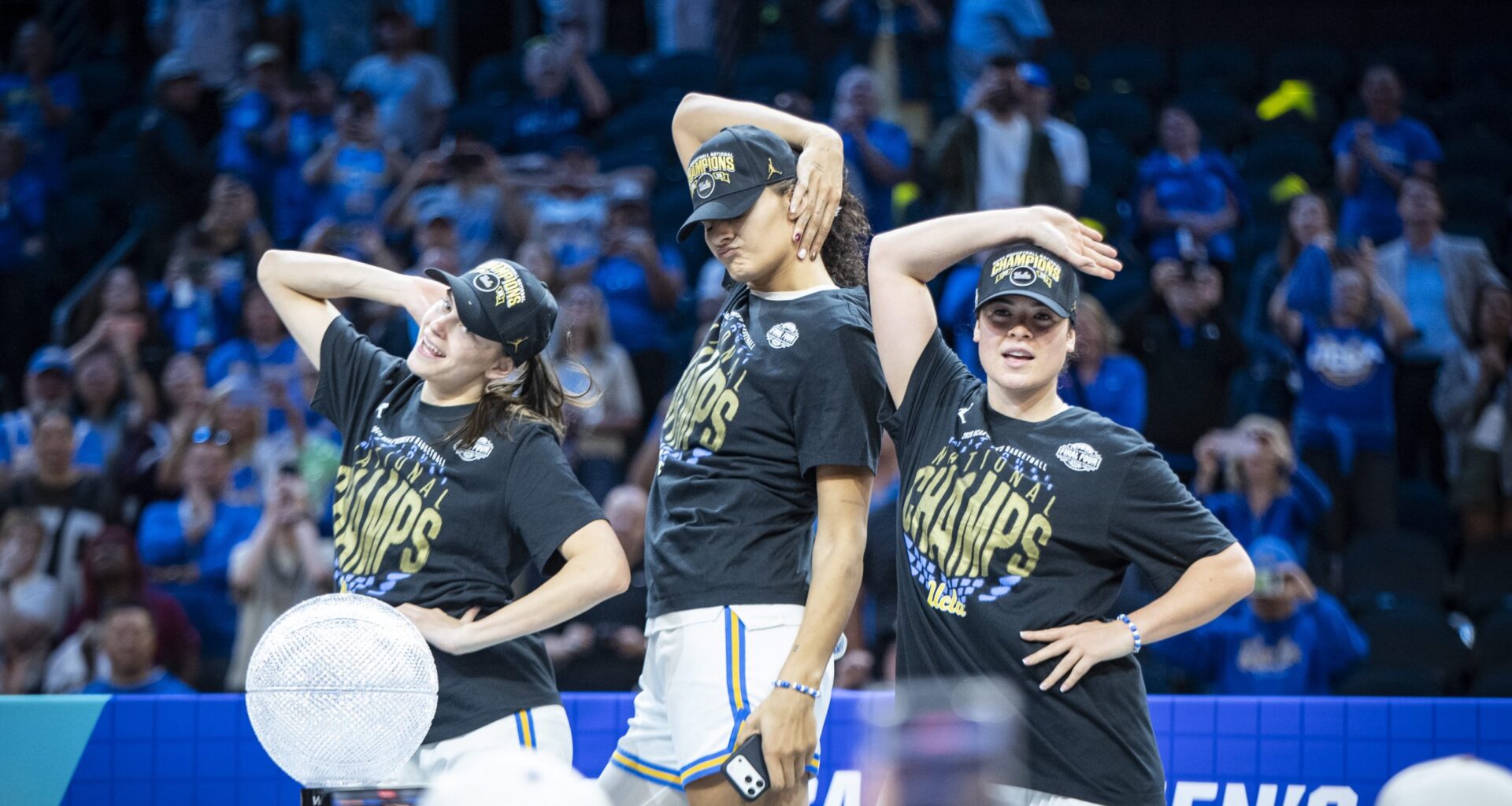
PHOENIX – “Firsts” make for an easy narrative to rally around. Everyone understands the magnitude of the accomplishment when a program that has been around for 45 years wins a national championship game for the very first time. But women’s basketball has a messy, nuanced history that doesn’t conform to clean labels and simple narratives. And that shouldn’t be a point against it. Because after digging in to learn the full history of women’s basketball at UCLA, it becomes clear that the program’s second national title is momentous for reasons that stretch far beyond the passage of time.
Heading into UCLA’s 79-51 win over South Carolina in the NCAA national championship game, many correctly stated that UCLA’s appearance would be its first in an NCAA title game. But NCAA is a crucial qualifier that’s easy to overlook, especially for those unfamiliar with the NCAA’s ever-evolving relationship with women’s basketball. Keen observers of the record books will have noticed that the NCAA’s accounting of women’s basketball begins with the 1981-1982 season. However, that does not mark the beginning of collegiate women’s basketball. In the decade prior, collegiate women’s basketball was governed by the Association for Intercollegiate Athletics for Women (AIAW), an organization founded because the NCAA had expressed no interest in adding women’s basketball to its roster of sports. It wasn’t until the AIAW provided a proof of concept for the viability of the women’s game that the NCAA decided to get involved. Even then, their expressed interest was undercut by their active attempts to use the legal system to push back on Title IX, a law enacted in 1972 prohibiting discrimination on the basis of sex (among other protected characteristics) that would require athletic departments to offer equal opportunities to women.
Though the NCAA is the standard-bearer for collegiate athletics today and other tournaments with relatively unknown four-letter abbreviations in front of them are considered lesser, that was not the case in 1978 when UCLA won its first national championship under the AIAW banner. At that point in the history of collegiate women’s basketball, the AIAW had already built the foundation and the NCAA was still on the sidelines, waiting to check into the game until after the AIAW had established a healthy lead.
UCLA head coach Cori Close doesn’t view the 1978 team’s AIAW title as lesser. “It’s not their fault that it was AIAW at that time,” Close said while speaking to the media following their win against Texas on Friday night. “They won a national championship. They went to back-to-back Final Fours. We always want to acknowledge that.”
Acknowledging history enables an understanding of the current moment. “We want to give credit to the people that have walked before us,” forward Gabriela Jaquez told reporters during the same press conference. “They have won championships.”
No matter who you ask, the current UCLA team or the 1978 team, they will tell you, a national title is a national title. “AIAW was the governing body for women’s athletics.” That’s the bottom line for Denise Curry, forward for the 1978 squad and the school’s all-time leading scorer with 3,198 points. As she noted in an interview with The IX Basketball, there was no NCAA championship to be won in 1978, “Every women’s team in the country, with the exception of NAIA, was playing AIAW, so it’s no different.”
Words spoken by the 1978 team still carry weight within the program. Close has welcomed their voices since the day she arrived in Westwood. “I get texts from them all the time. There’s nobody that supports the mission of our program [more], not just the growth of what you see on the court, but we do things a little differently, and they have been behind me every step of the way,” Close told reporters on Friday, after several members of the 1978 squad were in attendance at the game. “It is really meaningful to have so many people from that particular team, that set such an important course for UCLA women’s basketball to be so supportive of our women, and they feel that.”
Though the game has changed dramatically since the late ‘70s, alums of the 1978 team still see throughlines connecting the current team to what they built. Ann Meyers Drysdale, whose jersey hangs in the rafters of Pauley Pavilion alongside Curry’s, led UCLA’s last title team in assists, steals, and rebounds. In an interview with The IX Basketball, she recalled their offense involving a lot of “running, pushing the ball, and certainly a fast break style of game.”
In her pre-game media availability on Saturday, UCLA’s current center Lauren Betts described their plan to create offense against a tough defense in South Carolina, “[W]e like to push in transition and play really fast.”
And though the 2026 squad may not average 96.2 points per game on offense, they present a similarly balanced approach to scoring. This year’s team boasts four players averaging double-digits in scoring. In their win over South Carolina in the title game, five players scored at least ten points, with both Betts and Jaquez posting double-doubles. In the 1978 title game, UCLA had four players in double digits, with Meyers Drysdale logging a double-double and center Heidi Nestor coming just one rebound shy of a double-double herself. The 2026 team routed South Carolina 79-51. The 1978 team didn’t win by a margin quite that wide, but they did earn a definitive 16-point victory over Maryland.
On the other side of the ball, the 1978 squad was “[A]n aggressive team defensively,” according to Meyers Drysdale, “I always thought rebounding was a big, big part of it.”
What was the defensive gameplan for the 2026 squad heading into their final? “It’s going to be about our aggressiveness,” Betts told reporters on Saturday. “Defensively limiting them to one shot and rebounding.”
Despite the similarities between the two teams, the experience of playing women’s college basketball is vastly different in 2026 compared to 1978. After Title IX went into effect in 1972, Meyers Drysdale was the first women’s basketball player to receive a full athletic scholarship. Now, due to recent changes in legislation and NCAA policy, players are not only eligible for scholarships, but they’re also able to earn money using their name, image, and likeness and receive a revenue share from their schools.
While Meyers Drysdale remembers taking road trips in vans to the other California schools in the conference and driving back right after the game because there was no budget for a hotel, now UCLA is a member of the Big Ten with multiple trips to the midwest on the schedule that require not only hotels but chartered flights.
In 1978, the much smaller coaching staff (that didn’t include an athletic trainer until Meyers Drysdale’s sophomore year) worked out of a green trailer behind the gym. Early in Meyers Drysdale’s career at UCLA their games were played on the JV court, but in 1978, her senior season, they finally got to play on the main floor at Pauley Pavilion. The 2026 team on the other hand, has its own practice facility and offices and the coaching staff includes both an athletic trainer and a dietician working under the team’s Director of Women’s Basketball Athletic Performance, as well as a mental skills coach, who regularly receives shout outs from players during media availabilities.
2026 Transfer portal trackers
Then there are the differences within the game itself. The size of the players creates the most obvious contrast. The tallest players on the 1978 team were Curry and Nestor, both at 6’ 1”. Meyers Drysdale stands 5’ 9”, with guards Anita Ortega and Dianne Frierson-Fowler at 5’ 8” and 5′ 6”, respectively. Meanwhile, Betts is 6′ 7”, Jaquez and fellow guard Gianna Kneepkens are 6′ 0”, while guards Kiki Rice and Charlisse Leger-Walker are 5′ 11” and 5′ 10”, respectively.
And it’s not just that the players are bigger, members of the 1978 team went out of their way to praise the basketball IQ of this year’s team. “I am so impressed with their defense and how they talk to each other,” Frierson-Fowler told The IX Basketball. “They seamlessly come in and out of the game and fit right in.” Close likes to cycle through different rotations every few minutes, which has the potential to be challenging for players who struggle to internalize information and make adjustments. “To have them come in and out, where you can pull somebody out for two or three minutes and update them on something you notice,” Frierson-Fowler continued, “That shows exceptional basketball intelligence from the players.”
The circumstances surrounding the program have shifted dramatically as well. The 1978 title game was the first to be broadcast on television, but even then it was a clips package rather than a full-game broadcast. And when college careers came to an end, players in the late ‘70s were hoping to be drafted to the Women’s Professional Basketball League, the first professional league for women that tipped off in 1978 and folded after just three seasons, due in large part to financial concerns. Now, the national championship game is a jewel event for the NCAA’s broadcast partner. Then, mere weeks after the confetti falls, eligible players are drafted into the WNBA, a league nearing three decades of existence, currently in the process of expanding from 13 teams to 18 teams, and still celebrating its new Collective Bargaining Agreement that will guarantee players a minimum salary of $270,000.
But even when considering the vast differences in fanfare and opportunities to play professionally, Frierson-Fowler still sees an important parallel: “Both our team back in ‘78, and the team now in 2026 are at an exciting time in women’s sports in general.”
As the enthusiasm for women’s sports continues to grow and the game evolves, the most crucial characteristics of championship-caliber teams will remain unchanged. One of those characteristics is preparation. Meyers Drysdale credits her team’s aggressive mindset to the way head coach Billie Moore prepared them. Likewise, after the win on Sunday, Betts was asked when she knew UCLA had the title locked up. The reporter who posed the question clearly expected her to cite a momentum shifting play from sometime in the second half. Betts went back further. “I feel like I felt it in our prep. I mean, I felt like yesterday I knew that we were going to win just because we were so focused. When you have a certain energy in practice, you wake up the next morning, you’re like, We have done everything you can possibly do to be ready for a game. It’s just like the confidence that you have.”
Beyond the preparation provided by the coaching staff, both teams emphasize how their coaches valued each player as an individual while also bringing them together as a cohesive unit. Betts told reporters on Saturday that what she’ll remember most about playing for Close is how “She just knows what I’m capable of and she believes in me so much and is so confident in me on days when I don’t even believe in myself.” For Close, there’s an intentional effort to understand each individual on her roster, in part, to intentionally build a team that made sense together. When a reporter asked about the contributions of Kneepkens and Leger-Walker after their semifinal win on Friday, Close said of the decision to add the two transfer players to the roster, “It was really about the perfect fit to increase the productivity and efficiency of our collective puzzle.” Without a deep understanding of each individual piece of the puzzle, Close would not have been able to correctly identify that perfect fit.
Speaking of Moore’s coaching style, Meyers Drysdale highlighted how, “Billie was very good at understanding [which] players needed encouragement and [which] players needed to be pushed a little bit.” But according to Meyers Drysdale, Moore had her own way of summarizing her individualized approach that was a bit more succinct: “Some players you have to pat on the back. Other players you have to pat a little lower.”
Frierson-Fowler credited the 1978 coaching staff with the aspect of their title run that she’s most proud of: “We went from individuals who had been stellar athletes and then came together as a team.” As Frierson-Fowler tells it, when a team is able to come together and make magic happen on the court, it starts with the coaching staff. Coaching was the primary source of their powers.
It was not, however, the only source. “It took every single person,” she continued, “Each individual recognized what was required of them for team success.” For Frierson-Fowler it often meant passing and setting screens instead of taking shots. But as she viewed it, everyone had a role. “We made it to the top because we were just as excited, or more excited, for our teammates than we were for ourselves.”
Curry was a freshman on the 1978 team, sharing the floor with several well-established upperclassmen. “But I ended up being the leading scorer on that team because nobody cared,” she said. It didn’t matter who got the bucket, as long as the ball went in the hoop.
“Annie [Meyers Drysdale] and Anita [Ortega] and I all averaged 17, 18, 20 points.” Curry continued. “I mean, that’s a lot, to have three players, scoring that many points a game. But it was because of the team we had. And again, nobody cared who got the credit as long as we did well as a team.” For Curry, the connection they had on the court and the connection they maintain today are what defines the 1978 team.
“I do it for my teammates; I don’t do it for me.” Betts told Holly Rowe during the trophy presentation that she maintains composure while getting knocked around in the post by believing in her teammates to come through for her and trusting that if she does her job, together they win.
For this team the desire to win was never about individual accolades. “I think just the joy we have and the love we have for each other has really motivated us this whole season” Jaquez said in the post-game press conference, “We just want to do it for each other.”
Later Jaquez added, “I’m just super, super proud of this whole group, everyone in the program, for always believing.”
—
“I never walked into a game that I thought that I was going to lose. I always believed we were going to win every game. And I believe that today, with UCLA, I don’t believe that they’re going to lose.”
Meyers Drysdale said that on Saturday. On Sunday, the UCLA Bruins women’s basketball team became national champions.
Again.
Related