
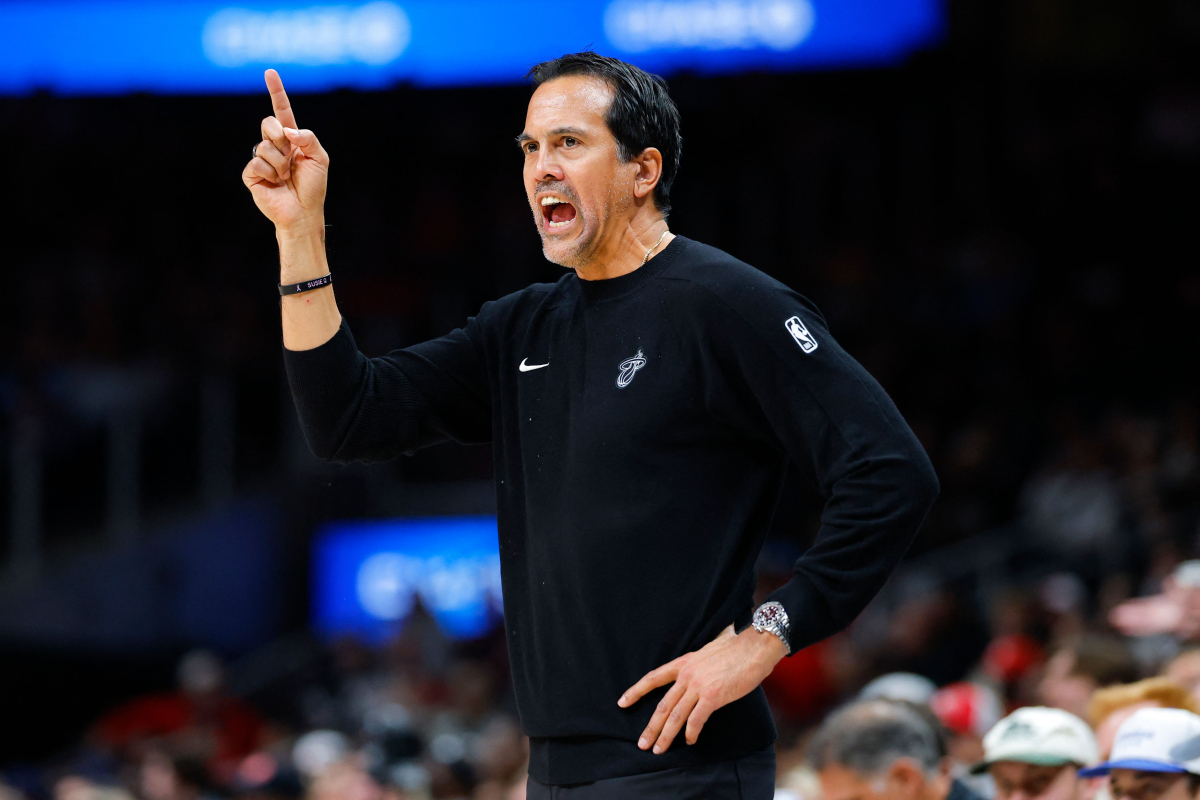
Nearly every modern offense in basketball is built around screens, matchups, and pick-and-roll actions designed to force defensive rotations. However, the Miami Heat are moving in a completely different direction.
Instead of relying on the pick-and-roll, they are building an offense based on pace, space, cutting, and constant decision-making. Their system emphasizes creating chaos before the defense settles rather than running structured plays.
What makes this approach unique is Miami’s attempt to replace the pick-and-roll as their primary advantage creator, rather than simply reducing its frequency.
Rather than forcing rotations with screens, Miami generates advantages through early offense, quick drives, and read-and-react principles.
The goal is simple: attack before the defense can organize, keep the ball moving, and turn every player into a decision-maker.
This style of play results in an offense that appears fast and unpredictable—even chaotic—yet remains anchored by clear principles: 5-out spacing, frequent paint touches, and constant cutting.
Instead of structured plays, Miami relies on rhythm and reactive movement to create open looks and driving lanes.
To understand the magnitude of this shift, one must look at the numbers.
Analyzing the Heat Statistical Shift
Miami is currently running approximately 12 to 15 pick-and-rolls per 100 possessions, accounting for only 5% of its total play types.
Historically, no team has relied less on the pick-and-roll as a primary action.
Even when factoring in both ball handlers and roll men, the action accounts for only seven percent of their offense–a stark contrast to a league where it remains the dominant half-court engine.
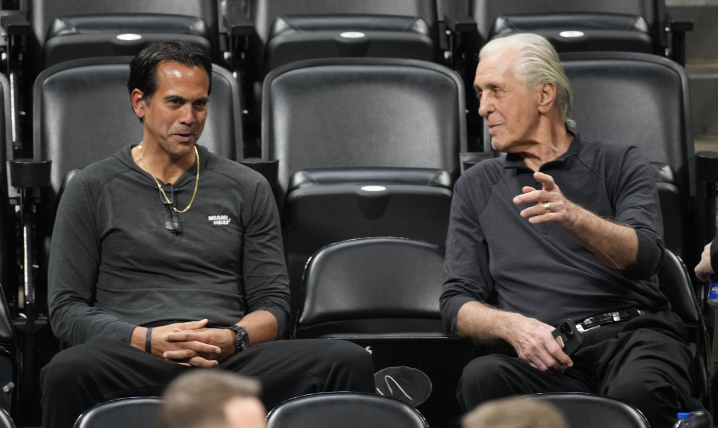
Heat
Credit AP-Scanpix
Instead, Miami’s offensive profile is built around entirely different sources of production.
Spot-up situations account for roughly 34% of their offense, transition nearly 25%, and isolation around 9%, while cuts, offensive rebounds, and putbacks fill in the margins.
Traditional structured elements like post-ups, off-screen actions, and the pick-and-roll serve only as complementary tools rather than foundational actions.
The Mechanics of Heat’s Offense Movement
At the core of this system is a blend of motion offense principles and what can be described as “wheel” actions.
The offense is not organized around set plays, but around reactions to penetration and spacing.
When a player attacks one side of the floor, for example, driving to the right, the entire unit shifts in that direction.
Teammates adjust their positioning dynamically, maintaining spacing while simultaneously moving with the drive. This coordinated movement reduces the effectiveness of help defense and creates clearer one-on-one opportunities.
Rather than forcing rotations through screens, Miami triggers defensive decisions through movement. By utilizing a 5-out alignment, they keep driving lanes open and encourage players to attack gaps aggressively.
Once the initial advantage is created, the offense flows into drive-and-kick sequences, cuts, and secondary attacks.
Off-ball movement becomes just as important as on-ball creation, with players constantly relocating, cutting, and filling open space.
Miami’s Pace and Roster Versatility
Pace is the engine of this system. Miami operates at the league’s fastest tempo, exceeding a historically high 103 possessions per game.
This speed allows them to initiate their offense before the defense settles, often bypassing the need for traditional pick-and-roll actions.
In many cases, the advantage already exists simply because the defense has not yet organized.
From a roster perspective, this approach is both practical and innovative. Lacking a traditional high-level pick-and-roll creator early in the season, Miami leaned into a system that distributes responsibility across the entire roster.
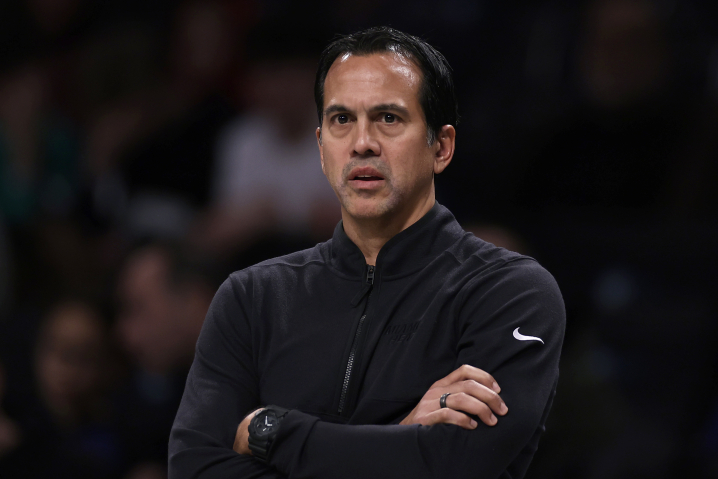
Erik
Credit AP Photo/Adam Hunger – Scanpix
Every player is expected to handle, pass, drive, and make quick decisions. The offense is collective rather than star-dependent.
The Evolution of Bam Adebayo
Another consequence of this shift is evident in the evolution of Bam Adebayo’s role.
In previous seasons, a significant portion of his offensive involvement came as a pick-and-roll screener and roll man. Last season, approximately 18% of his plays originated from pick-and-roll situations, a cornerstone of his offensive identity.
This season, that figure has plummeted to 7%, reflecting a fundamental change in the offensive environment rather than a mere statistical dip.
With Miami utilizing 5-out spacing and increased motion, Adebayo now operates with more freedom in space instead of serving as a primary screener.
The spacing Miami plays with has fundamentally changed how he attacks. Instead of rolling into crowded paint areas after setting screens, he now often starts on the perimeter, attacking closeouts and driving from the top of the key.
In many possessions, he functions less like a traditional center and more like a point-forward initiating the offense.
One of the clearest indicators of this transformation is his three-point shooting volume. Last season, he attempted a career-high 2.8 three-pointers per game.
This season, that volume has nearly doubled to approximately 5.5 attempts per game.
Even though he is shooting 31%, the sheer volume signals a major shift in confidence and philosophy.
Earlier in his career, he rarely attempted shots from deep. Now, perimeter shooting is required to maintain the integrity of Miami’s 5-out spacing.
His willingness to shoot forces opposing centers to leave the paint, which opens driving lanes for guards and wings and allows Miami to maintain its drive-and-kick rhythm.
In many ways, Adebayo may be the player who benefits the most from this new system. Instead of being used primarily as a screener and roll finisher, he is now a spacer, ball mover, decision-maker, and face-up attacker.
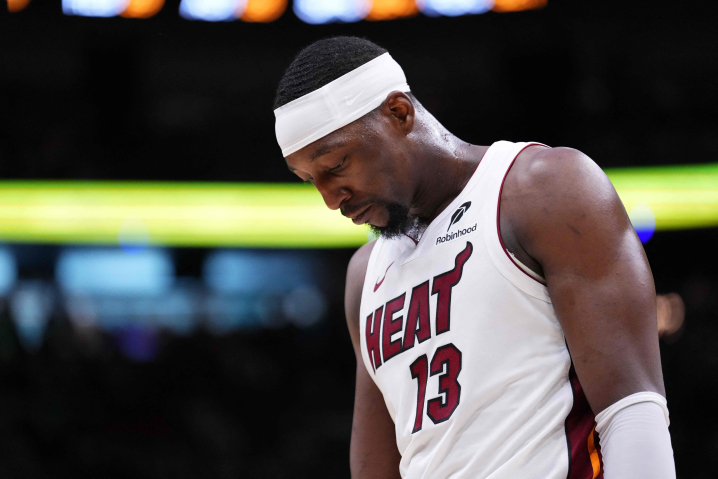
Bam
Credit Getty Images via AFP – Scanpix
Sustainability and the Playoff Challenge
However, the long-term sustainability of this approach remains an open question.
While Miami has shown flashes of brilliance with this system, recent struggles suggest that abandoning the pick-and-roll entirely may lower their ceiling in the half-court.
The pick-and-roll remains the most reliable advantage-creating tool in modern basketball, particularly in playoff environments where pace slows and defenses are more organized.
As a result, the challenge moving forward is not whether Miami can survive without the pick-and-roll, but whether they can balance innovation with enough traditional structure to stabilize the offense when the game slows down.

Vukašin played basketball competitively in his youth, and now contributes to Synergy Sports Technology and Sportradar regarding basketball analysis. He also has experience working as a journalist in Serbia and is passionate about writing basketball articles mainly focused on basketball X’s and O’s.
About author


Thank you for reading us! Help us even more.
If you like our content, please click here and add us as your preferred source. It helps us a lot, and we are committed to delivering you the very latest basketball news.