
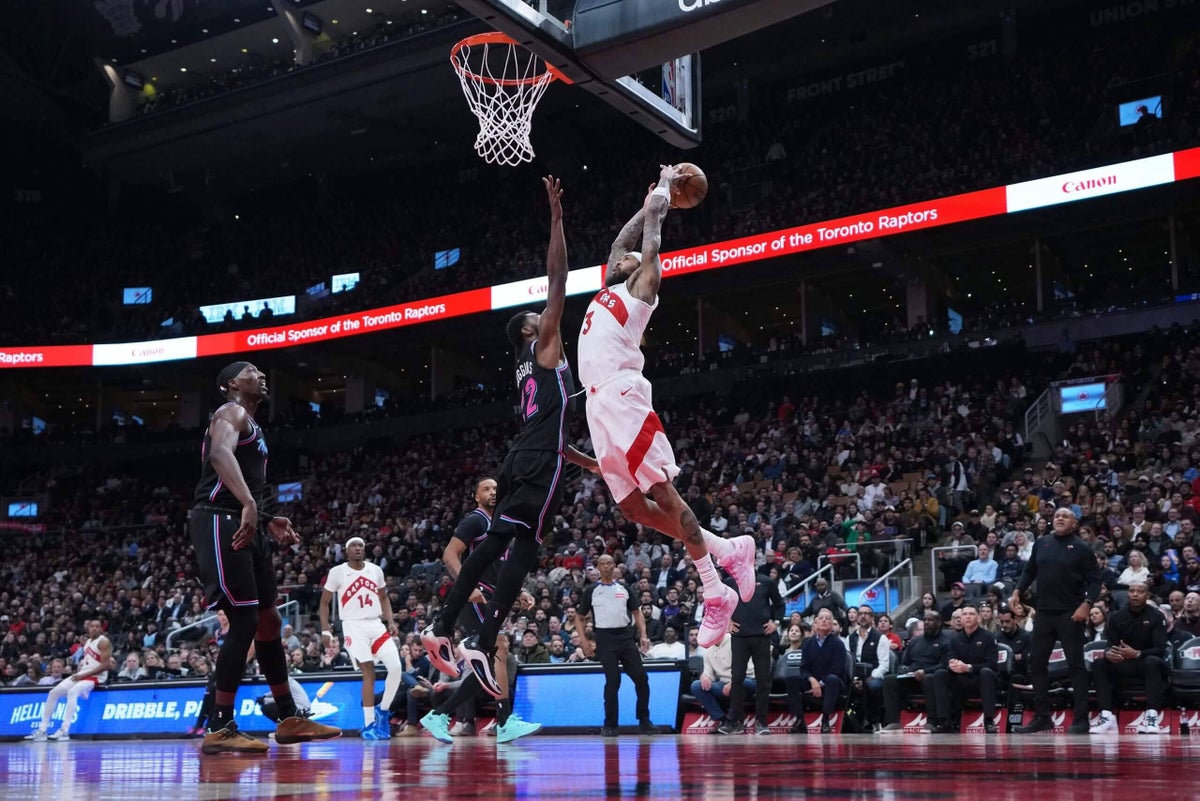
TORONTO — Raptors coach Darko Rajaković loves his espresso, which is perhaps how he has picked up some extra Italian culture. Hard to say. In Europe, it seems as if every country is just a two-hour flight away, so the culture can travel.
“They have a saying in Italy,” Rajaković said before his team’s game against the Miami Heat on Tuesday. “You always wanted to ride a bicycle, and finally you have a bicycle. Now you have to turn the pedals.”
Look, it probably sounds really wise in Italian. Or Serbian. In this metaphor, meaningful April basketball is the bicycle, and the Raptors need to start pedalling. Let’s be real: They have been benefitting from the slope of a friendly hill for a while now, using the momentum provided by a soft early-season schedule to get to a point where they can make the playoffs without needing the pesky Play-In Tournament. They have been cruising, the wind in their hair. Now, they have to push.
In this last week of the season, the Raptors took the first necessary revolutions by beating the Heat 121-95. They play them again Thursday. If they sweep their remaining three games — they’re at the New York Knicks on Friday and home against the Brooklyn Nets on Sunday — they will make the playoffs. One loss and they will need some sort of help, whether from the Houston Rockets against the Philadelphia 76ers on Thursday or something more complicated.
The Raptors pushed off with aplomb Tuesday. Brandon Ingram broke out of a mini-slump, making easy work of Andrew Wiggins and scoring 23 points. Scottie Barnes was the best player on the floor, a bully with the ball and a defensive roadblock. Starting point guard Immanuel Quickley returned from an eight-game absence caused by plantar fasciitis. He is not fully healthy and could be limited to bringing the ball up the floor and spacing in the half-court offence, but the Raptors badly need those things.
But Rajaković was so circumspect about his team because it is so young, in age and postseason experience. The bench hasn’t come together as expected this season, but there are two young players whom Rajaković can rely on in these games. Second-year wing Ja’Kobe Walter is acing the deceptively complicated act of knowing where to be. He can also knock down an open 3, a gift from the heavens for the Raptors.
Better still: Collin Murray-Boyles, a brick-built menace. As a rookie, the undersized big man has been one of the steadiest players on the roster late in the season, with game-changing defensive ability. On one play against the Heat, he blocked a 3 from Wiggins, who is listed at 6 feet 7, and finished on the other end, finding a soft spot in the defence. Without a reliable jumper, he has to rely on his feel to give the Raptors a chance offensively. The other end is no problem. In his first year, Murray-Boyles is nearly as versatile a defender as Barnes is in his fifth — which is to say, as versatile as any player in the league.
“I have utmost respect and trust in that guy,” Rajaković said. “The way he competes, the way he thinks about how to help the team. He’s playing basketball with no agenda. He’s just playing basketball to win. Whatever needs to be done — he’s gonna be guarding wings, he’s gonna be guarding (big men), he’s gonna be rebounding, he’s gonna be running in transition every single time. He does so much for us.”
Like Quickley, Barnes (ribs) and probably others, Murray-Boyles is playing through injury so the Raptors can try to get to the playoffs. He was listed as questionable because of a quad contusion going into Tuesday’s game, and he appeared to wince a few times after collisions. His thumb sprain, which cost him 11 consecutive games recently, is the constant worry.
Murray-Boyles’ game, after all, is based on deflecting passes and disrupting the opposition’s movement.
“I wouldn’t be playing if I (worried about my thumb),” Murray-Boyles said. “That’s my identity: being aggressive, being a defensive pest out there.”
“He changes games,” added Barnes, saying the team’s defence changes when he comes into the game.
It is that defence that defined the Raptors earlier in the season. More recently, mediocrity has defined them. Though there were moments this season when it seemed the Raptors might avoid a dramatic final week, it has felt like a lock for at least six weeks. Part of that is because of the excellent play around them, with the Atlanta Hawks and Charlotte Hornets making huge second-half surges. Part of it is because the Raptors have been thoroughly average since starting the season 14-5.
The Raptors are 30-30 since that start. Before Tuesday’s game, they were outscoring their opponents by 0.8 points per 100 possessions — or 47 total points. Take away their 52-point win over the Orlando Magic in late March and, well, you can do the math. Among the 20 teams heading for the postseason, the Raptors have scored at a better rate than only Orlando and the Portland Trail Blazers. Though Toronto has the No. 10-ranked defence during that stretch, it is only sixth in the East. The Raptors want to be known for their aggressive defence. Since taking care of some mostly bad teams, they have been a bit better than fine.
If you look at the stretch when the Raptors won 13 out of 14 games, it appears less impressive with the benefit of time. More than half of the wins came against teams that will miss the playoffs. They beat the Hawks and Hornets before both teams found their grooves. They won three times against the Cleveland Cavaliers at various stages of health, including once when Cleveland had three of its four All-Stars available. The Raptors also beat the 76ers without Joel Embiid or Paul George.
Since then, there have been flashes, but not sustained stretches, when they have looked dangerous. Fortunately for them, all they need is one excellent week.