
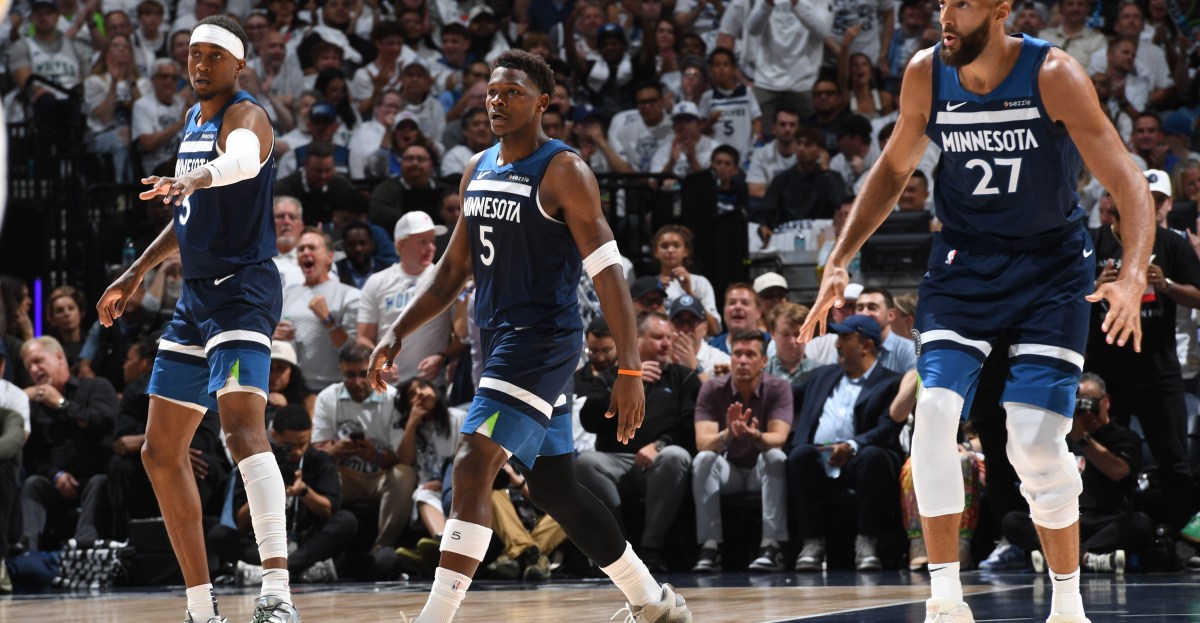
After an 82-game grind that at various points felt like a thriller, a slog, a dark comedy, and a group therapy exercise for everyone invested in Minnesota basketball, the Timberwolves have arrived exactly where they finished a year ago: the Western Conference’s sixth seed. On paper, that sounds almost boring. Same slot, same franchise trying to push through the same door for a third straight spring. But anyone who has watched this team closely knows there is nothing copy-and-paste about the situation the Timberwolves are walking into now.
Last year, the sixth seed felt a little like a gift basket. The Wolves drew a Los Angeles Lakers team that was trying to figure itself out, wrestling with new pieces, lacking real depth, and most importantly, vulnerable to the exact kind of physical, frontcourt-heavy pressure Minnesota wanted to apply. This time around, there is no such soft landing. There is no confused opponent trying to assemble the plane while already in the air. Instead, waiting on the other side is Nikola Jokic, the best player on the planet, and a Denver Nuggets team that looks more stable, deeper, and frankly nastier than the version Minnesota regular-season swept a year ago.
This formidable first-round matchup is the fitting punishment for a team that failed to meet the lofty expectations thrust upon them this season. Minnesota flirted with being a top-tier Western Conference team. They briefly put a hand on the three seed. They spent stretches looking like they might finally seize control of their own destiny. And then, like they did far too many times this season, they let go of the rope.
Now, to be fair, the Wolves did not exactly limp into the postseason in disgrace. They had injuries. They had guys rotating in and out. They had Anthony Edwards and Jaden McDaniels miss time. They had all the usual wear and tear that comes when you’ve gone to the Western Conference Finals two years in a row and are trying to keep a veteran-heavy, expectation-heavy team alive through another 82-game marathon. But they also had too many nights where the problem wasn’t health or fatigue or roster construction. The problem was that they just didn’t show up with enough seriousness.
That is the tension hanging over this series.
Because if you are looking for reasons to believe in Minnesota, there are plenty. This team has been to back-to-back Western Conference Finals. It has playoff scar tissue. It has a real star in Edwards. It has size. It has defensive versatility. It has a deeper roster than this franchise has almost ever had. And perhaps most importantly, it has actual lived experience against Denver. They know what Jokić looks like over a seven-game series. They know what the Denver crowd feels like when things start rolling downhill. They know the physical toll, the emotional swings, and the pressure that comes with a series this massive.
They also know they can beat Denver.
There are only a handful of teams in the league that can say that with a straight face. Minnesota is one of them. They went toe-to-toe with Denver before. They took them seven and lived to tell the tale. They’ve matched up well historically. Even in a season where the Wolves never quite found the same down-the-stretch cohesion they had a year ago, there remains a real belief that this is not some impossible draw. Difficult? Absolutely. Brutal? Without question. But impossible? No.
Still, belief and reality are not always on speaking terms in April.
The reality is that the Nuggets did not spend the past few months standing still. After taking a step back from their 2023 title peak and bowing out in the semifinal round in consecutive postseasons, Denver responded the way smart, motivated contenders usually do: they got sharper. The front office instability and the Mike Malone firing might have created a little drama, but it also pushed the organization to recalibrate. They brought in Cam Johnson and Jonas Valanciunas. They brought back Bruce Brown. This is not a team waiting to be exposed. This is a team that looks like it spent the year quietly taking notes.
That is why the Wolves cannot treat this like 2024’s sequel.
It is not enough to show up and expect that the old script will still work. This is not a series they can win by playing B-plus basketball and hoping Denver blinks first. Minnesota is going to have to be at or near its best. That phrase gets thrown around too loosely in sports writing, but here it actually applies. If the Wolves are going to move on past the first round for a third straight year, and only the fourth time in franchise history, they are going to need the best possible version of themselves. Not the version that sleepwalks through random regular-season Tuesdays. Not the version that gives away fourth quarters like unwanted coupons. Not the version that thinks it can flip the switch in the final five minutes and survive. The real version. The dangerous version. The one that has spent the last two postseasons convincing everyone this franchise is not just a cute story anymore.
And maybe, if you want to search for a silver lining, there is one.
For all the frustration of the final few weeks, for all the injuries and lineup juggling and weird late-season sputtering, the Wolves should be walking into this series relatively fresh. Edwards, Randle, McDaniels, and Gobert have all effectively been on reduced mileage programs over the past two weeks. They are not entering this series like a team that has been redlining into the finish line. Against Denver, where the series is likely to be a bar fight stretched across two weeks, freshness matters. They need their apex Timberwolves.
That is really what this series comes down to. This team has title aspirations, or at least it has been carrying itself like a team that wants to pretend it does. And title aspirations are not just about surviving the first round. They are about proving that beating Denver is not some one-off act of defiance from two years ago, not some piece of franchise folklore that gets dragged out every April like an old VHS tape. It is about showing that the Wolves can still play with championship pressure on their shoulders and not flinch. It is about getting back to the Western Conference Finals and, for the first time in franchise history, pushing beyond it.
That is the challenge. That is the opportunity. And that is why this series feels so massive.
Because if you strip away the standings drama, the regular-season wobbling, the what-if games they donated over the winter, and the endless debates over seeding, this is where the season was always headed. Toward a real opponent, a real test, and a real answer. Can the Wolves finally take all of that talent, all of that postseason experience, all of that maddeningly inconsistent regular-season potential, and turn it into four wins against the best player in basketball and a team built to maximize him?
And with that in mind, here is what has to happen for the Timberwolves’ core players if Minnesota is going to survive this first-round war and keep the bigger dream alive.
Anthony Edwards: The Series Has to Bend to Him
If the Timberwolves are going to beat Denver, it starts with Anthony Edwards playing like the best player in the series.
That is a huge ask when Nikola Jokic exists. It is also the reality.
Hopefully this week off has done for Ant what it looked like it desperately needed to do, which is get his body right, get his legs back under him, and get him back to looking like the version of himself that can tilt an entire playoff series with force, shot-making, and swagger. But, and this is the key part, it cannot be empty-calorie hero ball.
That is the trap with Ant sometimes, and it is a trap that feels especially tempting in a series like this, where the stakes are high, the opponent is elite, and your star naturally wants to grab the game by the throat. There will absolutely be moments where that is needed. Late clock. Final two minutes. Series swinging in the balance. Of course you want Anthony Edwards taking those shots. He has proven over and over again that he can hit the dagger, that he can rise into a jumper with two defenders draped all over him and somehow make it feel inevitable. Those moments are his. That is part of what makes him special.
But for the other 47 minutes and 30 seconds, this has to be a series where Ant operates within the flow of the offense and uses his gravity like the superpower that it is. Denver is going to load up on him. They are going to try to wall off driving lanes and force him into difficult, high-degree-of-difficulty jumpers. The counter to that is not just to take even harder shots and try to out-alpha the problem. The counter is to weaponize everything, the three ball, the mid-range, and the downhill attacks. But also the playmaking. He needs to be the guy who doesn’t just score 32, but who creates six or seven other baskets because Denver is so terrified of him getting to his spots.
It has been joked about for years now that Anthony Edwards is secretly Michael Jordan’s son. Cute joke. Fun meme. But if there is ever a time to lean fully into the MJ mythology, the killer instinct, the refusal to blink, the sense that the moment belongs to you because you said so, this is it.
The Wolves do not need Ant to impersonate Jordan stylistically. They need him to channel that mentality, that ruthless understanding that great teams do not advance because their best player had a nice statistical series. They advance because their best player imposed his will on everything around him.
There may not be a more polarizing player on this roster than Julius Randle, and honestly, that is pretty understandable. When you are the main incoming piece in the trade that shipped out Karl-Anthony Towns, a franchise pillar and beloved player, you are never walking into a neutral room.
The tricky part with Randle is that his game almost invites that emotional volatility. When he is bad, he is loudly bad. The ball sticks. The offense bogs down. He dribbles the air out of the possession, lowers his shoulder into traffic, and suddenly you are staring at a forced miss or a live-ball turnover while everyone else stands around watching. Defensively, he can drift. He can have possessions where he looks fully engaged followed by possessions where he appears to be operating under the assumption that someone else will handle it.
That is the frustrating version. The one that makes you yell at your television and start fantasizing about alternate trade constructions.
But when Julius is right, when he is locked in and forceful and fully engaged, he becomes one of the most valuable players on the team because he gives Minnesota something very few guys on the roster can: self-created offense with real force behind it.
Against Denver, there is real value in having a player who can bully his way into the paint, who can create a decent look out of a broken possession, and who can absorb contact and still finish. The Wolves are going to need that bruising version of Julius. Because this is not a finesse series. This is not a spread-you-out-and-jack-40-threes series. This is a weight-bearing series. A leverage series. A series where size and force have to matter.
Even that is not the full version of what Minnesota needs. Because the best playoff Julius is not just the bully-ball Julius. It is also the facilitator Julius.
It is the version who draws two defenders into the lane, keeps his head up, and sprays the ball out to open shooters instead of forcing some impossible interior contortion act. The Wolves need him reading the floor, finding cutters, kicking out to Ant, Dante, Jaden, and everybody else when the defense loads up. When Randle is doing that, both scoring and orchestrating, the offense takes on a completely different shape.
Minnesota also needs him to be credible from three. When he takes those shots, they need to matter. They need to go in often enough to punish Denver for cheating off him. They need to keep the spacing real. If Randle is bricking wide-open threes and drifting through defensive possessions, this gets ugly. If he is knocking them down efficiently and playing engaged basketball on both ends, this gets a whole lot more manageable.
We have already seen what playoff Julius can look like when everything is aligned. Last year against the Lakers and Warriors, he was a player who didn’t just support the stars but occasionally looked like one himself. That version changed the geometry of the floor.
The Wolves need that guy again.
No player on the Wolves has drawn a more difficult, more essential, or more exhausting first-round assignment than Rudy Gobert.
Rudy is the center of gravity here because Jokic is the center of gravity over there. That is the matchup. That is the series. Everything else branches off from that central problem.
Gobert is the only player on Minnesota’s roster with the size, discipline, and defensive instincts to take the first punch from Jokic and keep getting back up. That does not mean he will stop him. Nobody stops him. Rudy’s purpose is to make every decision harder, every pass a beat slower, every look a little more annoying, every rebound a little more physical.
We saw these two go to war in the 2024 semifinals, and yes, Gobert did not do it alone. He had Karl-Anthony Towns. He had Naz Reid. He had wave after wave of bodies helping wear Jokic down. That will be true again here. This is going to take all three of Minnesota’s bigs, maybe even more if foul trouble becomes a thing. But Rudy is still the center of the strategy.
To do that, Gobert has to be both aggressive and smart. The Wolves cannot afford foul-trouble Rudy. They cannot afford the version that gets baited into cheap whistles or overcommits on a possession and suddenly finds himself on the bench while Jokic takes a breather from the hardest part of his night. Rudy has to pick his spots. He has to stay disciplined.
He also has to dominate the glass.
Denver cannot be allowed to feast on second chances. The Wolves cannot survive a series where they defend for 18 or 20 solid seconds and then let Jokic or Valanciunas or some cutting wing grab the rebound and restart the torture chamber. Gobert has to be there cleaning everything up, ending possessions, denying extra life, and making Minnesota’s defense feel finished rather than unfinished.
Then there is the offensive side, which matters more than people like to admit.
The Wolves need high-efficiency Rudy. They need the version who catches lobs cleanly, who has ready hands in traffic, who puts back misses, who punishes Denver when they rotate too aggressively toward Ant or Randle. Against a team as smart as Denver, wasted easy points become haunting points. Gobert has to make Denver pay when they concede space behind the play.
When Rudy is truly locked in, he is not just a rim deterrent. He is a possession finisher. He keeps the defense anchored and the offense moving. He makes the Wolves feel bigger, meaner, more stable. We saw it in Game 5 against the Lakers last year, when he more or less reached into that series and pulled the Lakers’ soul out through their rib cage. The Wolves need that version of him now more than ever.
Defensively, McDaniels’ assignment is about as serious as it gets. He’s going to spend long stretches chasing Jamal Murray and trying to disrupt the rhythm of one of the most dangerous playoff guards in basketball. He’ll also have his hands full at times with players like Cam Johnson and Bruce Brown.
But here’s the part that matters just as much: offense.
The Wolves don’t need Corner-Spectator McDaniels. They need the aggressive version, the one who attacks closeouts, gets downhill, and lives in that deadly mid-range/paint area where he’s quietly one of the most efficient players on the roster. When McDaniels is scoring 15–18 points on high-percentage looks, the offense unlocks.
This has to be a two-way series for Jaden. If he brings both ends, the defensive menace and the opportunistic scorer, he becomes the kind of player Denver has to account for on every possession. That’s when things start to tilt.
You already know what you’re getting from Donte in terms of effort. That’s not the question. He’s going to dive on the floor, chase loose balls, and generally play like a guy who thinks every possession is a schoolyard brawl. That part is locked in.
What isn’t always locked in, and what will define his impact in this series, is the shooting.
This Wolves team, for better or worse, is still heavily tied to the three-point line. When the shots fall, they look borderline unstoppable. When they don’t, things fall apart…. quickly. Donte sits right in the middle of that equation. He’s one of the purest shooters on the roster, but he’s also prone to the kind of streakiness that can swing a game, or a series, in either direction.
Minnesota doesn’t need him to go nuclear every night, but they do need consistency. If Donte can hit at a high clip, punish rotations, and make Denver pay for helping off him, he becomes the kind of connective piece that keeps the offense humming. If he goes cold for long stretches, it puts even more pressure on Ant and Randle to manufacture everything.
The Wolves spent most of the season trying to solve their point guard situation like it was a puzzle missing two or three pieces. Then Tim Connelly swooped in at the deadline and brought in Ayo Dosunmu, giving the team something it had been lacking: juice.
Ayo changes the tempo. He gets the Wolves out of half-court mud and into transition opportunities where things are simpler and cleaner. His ability to speed things up is incredibly valuable.
And then there’s the sneaky part: the shooting. He’s not a volume bomber, but he’s absurdly efficient when he does let it fly. If Ayo is knocking down open threes, he becomes a real problem because now you have to guard him honestly, and once that happens, his driving lanes open up, his playmaking improves, and suddenly he’s dictating possessions instead of just participating in them.
He doesn’t have to be the star of the series. But if he consistently tilts the pace and hits timely shots, he would instantly put his name in the running for the best trade deadline acquisition of the season.
Naz Reid is the definition of a “what version are we getting tonight?” player, and in a series like this, that unpredictability can either be a problem or a weapon.
At his best, Naz is a nightmare matchup. He stretches the floor. He can score inside and out. He brings energy off the bench that changes the feel of the game. And most importantly, he gives the Wolves a third big body to throw at Jokic, which is absolutely essential over the course of a seven-game series.
At his worst, especially when the shoulder has been bothering him, he can look a step slow, a little out of rhythm, and not quite the same offensive spark.
Minnesota needs the good version. The one who is nailing threes, who’s finishing through contact, and who’s spacing the floor and forcing Denver’s bigs to make decisions.
Every playoff series has a moment, or two, or three, where things get weird. Shots aren’t falling. The offense stalls. Nobody can generate anything clean. And that’s when a guy like Bones Hyland becomes incredibly valuable.
He can come in, hit three shots in 90 seconds, and completely flip the energy of a game. He can attack the rim, pull up from deep, and play with the kind of fearless aggression that doesn’t always make sense but sometimes is exactly what you need. He’s not going to be consistent every night. That’s not his role. But if he gives you two or three explosive scoring bursts over the course of this series, that could absolutely swing a game.
In a matchup this tight, one stolen game can change everything.
Two years ago, Mike Conley was the steady hand guiding this team through one of the most emotional series in franchise history. This time around, his role is going to be much smaller, maybe even sporadic.
That doesn’t mean it’s unimportant.
If Conley sees the floor, it’s because the Wolves need calm. They need organization. They need someone to slow things down and make sure the offense doesn’t spiral into chaos. Even if he doesn’t play much, his presence still matters. Leadership in the playoffs isn’t always about minutes. Sometimes it’s about making sure the guys who are playing don’t lose the plot.
If there was one guy who used the final week of the regular season to bang on the door and demand attention, it was Terrence Shannon Jr.
Thirty-three against Orlando. Another 20+ against Houston. Suddenly, the flashes we’d been waiting for all season started to look a lot more real. Shannon brings something this team doesn’t have a ton of: straight-line speed, downhill pressure, and a willingness to attack the rim without overthinking it.
Will he have a big role in this series? Maybe not.
But if foul trouble hits, or if the Wolves need a jolt of energy, or if someone simply isn’t bringing it, Shannon has at least put himself in the conversation as a guy who can step in and give you real minutes.
All season long, Jaylen’s role has fluctuated, but what Clark brings is something you can’t really manufacture: instinctive, disruptive, borderline annoying defense. He’s the kind of guy who can come in cold and immediately pick up full court, blow up a dribble handoff, or turn a routine possession into a fast-break in the other direction.
And in a series against a player like Jamal Murray, having a defensive wildcard matters.
Clark may not be part of the primary rotation, but don’t be surprised if there are moments where Murray strings together a few buckets, the Wolves need a different look, and Finch reaches down the bench and says, “Go bother him for a few minutes.” That’s Clark’s lane. He’s not there to score 15. He’s there to disrupt, to inject energy, and to give Minnesota a defensive gear they don’t otherwise have.
Every playoff series has that moment where your depth gets tested in a way you didn’t plan for. A couple quick fouls, someone tweaks something mid-game, and suddenly you’re looking down the bench…
That’s where Joan Beringer comes in.
He’s not expected to play meaningful minutes in a perfect-world scenario. But against a team like Denver, where Nikola Jokic has a habit of dragging bigs into foul trouble and physically wearing teams down, having another capable body matters more than you’d think.
Beringer gives you size. He can soak up a few minutes, contest a couple shots, grab a rebound or two, and just… survive a stretch. Think of him as the “break glass in case of emergency” option. You don’t plan around him, but if the moment calls for it, having that extra layer of depth could quietly save you in a game that hangs in the balance.
Now it’s time for a little Chris Finch discourse.
On one hand, it’s fair to say this team underachieved relative to its talent. You don’t go to back-to-back Western Conference Finals and expect finishing sixth to feel like a clean success. There were too many nights where the effort wasn’t there. Too many games where they played with their food. Too many collapses that turned wins into head-scratching losses.
Some of that is on the players. Some of that is on the coach.
But zoom out for a second. Finch is still, by basically every meaningful measure, the best coach this franchise has ever had. He’s taken them further, more consistently, than anyone before him. That matters.
Now comes the part where he has to level up again.
Playoff coaching is different. It’s about adjustments. It’s about recognizing when things are slipping and calling that timeout before the avalanche hits. It’s about rotations, matchups, counters, and making sure your team doesn’t fall back into the bad habits that haunted them in January and February.
Finch has the pieces. Now he has to put them together in a way that gets the absolute best version of this team onto the floor for as many of these next seven games as possible.
That’s a long list of names. A long list of expectations. And honestly, when you step back and look at it, you can make a pretty strong case that this is the deepest, most versatile roster this franchise has ever rolled into a playoff series with. Top to bottom, in terms of guys who can swing a game on a given night? This might be the one.
And that’s what makes this whole thing so fascinating… and, if we’re being honest, so maddening.
Because we’ve seen it. Over 82 games, we’ve seen the version of this team that looks like a legitimate contender, the one that locks in defensively, moves the ball, hits threes at a respectable clip, and suddenly turns into a serious problem for the team in the opposing jerseys. We’ve also seen the other version. The one that sleepwalks through a Tuesday night, blows a fourth-quarter lead, or spends three possessions in a row dribbling into bad shots like they’re trying to speedrun a collapse.
That’s the push and pull of this entire season. The reason it’s felt like a roller coaster instead of a coronation.
But here’s the thing: none of that matters anymore.
This is the part of the season where reputations get made or rewritten. Where you either prove what you are… or you don’t.
There are no more dress rehearsals. No more “we’ll figure it out.” No more blaming the schedule, or injuries, or chemistry, or whatever excuse you want to reach for. This is it. This is the moment this team has been building toward since they walked off the floor in Oklahoma City last May.
The opponent isn’t exactly a soft landing.
Denver brings the best player on the planet, a team with championship pedigree, and a roster that’s been sharpened specifically for this kind of fight. There’s no easing into this postseason. It’s straight into the deep end.
But here’s the flip side, and it’s the part that should give Wolves fans just enough irrational confidence to talk themselves into this thing: Minnesota knows this team. They’ve been here before. They’ve stood toe-to-toe with this group and survived. They’ve proven that they can beat this opponent in a playoff setting.
So now it comes down to something simple, even if it’s not easy: Can they be the best version of themselves, four times in seven games? Can they string together the defensive intensity, the offensive flow, the composure, the shot-making, all the things we’ve seen in flashes, and actually sustain it when it matters most?
They have to lean into what they are at their peak. They have to become what they’ve teased all season long.
Not the team that shows up for three quarters. Not the team that waits for someone else to close. Not the team that plays with its food.
The one that hunts. The one that finishes. The one that leaves no doubt.
Because the potential is there. We’ve all seen it.
Now it’s time to prove it.