
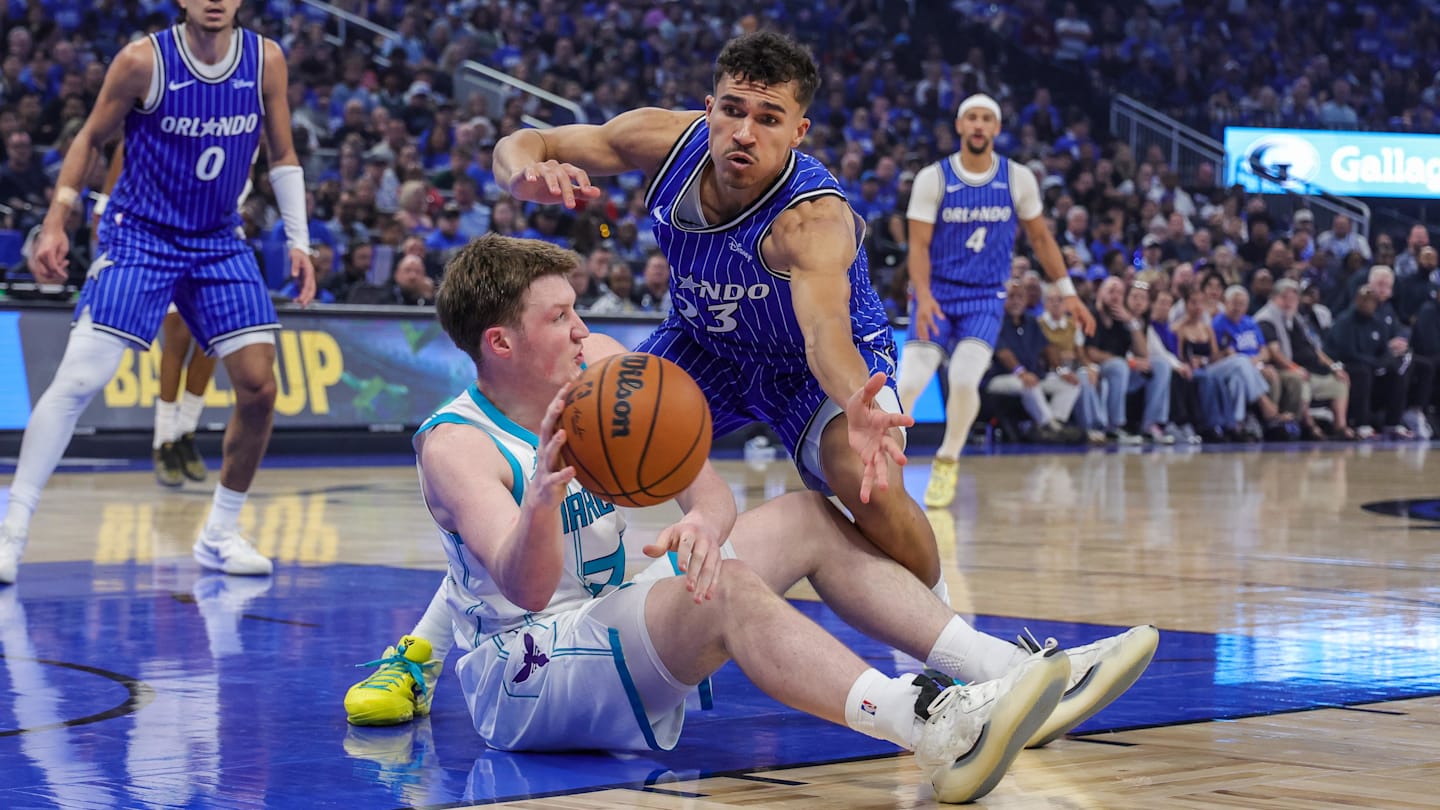
Well, that wasn’t the storybook ending people have in mind when they think about Orlando.
The Charlotte Hornets‘ season is officially over, ending at the hands of Paolo Banchero and the Orlando Magic in yet another Play-In Tournament drubbing. Charlotte was punched in the mouth early by Orlando’s physical brand of basketball, offering minimal resistance to the Magic’s relentless pressure on both ends of the floor.
Charlotte dug themselves an insurmountable first half hole, and despite a second half flurry from LaMelo Ball, the roller coaster ride that was the 2025-26 season came to its final stop at the Most Magical Place on Earth.
The franchise has been here before. Tonight’s game was reminscent of Charlotte’s 2021 Play-In loss to Indiana (144-117) and their 2022 Play-In loss to Atlanta (132-103). Although they’ve been in this exact scenario before, licking their wounds after getting dismantled by a more veteran-laden team on a big stage, things do feel different for this group of Charlotte Hornets.
It starts with ownership. Rick Schnall and Gabe Plotkin have clearly stated their goal of turning the Charlotte Hornets into one of the premiere franchises in the NBA, and the investements their group has made in terms of organizational infrastructure from top to bottom are noticable steps up the ladder towards that goal.
For example, LaMelo Ball and Brandon Miller combined to play 137 games this season. That doesn’t happen without the complete overhaul of the training staff that Schnall and Plotkin oversaw this summer. Charlotte is set to open a state-of-the-art practice facility sometime next season which will mark a big step forward in the franchise’s growth on that front.
The two men they have hired to lead the day-to-day directon of the franchise, Charles Lee and Jeff Peterson, have been nothing short of fantastic.
Lee and his staff have drastically improved the Hornets’ on-court product. The jump Charlotte made from 2024-25 to 2025-26 can be chalked up to health on some level, but Lee has also done a masterful job at putting his players in positions to succeed all season long. The Hornets have made a strong committment to player development, and the growth from Ball, Miller, and Moussa Diabate, and the instant successes of Kon Knueppel, Sion James, and Ryan Kalkbrenner, is a feather in the cap of Charlotte’s coaching staff.
Peterson has proven to be a master of the margins — he’s not afraid to shake up the bottom of his roster in an attempt to extract value from every transaction. The transaction tree rooted in Cody Martin and Vasa Micic that sprouted the trade for Coby White was a multi-year masterstroke of asset management that Peterson has been rightfully praised for.
Charlotte’s lead decision-maker has completely flipped the roster in a two-year span, developing the Hornets into one of the league’s most-talented young teams that still possesses a treasure trove of future draft capital.
Which brings us to the final difference in these Hornets compared to previous iterations of the franchise: the young talent in the building.
LaMelo Ball made a legitimate case to be named to one of the league’s three All-NBA teams. Brandon Miller took a major leap in year three, proving the sky is the limit for him with a full offseason in the gym. Kon Knueppel could be named the NBA’s Rookie of the Year in just a matter of weeks.
At 4-14, the Hornets season was hurtling towards one of its other familiar ends: the top-end of the lottery, wishing on a ping pong ball to deliver a top-end prospect to the Queen City.
At 43-39, the Hornets now have the chance to build on a foundation that was among the league’s best in the last four months of basketball.
The building blocks are in place. Jeff Peterson’s “push the chips in” comment in an episode of Reel Access was stuck on replay in the mind’s of fans all season, but now, for the first time in forever, the cards are good enough to do so.
Subscribe to our FREE Newsletter for the latest news and updates on the Charlotte Hornets
 Add us as a preferred source on GoogleFollow