
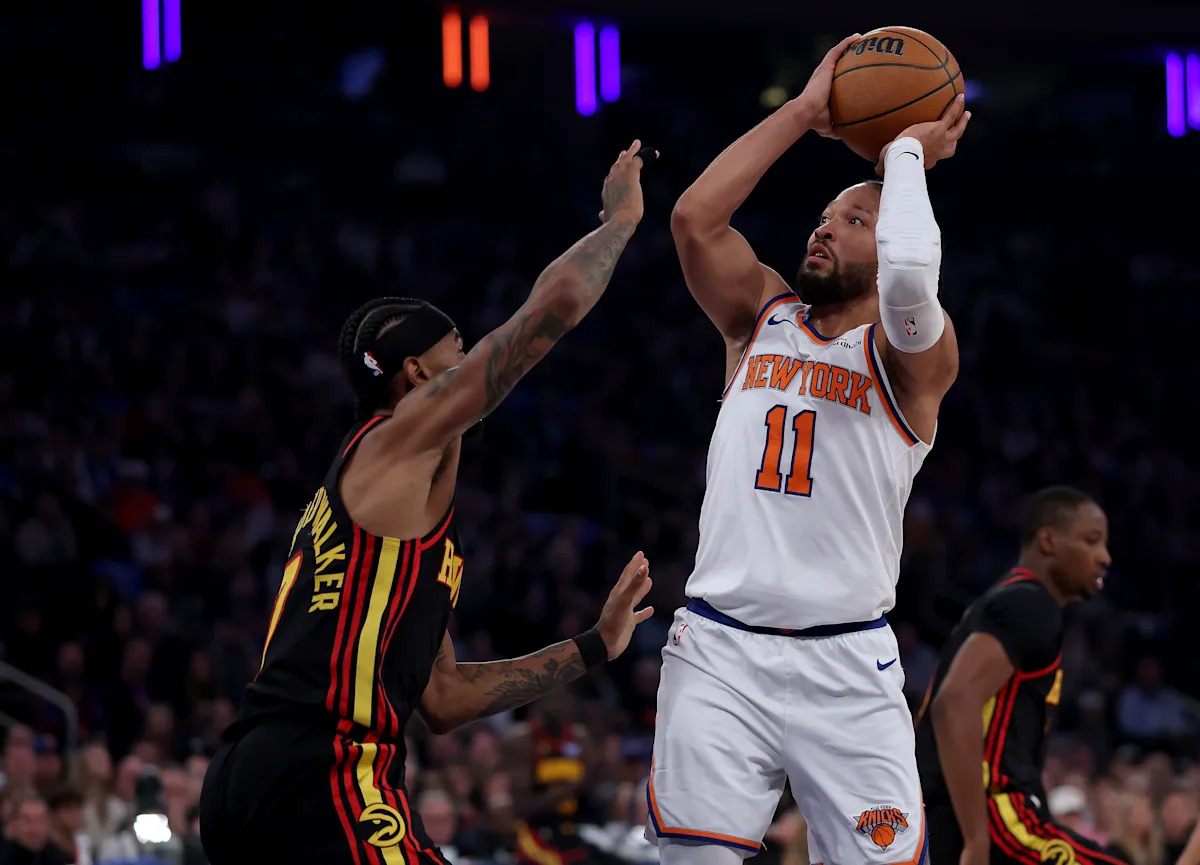
The 206 NBA playoffs opened Saturday with four games: Raptors-Cavaliers; Timberwolves-Nuggets; Hawks-Knicks; and Rockets-Lakers. We’ll break down the key takeaways from each Game 1 as they finish.
Jalen Brunson was ready to party
New York’s All-Star point guard made his presence felt early, opening his account by cutting backdoor for a layup off a nice high-low feed from Karl-Anthony Towns just 89 seconds into Game 1. He didn’t look back from there, making his first six shots from the field and scorching his way to 19 points in the opening frame — two shy of the highest-scoring quarter of his postseason career.
Brunson would cool down from there, making just one field goal over the final free quarters as he fought through layers of physical defense from multiple Hawks perimeter defenders, and coming up empty late on several attempts to deliver his now-customary crunch-time knockout blow. But he continued to act as the tip of the spear of New York’s offense, finishing with 28 points on 9-for-22 shooting and dishing seven assists against two turnovers in 36 minutes, as he paced a Knicks attack that scored enough to get across the finish line on a Hawks defense that had been the NBA’s fourth-stingiest since the trade deadline — thanks, in part, to Brunson getting them off on the right foot.
Advertisement
KAT gets out of the bag
After he’d averaged 28.5 points per game on 63% shooting against Atlanta during the regular season, how the Hawks would defend Karl-Anthony Towns loomed as one of the series’ most interesting tactical questions. For the most part, head coach Quin Snyder elected to play it straight, with center Onyeka Okongwu defending the Knicks’ All-Star big man.
New York responded by dialing up the Brunson-Towns pick-and-roll and by running offense through Towns as a playmaking hub at the top of the key, allowing him to try to pick out cutters over the top of the Atlanta defense. But while he was able to find a few teammates, delivering three assists in the first half, he didn’t create much of his own offense, scoring just five points on 1-for-6 shooting through two quarters, and struggling at times to create space and good looks against Okongwu.
After intermission, though, Towns got unstuck.
Towns used his pump-and-drive game to get past Okongwu and backup center Mouhamed Gueye on the perimeter, get into the paint, draw fouls and finish, helping New York extend its lead. He cranked up his play on the defensive end, using his size and timing to block a pair of shots and help limit Atlanta to just 41.9% shooting in the second half. And with the Knicks up 16 with just under five minutes to go, he took an inbounds save from a diving Brunson and delivered one of those flick-of-the-wrist bombs that have made him one of the league’s premier shooting big men for years:
It was an impressive close to an impressive postseason opener for Towns, who finished with 25 points on 6-for-13 shooting, 8 rebounds, 4 assists, 3 blocks and a steal in 33 minutes — the kind of two-way production that he’s chipped in through what’s quietly been an excellent all-around season for the oft-maligned big man, and precisely what New York needs to get where it wants to go as spring turns to summer.
Advertisement
Lacking in depth
The Hawks’ post-Trae Young-trade starting lineup — Okongwu, All-Star forward Jalen Johnson, Most Improved Player candidate Nickeil Alexander-Walker, defensive dynamo Dyson Daniels and veteran scorer CJ McCollum — was one of the best five-man units in the NBA this season, and it largely held up its end of the bargain in Game 1. McCollum — who frequently attacked Brunson and Towns, trying to force the Knicks’ offensive stars to work on the other end — scored a team-high 26 points on 50% shooting. Johnson struggled in his maiden postseason voyage as a No. 1 option — and particularly the defense of Josh Hart — missing 11 of his 19 shots, but he still grinded his way to 23 points in 39 minutes.
While battling Towns, Okongwu still added 19 points, drilling four 3s. And while Daniels — often guarded by Towns, as the Knicks cross-matched their big man onto a non-threatening shooter to try to gum up the works of the Atlanta offense — only scored four points on 2-for-7 shooting, he found other ways to make an impact: 11 assists, nine rebounds and three steals in his 36 minutes.
Everything to know for the NBA playoffs: Predictions, series previews, X-factors
Advertisement
When Snyder went to his bench, though, he found precious little. Midseason addition Jonathan Kuminga scored eight points in 27 minutes. Gueye and veteran Gabe Vincent combined for just five points. Snyder gave former No. 1 pick Zaccharie Risacher a look late in the first quarter; he grabbed four rebounds, but he missed three shots and fouled Brunson in a two-and-a-half-minute stint during which the Hawks were outscored by five points. He wouldn’t see the court again.
New York, on the other hand, got a lift from its second unit. Brown rolled out lineups without either Brunson or Towns to start the second and fourth quarters, and got positive contributions from the likes of Mitchell Robinson and Landry Shamet. Deuce McBride struggled early, but made a pair of big 3s late; Jordan Clarkson continued his second-half surge, chipping in eight points, a pair of offensive rebounds and some physical defense.
The Hawks’ frontline can go toe-to-toe with New York’s starters. If Snyder can’t find a way to get more out of his reserve corps, though, the Hawks just might not have enough firepower to stick it out in this series.
Nuggets recover from early struggles
Through one quarter Saturday, Nikola Jokić had as many turnovers (three) as points. Rudy Gobert and Minnesota’s defense flustered the Nuggets and their three-time MVP center, limiting Denver to 27.3% shooting and forcing six turnovers en route to a 33-23 lead.
Advertisement
Aaron Gordon picked up his third foul on offense late in the quarter and went to the bench, leaving the Nuggets without a key to the NBA’s most efficient offense.
But the Nuggets weathered the early storm after six days off. Spencer Jones, who was a game-time decision after missing the last six games of the regular season with a hamstring strain, gave the Nuggets a boost off the bench with five straight points, including a 3-pointer. Jamal Murray was perfect at the line in 11 first-half attempts. And Denver’s offense found its rhythm from the field, particularly from 3. By halftime, the Nuggets were shooting 44.7% from the field and 47.4% (9 of 19) from 3.
Murray had 17 points at halftime while Cameron Johnson (4 of 7, 2 of 5 from 3) was Denver’s most reliable weapon from the field.
Jokić, Gordon step up after halftime
The Nuggets made a concerted effort to get Jokić involved early in the third quarter. He attacked Gobert on the first possession of the half and got a layup off his own miss. Three possessions later, he pump-faked Gobert from the top of the key and drove past him for an uncontested layup.
Advertisement
Gordon, meanwhile, was off his foul-induced minutes restriction and became the aggressor in the third quarter. He hit a 3 to extend Denver’s lead to 75-68 midway through the period. He then scored a put-back dunk to cap 14-0 run and send the Denver crowd into a frenzy.
The dunk extended Denver’s lead to 82-68, and the Nuggets were in control. They took a 91-79 lead into the fourth quarter.
Minnesota ensured that the Nuggets didn’t run away with the win. The Timberwolves cut their deficit to 97-95 midway through the fourth quarter. But Jokić’ reeled off a personal 5-0 run, including an and-1 layup past Gobert to help the Nuggets again persevere.
Denver maintained control from there despite shooting 1 of 17 from 3 after halftime. But the Nuggets did go 30 of 33 at the line, with Murray hitting all 16 of his free-throw attempts while shooting 0 of 8 from the 3-point line.
Advertisement
Jokić tallied 25 points, 13 rebounds and 11 assists. He finished with five turnovers after committing four in the first half. Murray led the Nuggets with 30 points and 7 assists, and Gordon posted 17 points and 8 rebounds after scoring 5 in the first half.
Anthony Edwards looked fine
Anthony Edwards’ status for the Timberwolves wasn’t certain until game-time. He was initially listed as questionable with a lingering knee injury that sidelined him late in the regular season.
He wasn’t efficient from the field while tallying 22 points, 9 rebounds and 7 assists on 7 of 19 shooting. But he was aggressive and didn’t appear to have any limitations. How he continues to play on his ailing knee will be key to Minnesota’s hopes of tying the series in Game 2 Monday night.
Advertisement
— Jason Owens
Cavaliers 126, Raptors 113Cavs owned the paint
The Cavs were brilliant at all three levels, but it was their dominance near the rim that created the biggest advantage in Saturday’s victory. Cleveland scored 48 points in the paint, generating high-percentage attempts off James Harden‘s pick-and-roll operation and Donovan Mitchell‘s unrelenting drives. Toronto, meanwhile, managed 30 points in the paint — a workable number in isolation, but a losing number when the team on the other side is getting to the rim that freely.
The Raptors’ first dunk as a team didn’t come until Scottie Barnes converted one midway through the fourth quarter, by which point the game was effectively over. Sandro Mamukelashvili led the Raptors in rebounding, signaling a major issue if they want to keep up in this series. Jakob Poeltl was a no-show (4 points, 6 rebounds) for Toronto, while Evan Mobley and Jarrett Allen combined for 27 points and 14 rebounds, shooting 9 for 13 from the paint. Brandon Ingram was elite in the mid-range in the first half, but when Cleveland is getting that many clean looks at the rim while you’re settling for contested mid-range attempts, you’re playing into their hands.
Advertisement
Cavs’ bench closes out the game
Cleveland outscored the Raptors 36-22 in the frame and pushed the lead to 21 entering the fourth. Mitchell scored nine of his 30 points in the period. Then Max Strus got loose. He scored eight of his 22 points (8-10 FG, 4-6 3PM) in the third quarter, providing a game-changing momentum boost in the third. And that’s where the game started to separate itself.
Cleveland’s depth was far too much for Toronto. Both squads went deep into their rotations — the Cavs went with 10, while the Raptors ran nine. However, the Cavaliers’ bench outscored the Raptors’ 36-20 before garbage time, led by Strus. Cleveland was one of six teams in the league this season to utilize 40-plus lineups, and while rotations typically tighten in the playoffs, its depth is a genuine weapon rather than a byproduct of regular-season experimentation. The Cavs’ plug-and-play scheme could prove to be a leverage point in this series, especially with Raptors point guard Immanuel Quickley injured.
What’s next?
For the Raptors, the 18 turnovers are the most urgent and fixable issue. Cleveland turned them into 22 points, which alone made up the final margin. Ball security in Game 2 is non-negotiable. Toronto led the league in fast-break points this season, but managed just one on Saturday. To have a chance, the Raptors must push the pace before Cleveland sets its defense and weaponizes transition to neutralize Mobley and Allen without fouling.
Advertisement
The 3-point shooting was there (48% on 27 attempts), proving the offense can click when the ball moves. They need Quickley back healthy to run at full speed and more from their bigs. Toronto showed real fight in the first half. Its path back in the series is clear: Make better decisions, play faster and get more production from the frontcourt. Ingram needs to step up. After a strong first half, he scored four points (0-1 FG, 4-4 FT) in the second half. Inexcusable.
For the Cavaliers, they need to keep pounding the paint. There’s no reason to change that approach. Harden set the tone early and having six Cavs score in double figures with Mitchell going for his usual 30-piece is Cleveland at its best. Its depth allows it to match any Toronto lineup. If the Cavs keep Toronto a jump-shooting team rather than one that feeds off defense and transition, this could be a quick series.
— Dan Titus