
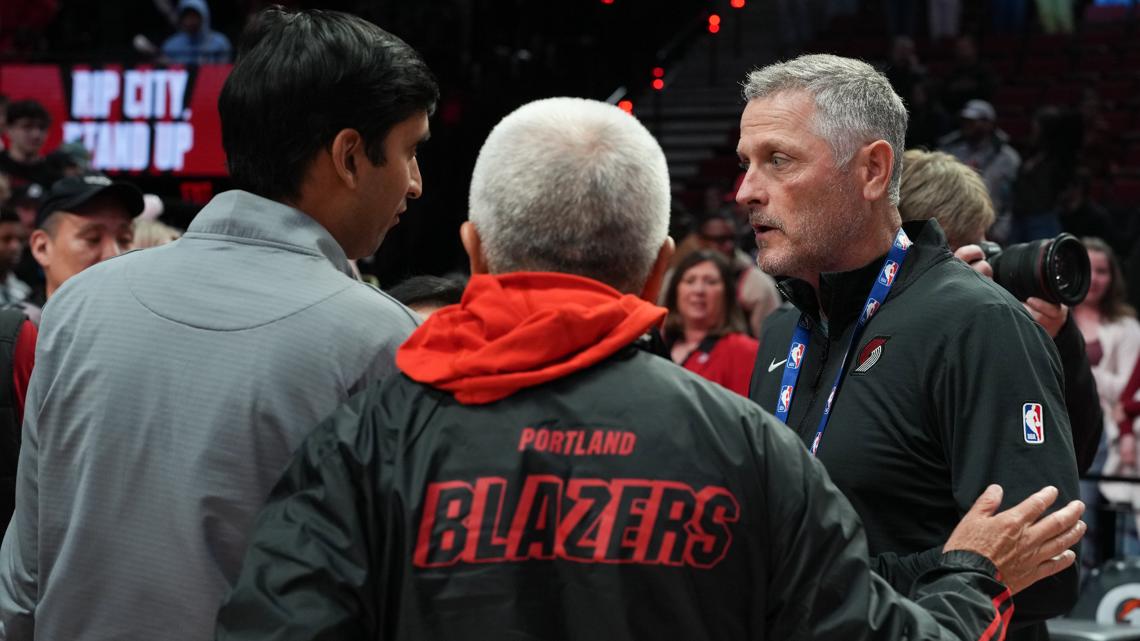
Tom Dundon is facing scrutiny over a series of cost-cutting decisions that could shape both the franchise’s competitive outlook and its reputation around the NBA.
PORTLAND, Ore. — Three weeks into his tenure as owner of the Portland Trail Blazers, Tom Dundon is facing early scrutiny over a series of cost-cutting decisions that, according to longtime Blazers reporter Mike Richman, could shape both the franchise’s competitive outlook and its reputation around the NBA.
On Monday’s episode of the Locked On Blazers podcast, Richman described a pattern of frugality from the new ownership group that he said is already “speedrunning being the cheapest owner in the league,” citing reporting from multiple outlets and league sources.
Coaching search
At the center of the discussion is Portland’s ongoing search for a permanent head coach. Interim coach Tiago Splitter has led the team for most of the season, but the organization is expected to make a formal hire this offseason. According to reporting attributed to The Oregonian’s Bill Oram and The Stein Line’s Jake Fischer, Dundon’s group has explored hiring a head coach in the range of roughly $1 million annually — far below the league norm, where established NBA head coaches commonly earn several million dollars per year and top-tier coaches make more than $10 million.
Richman noted that Portland has reportedly engaged in exploratory discussions with as many as 20 college and international coaches, along with NBA assistants including Denver’s Jared Dudley and Houston’s Royal Ivey. College head coaches such as St. Louis’ Josh Schertz and Iowa’s Ben McCollum have also been mentioned as possible candidates.
Some of those potential hires currently earn more in college than the reported NBA offer, meaning a move to Portland could require a pay cut for a more prominent role.
While acknowledging that lower-cost hiring is not inherently problematic, Richman argued it meaningfully narrows the pool of candidates. He said NBA head coaches are not only tactical leaders but also public-facing representatives of the franchise, interacting with media daily and setting the tone for organizational culture.
“You just aren’t going to get people with a bunch of experience in that role,” Richman said on the podcast. “You are going to hire someone very green.”
League reporting has already suggested Dundon’s approach is being noticed elsewhere in the NBA, contributing to a growing perception that the new ownership group is highly cost-conscious.
The coaching search, however, is only one piece of a broader pattern Richman described as cost-cutting across basketball operations.
Scouting and travel
He cited reports that the team has not sent advance scouts to certain potential playoff opponents, a decision that could limit in-person evaluation of opposing strategies during critical games. While such scouting decisions may not guarantee on-court consequences, Richman said they can create competitive disadvantages in preparation and game planning.
More striking, he argued, are decisions affecting travel and support staff. Reports from multiple outlets, including Sports Illustrated writer Chris Mannix, described instances in which staff members were not provided late hotel checkout during the play-in tournament, forcing them to wait in hotel lobbies with luggage before travel.
Additional reporting suggested Portland did not travel certain non-playing personnel, including longtime team photographer Bruce Ely and digital media staff member Casey Holdahl, to road postseason games. The team also reportedly did not bring broadcast and content staff typically included in traveling party rotations.
Richman emphasized that while these decisions may not directly impact wins and losses, they contribute to what he described as an emerging reputation issue.
“At some point in the NBA your currency becomes what people think of you,” he said. “And one of the things people think of you is that Tom Dundon is cheap.”
Two-way players left at home
The Blazers were also the only team in their first-round playoff series not to bring two-way players on the road, according to reporting from Sean Highkin of the Rose Garden Report. Those players, Caleb Love, Chris Youngblood and Jayson Kent, are ineligible to participate in postseason games but typically travel with teams for developmental and team-building purposes.
Richman argued that excluding them from travel limits developmental exposure to playoff environments, which he said could have long-term effects if those players are needed in future seasons due to injuries or roster changes.
“You are worse off because of it,” he said, referring to the lack of exposure to playoff preparation and team environments.
Despite the concerns, Richman acknowledged that NBA roster spending is largely constrained by league rules, including salary caps and minimum spending thresholds. He said the more meaningful indicator of ownership investment is discretionary spending: coaching budgets, scouting resources, medical staff investment and general player amenities.
That includes what he described as “quality of life” infrastructure for players: travel accommodations, practice facilities, food services and logistical support for athletes and their families.
Those factors, he argued, play a role in free agent retention and organizational reputation, even if they do not directly affect salary cap decisions.
“If your reputation is you are cheap, that doesn’t help you,” Richman said.
T-shirt controversy
Beyond staffing and travel decisions, Richman also pointed to what he described as a “T-shirt controversy” that further fueled perceptions around the new ownership group’s spending priorities.
Portland Trail Blazers president Dewayne Hankins told KATU News reporter Guillermo Mota last week that the team would not be distributing promotional T-shirts at home games this season, a staple of in-arena fan giveaways across the NBA. The decision was later addressed publicly by ownership representative Sheel Tyle, who said on social media that the team was “not doing T-shirts because we’re doing something else,” adding that the organization would be “rocking for Games 3 and 4.”
The explanation did little to quiet discussion among fans, particularly after San Antonio distributed widely praised playoff T-shirts during Game 1 of the series, drawing a contrast between the two organizations’ in-arena presentation.
While relatively minor in terms of basketball operations, Richman argued the episode contributed to a broader perception issue surrounding Portland’s new ownership group, which he said is increasingly being viewed around the league as cost-conscious.
“It’s hard, no matter how powerful and beautiful your makeup skills might be, to put lipstick on this pig,” Richman said on the podcast. “This is embarrassing. It’s embarrassing for Tom Dundon. It’s embarrassing for the entire ownership group.”
Dundon’s history as an NHL owner
Dundon’s approach has drawn comparisons to his earlier tenure as owner of the NHL’s Carolina Hurricanes. Richman noted that in Carolina, Dundon emphasized spending on on-ice talent while reducing costs elsewhere, and same philosophy may be carrying over to Portland.
However, he cautioned against drawing direct parallels between NHL and NBA operations, noting structural differences between the leagues and the distinct mechanisms of roster building.
Ultimately, Richman framed the situation as a test of competing theories in team building: that maximizing investment in players while minimizing overhead costs can still produce winning results.
“The way we will judge Tom Dundon as an owner is not whether he sends their incredibly talented team photographer on the road, or whether Caleb Love, who kept the Blazers in the hunt this season, gets to be at a playoff game where he deserves [to be present] … that’s not how we’ll judge Tom Dundon,” he said. “We will judge him by whether the Blazers are good or not.”
That outcome, he added, remains to be seen.
Early impressions, he said, are mixed at best.
“My early impressions three weeks into this experience,” Richman said, “is all of the bad stuff you heard whispers about seems to be coming true.”
Still, he acknowledged that the ultimate evaluation will come on the court.
“You’ll judge the owner of the team you like whether they’re good,” he said. “The results on the court will ultimately be the thing that you judge Tom Dundon by.”