
Offseason Approach
Add pieces to the returning vets and young core to pursue the playoffs
Actual Cap Space
-$39.9 million
Practical Cap Space
-$39.4 million
Projected Luxury Tax Space
$48.1 million
Under Contract (11)
Ace Bailey
Isaiah Collier
Kyle Filipowski (non-guaranteed)
Keyonte George
Blake Hinson (two-way)
Jaren Jackson Jr.
John Konchar
Lauri Markkanen
Svi Mykhailiuk (non-guaranteed)
Brice Sensabaugh
Cody Williams
Potential Free Agents (7)
Hayden Gray (restricted – team option)
Elijah Harkless (restricted – two-way)
Walker Kesser (restricted)
Kevin Love (unrestricted)
Bez Mbeng (restricted – team option)
Jusuf Nurkic (unrestricted)
Oscar Tshiebwe (restricted – two-way)
Dead Cap (0)
None
Projected Signing Exceptions
Non-Taxpayer MLE ($15.0 million)
(No Bi-Annual Exception due to using it during the 2025-26 season)
Notable Trade Exceptions
None
Projected First Round Draft Pick (pre-Lottery)
#4
Notable Extension Candidates
Kyle Filipowski (veteran extension)
Keyonte George (rookie scale extension)
John Konchar (veteran extension)
Svi Mykhailiuk (veteran extension – as of August 10)
Jusuf Nurkic (veteran extension – through June 30)
Brice Sensabaugh (rookie scale extension)
Analysis
The Utah Jazz threaded a pretty tight needle over the last few seasons. They were competitive enough to give their players, coaches and fans hope for the future. But they were bad enough to keep a protected pick out of the hands of the Oklahoma City Thunder. While some may not applaud Utah’s tanking efforts, at least 28 other teams will thank them for not handing Sam Presti yet another lottery pick.
Beyond tanking to keep their pick, the Jazz accomplished something else important last season. Utah exercised some “pre”-agency and acquired Jaren Jackson Jr. ahead of the trade deadline. Jackson will team with Lauri Markkanen, and ideally Walker Kessler (more to come!), in a jumbo-sized, versatile frontcourt. Acquiring Jackson effectively took Utah out of the cap space derby for this summer, but the cost wasn’t overly prohibitive to acquire a player who should fit in perfectly for a team trying to push up the standings.
In order to make that push successful, the Jazz need to re-sign Kessler. After being unable to come to terms on an extension last offseason, Utah’s starting center will head into restricted free agency. Kessler being a restricted free agent gives Jazz president of basketball operations Austin Ainge a leg up on keeping him in Utah. But that doesn’t mean Kessler isn’t going to get paid.
To start with, Kessler was reportedly looking at $120 million over four years, but the Jazz held firm. The initial idea was to use the big man’s relatively low cap hold to aid the team in creating cap space. The lack of an extension frustrated Kessler, who then missed most of the season after shoulder surgery. But that’s the high-end range of where talks will likely start.
This offseason, a couple of the projected cap space teams, the Chicago Bulls and Los Angeles Lakers prime among them, don’t have a long-term answer at the center position. While the 2026 NBA Draft class is deep in talent, it’s not overwhelming at the center position. That could put Kessler in play for an offer sheet this summer.
But Utah knows how important Kessler is. He’s an ideal fit next to Jackson and Markkanen, because he’s a sturdy rim protector and rebounder. Kessler is also a good finisher, who can play off Markkanen and Jackson on offense. And, Kessler should be a good pick-and-roll screener for Keyonte George who is coming off a breakout season.
The Jazz should be about $48 million under the luxury tax before re-signing Kessler, with only a few roster spots to fill. That’s leaves more than enough wiggle room to bring Kessler back, while filling out the roster and staying under the tax.
Factoring in that Kessler is coming off a lost season, and that Utah added significant long-term salary for Jackson, Ainge does need to be careful here. George is due for an extension this summer, and that’s not going to be a cheap one (once again: more to come!).
Given Kessler’s importance to the organization, even more so as they hope to compete for a playoff spot, expect the Jazz to try to get him signed long-term before an offer sheet can even become a thing. Something in the range of $112 million over four seasons would make a lot of sense. $28 million AAV would put Kessler even with Jarret Allen and just behind Isaiah Hartenstein in terms of per-year salary. If Utah can get Kesser for less, even at $25 million AAV, he’d still be in the top-12 in terms of highest per-year salary. That feels fair for where he ranks among starting fives.
For practical purposes, the Jazz could try to keep this salary a flat amount per season. That will help down the line when Markkanen, Jackson and, presumably, George are on big contracts. The challenge there becomes keeping the deal large enough in the final season that Kessler can still extend at a fair number.
Getting their starting center signed even at $28 million would leave the Jazz with roughly $20 million to spend under the tax. That could be used to bring back Jusuf Nurkic, who played well this past season, or more than enough room to use the entire Non-Taxpayer MLE. Either way, the Jazz are in a good spot to fill out the roster. In addition, if the team moves on from players like Svi Mykhailiuk, Bez Mbeng and Hayden Gray, that would free up an additional $8 million in room under the tax.
In free agency, Utah won’t be able to get involved with the best free agents (it’s a thin crop anyway), but having the full Non-Taxpayer MLE of $15 million should land them a rotation player or two. The team could use another guard, ideally one that can shoot. Tim Hardaway Jr., Luke Kennard, Landry Shamet or Quentin Grimes could be targets using some of the MLE. If the Jazz wanted more of a combo guard, someone like De’Anthony Melton or Jordan Goodwin would be a good fit.
The Jazz are also going to have a high lottery pick. Even if disaster strikes and four teams leap them in the lottery, Utah won’t pick any lower than eighth in this draft. That puts them in line to add a premium talent. If they land one of the top few picks, any one of A.J. Dybantsa, Darryn Peterson or Cameron Boozer makes sense. Dybantsa would give them a big wing, Peterson would be ideal as a scorer/playmaker in the backcourt and Boozer would give them another developmental forward. If Utah slips at all in the lottery, look for backcourt help. Darius Acuff Jr., Kingston Flemings, Keaton Wagler or Mikel Brown Jr. would all make excellent running mates for Keyonte George in the backcourt.
No matter what happens at the draft or in free agency, the Jazz will want to give some runway to the young talent already on the roster. Ace Bailey came along great as his rookie season progressed. Brice Sensabaugh has flashed some big-time scoring ability. Cody Williams had moments in the second half of the season. Kyle Filipowski looks like he’s at least a quality backup big. Isaiah Collier has had moments running the show at point guard too. Years of multiple draft picks have left Utah flush with young talent.
Some of that young talent that went to the Memphis Grizzlies for Jaren Jackson Jr. If the team is serious about contending for the playoffs, don’t be surprised if another trade is made. In addition to the prospects listed above, the Jazz own all of their own first-round picks moving forward, and have another additional pick likely headed their way too. If the right-fit veteran is available in trade, expect Utah to take a look, potentially even offering this year’s pick, pending where it ultimately lands.
The last, but hardly least important, bit of business for Utah this summer will be extensions. Keep an eye on a possible extension for Jusuf Nurkic before he hits unrestricted free agency on July 1. He was productive for the team, and getting him on a short-term deal between $12 and $15 million would give the Jazz a solid backup center and some tradable salary down the line.
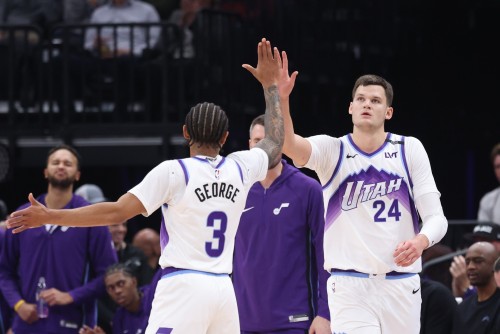
The big extension will come with Keyonte George however. George built on a strong finish in 2024-25 with a huge season in 2025-26. Despite playing in often wonky lineups, the 6-foot-4 combo guard was efficient on high volume. Because he can play on- and off-ball, George’s versatility is ideal as the Jazz build out the rotation of a playoff team.
The production plus efficiency aren’t established enough for George to command anything approaching a max extension, but he should still get paid quite nicely. Something in the range of $35 million AAV makes sense, which means a four-year, $140 million deal or, ideally for Utah, a five-year, $175 million contract. That puts George just ahead of what contemporaries like Jalen Suggs and Dyson Daniels got from the Orlando Magic and Atlanta Hawks respectively.
Again, the Jazz would do well to keep this contract flat, or even declining year-to-year, which has been something we’ve seen recently with other teams. Daniels’ deal is a flat $25 million per season, while Suggs’ contract started high at $35 million and declines over the following four seasons. George has a bit more potential, so the declining structure could leave his salary too low in the end to work a reasonable extension off of.
Brice Sensabaugh is also up for an extension, but this is one where Utah should wait. Unless Sensabaugh is willing to do one of those team-friendly deals where he takes around $9 to $10 million AAV, the Jazz shouldn’t lock in. There’s a lot of long-term money on the books, with more to come. The quickest way to short circuit a rebuild is by clogging up the cap sheet too early.
The Utah Jazz pulled the rug out from teams that looked like they could make the Play-In Tournament in the past, then tanked like crazy this season. Mission Keep the Pick is now accomplished and in the rearview mirror. The pieces are place for this team to climb the standings, even in a very competitive Western Conference. Keeping their talent in Utah, combined with adding some outside help, should see the Jazz in the mix for a playoff spot next season and beyond.