
Life comes at you fast, and nowhere does it come faster than in an NBA playoff series.
Best-of-sevens can turn in an instant. One minute, it looks like the New York Knicks are cruising to a 2-0 series lead and leaving the Atlanta Hawks facing a must-win Game 3 at home. One sudden 11-0 run later, and the Hawks are coming home with the series tied and eyeing a realistic chance to advance by holding serve in Atlanta in Games 3, 4 and 6.
In the wake of the first two games, and having watched this Atlanta team all season long, I have five big thoughts on Game 2, the series and what’s ahead:
Atlanta’s dynamic duo dud
The most amazing thing about Atlanta’s Game 2 win is that it did it with underwhelming games from its two best players. All-Star forward Jalen Johnson and guard Nickeil Alexander-Walker shot just 23 of 60 (38.3 percent) in the first two games, including 15 of 37 inside the arc (40.5 percent — blech!). Johnson struggled to get free from the tough defense of Josh Hart, while Alexander-Walker similarly had difficulty freeing himself from the length of Mikal Bridges (more on him below).
Through two games, those two are the standout disappointments among the Hawks’ top seven players (those seven have played all but 39 of the minutes in the first two games). The other five have been somewhere between good and excellent.
CJ McCollum is unexpectedly the biggest villain in Madison Square Garden since Trae Young. Onyeka Okongwu’s 82.4 percent true shooting mark through two games is impressive considering half his shots have been 3s. Dyson Daniels has been a monster on defense, Jonathan Kuminga was a game-changer in Game 2’s fourth quarter, and Gabe “Just Don’t Kill Us” Vincent has stayed out of the way (7.9 percent usage!), hit a couple perimeter shots and played passable defense.
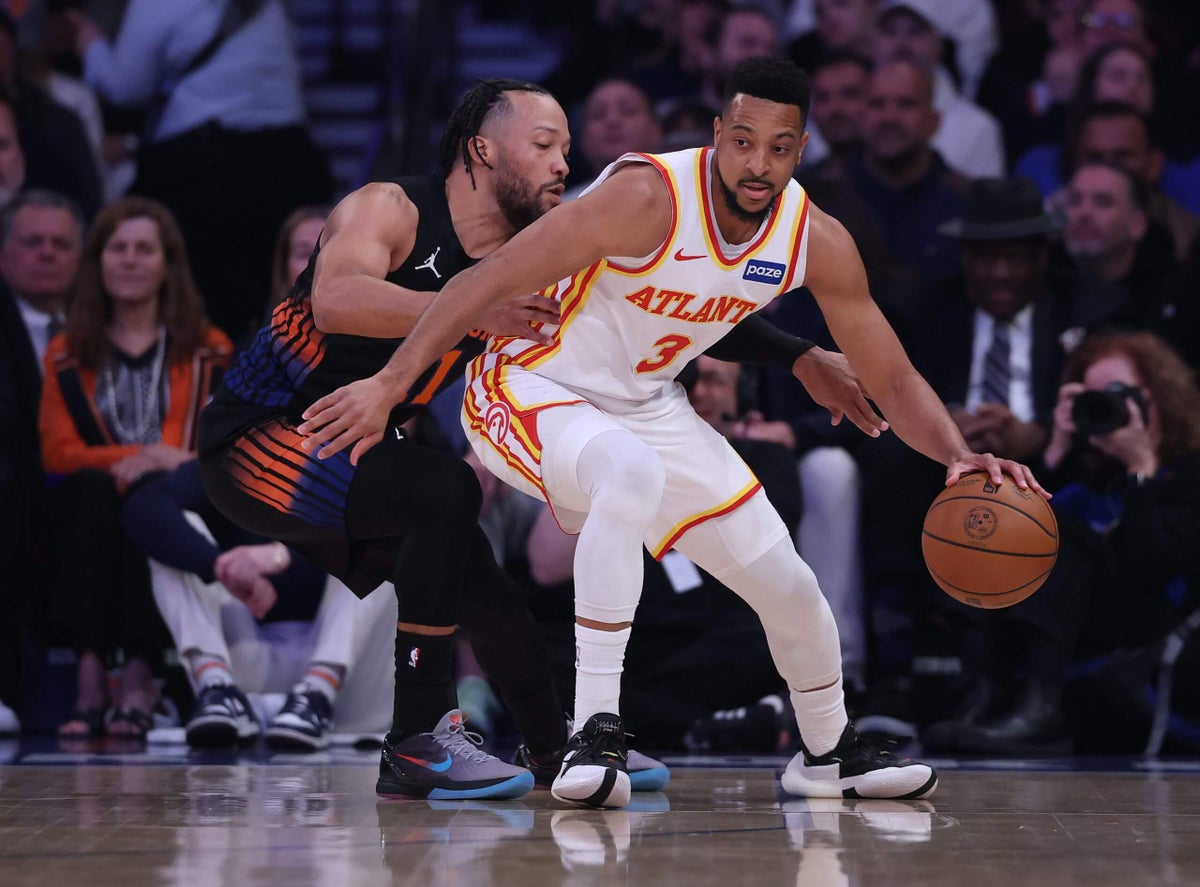
I’ll note that part of the offensive shift in emphasis from Johnson and Alexander-Walker to McCollum (a staggering 35.0 percent usage) seems intentional. McCollum repeatedly cooked Jalen Brunson down the stretch in Game 2, and the Hawks have been focused on attacking New York’s worst perimeter defender rather than going at the stout trio of OG Anunoby, Bridges and Hart.
New York has also been reluctant to switch Brunson onto Johnson in pick-and-rolls; McCollum’s go-ahead floater with two minutes left came after Hart stayed attached to Johnson on a screen. On the next trip, the Hawks didn’t even bother with a ball screen; they just had Alexander-Walker cut to the baseline to take away any double-team help and let McCollum incinerate Brunson one-on-one.
Additionally, the Hawks’ relative lack of transition opportunities has made it harder for Johnson to shine. That said, the Hawks still need more from their two best players to have a realistic chance of winning three more times. Alexander-Walker is only 4 of 16 on 2s in the two games, has only five free-throw attempts and at times has resorted to some of the iffy shot selection that plagued him early in the season.
A sequence with eight minutes left in the fourth quarter stands out, when Alexander-Walker got the ball in transition and wanted to shoot a pull-up 3, but Anunoby was ready for him and took away the look. Instead of pulling the ball out, Alexander-Walker dribbled inside the line into a contested 20-foot 2-pointer that Anunoby blocked. (Ironically, McCollum beat Anunoby with a nearly identical move for the game-winner.)
As for Johnson, he had three turnovers and no field goals in the first half on Monday, including missing an easy shot the one time he got iso’d against Brunson. I thought Johnson looked tired late in the regular season, but the eight days off between his last regular-season game (against Cleveland on April 3) and Saturday’s Game 1 should have revived him. He was better in the second half, but overall, he’s been too lethargic on defense and not particularly efficient on offense.
Johnson didn’t play well (by his standards) in any of the three regular-season games against the Knicks, either. This is a tough matchup for him with Hart and Anunoby in his grill for 48 minutes. But this is the playoffs; all the matchups are tough. The Hawks can survive some cold shooting from Alexander-Walker, but to hang with the Knicks over seven games, they need the All-Star version of Johnson.
The Kuminga question
I partly addressed this in my takeaway right after Game 2, but I think it’s worth talking through further: Jonathan Kuminga is the key hinge point in Atlanta’s offseason.
Atlanta has a $24 million team option on Kuminga, and picking up that option is just one of the alternatives the Hawks would be looking at with him — and arguably the least likely.
For starters, Atlanta in theory can be a cap room team this summer if it doesn’t re-sign McCollum, declines the option on Kuminga and stretches Buddy Hield (his $3 million guarantee can be atomized into five years at $600,000 a pop). That’s true even if they win the draft lottery with the pick gift-wrapped from the New Orleans Pelicans last June.
There are even scenarios where the Hawks re-sign McCollum and still have more than the midlevel exception in cap room, although that would likely involve trading one or both of Corey Kispert (may I interest you in two years and $27 million for our 10th-best player?) or Zaccharie Risacher.
More likely, however, the Hawks’ play since the deadline threw that idea out the window. Atlanta is good enough that re-signing the 35-year-old McCollum on a short-term deal for, say, a bit above the projected $15 million midlevel exception makes sense. That means the Hawks are likely operating as an over-the-cap team: Using their non-taxpayer midlevel exception on a quality big, their biannual exception on another guard … and figuring out what to do with Kuminga.
Is he worth $24 million? Probably not. My BORD$ free-agency evaluation is still in beta for 2026-27, but suffice it to say, its early estimates of Kuminga’s value are well south of that number. Like, Roald Amundsen expedition-type south.
However, that doesn’t mean the Hawks should just decline the option and let him walk. There are scenarios where picking it up still makes the most sense, just to have the tradeable salary on hand; there are even more scenarios where declining the option but agreeing to a longer deal with Kuminga at lower money makes all kinds of sense.
Of course, Kuminga’s perceived value may swing dramatically based on what transpires the rest of this series (and beyond, should the Hawks advance). In the big picture, Atlanta’s books are clean enough to go in several directions with the $24 million. If his play attracts other teams, the option may also permit the Hawks to immediately flip him for a different player who is less duplicative of Johnson … or decline the option and sign-and-trade Kuminga on a longer deal … or, yes, bring him back and see where this goes a year from now.
About that last shot…
Mikal Bridges is going to have a tough time beating the charges after his shot at the end of Game 2. The rap on him, from his critics, is that he values his consecutive games streak so much that he is unwilling to absorb any contact around the basket and will actively duck situations where he might draw a foul or create contact to flee for the safety of a perimeter jumper.
Welp … on the final play of Game 2, the Hawks screwed up their coverage just enough to let Bridges catch the ball on the go with a full head of steam, three seconds on the clock, a half-step advantage on Jalen Johnson and no Hawks at the rim.
Yes, Bridges also had to worry about Dyson Daniels flying back on defense, and Johnson is athletic enough to contest a shot attempt at the cup. At the moment he catches the ball, however, Bridges is already bailing toward the corner with his first step rather than pressing his advantage to draw a foul on Johnson … to the point that he nearly steps on the referee’s foot!

In a related story, Bridges only drew 98 free-throw attempts this season in his 82 games, and his foul-drawing rate of 6.5 percent on 2-pointers is one of the league’s lowest (18th-worst among players with at least 500 minutes, according to pbpstats.com; nearly all the players below him are small guards).
That doesn’t mean Bridges isn’t a valuable player; his defense has been a huge plus, and his shooting normally is too (those back-to-back Bridges misses on wide-open 3s in the middle of the fourth quarter of Game 2 were a lucky break for Atlanta). And, of course, he does keep himself in the lineup for 82 games every year, which is no easy feat for a lean player.
But in a high-leverage situation, his seeming unwillingness to absorb contact to get an advantage stood out.
The Tony Bradley experience
Atlanta backup center Jock Landale is likely out for the entire series because of an ankle injury, and that has left the Hawks’ backup center rotation in tatters. At times, rail-thin Mo Gueye has tried to match up against Knicks behemoth Mitchell Robinson; in Game 2, Hawks coach Quin Snyder switched around his first-half rotation to match Okongwu’s minutes with Robinson as much as possible.
However, another solution may be coming into focus: Tony Bradley looks like he’s in shape to help a little.
The Hawks tried Bradley for a disastrous three-minute stint in their April regular-season game against the Knicks, mere hours after signing him off his couch, but he clearly wasn’t ready for the assignment. Atlanta had been terrified to send him back on the court; however, the fact that the Knicks weren’t guarding Gueye finally persuaded Snyder to give Bradley another look in Game 2.
All things considered, it went OK. Bradley played 12 minutes and finished with a tidy plus-7 plus/minus, helped along by a rough night from the Knicks’ subs. He had enough juice to grab a steal and a block and offers a legit roll target who got free for a dunk in a half-court pick-and-roll.
Bradley was dealing with Robinson as a Pacer in last year’s Eastern Conference finals. As this series winds on, I’d expect the backup center job to be his until further notice.
One side note while we’re talking about the bigs: With all the focus on Robinson and New York’s offensive rebounding, the Knicks’ 24.4 percent offensive rebound rate is very survivable for the Hawks.
The flip side, however, is that the Hawks are also allowed to grab offensive boards and haven’t really been doing so. The Hawks have grabbed only 16.3 percent of their misses across the two games, which would be a league-worst rate (emphatically so) over the regular season. When your probability of an offensive rebound is lower than Dyson Daniels’ 3-point percentage, that’s a bad sign. It’s one reason the Hawks have fewer points than the Knicks over the two games despite outshooting them in effective field goal percentage, 53.3 to 53.0.
The leading offensive rebounder for Atlanta in this series? That would be Risacher, who grabbed two in his two-minute cameo in Game 1. Five other Hawks also have two, but nobody has any more.
The Pelican Brief
The last time McCollum, Jose Alvarado and Daniels were in the playoffs was in 2024, as members of the Pelicans team that was rudely swept out of the first round by Oklahoma City. (An injury to Zion Williamson didn’t help.)
So, it was a bit humorous to see McCollum and Alvarado, teammates for four seasons in New Orleans, getting into it and each receiving double technical fouls after their, um, interaction late in the third quarter of Game 2.
The Pelicans’ fingerprints are all over this series, actually. Alexander-Walker was originally drafted by the Pels and overlapped both Alvarado and McCollum (though not Daniels). Daniels was drafted (and given up on) by New Orleans before landing in Atlanta in the Dejounte Murray trade.
Hart overlapped with both McCollum and Alvarado on the last Pelicans team to actually win a playoff game, in 2022 against the Phoenix Suns. And of course, the Hawks own an unprotected lottery pick courtesy of the Pelicans that has a 9.8 percent chance of netting Atlanta the top pick this June; the same deal also brought in little-used Hawks rookie Asa Newell.
Enjoy this series, Pels fans; this might be as close as you get to the playoffs for a while.