
NBA
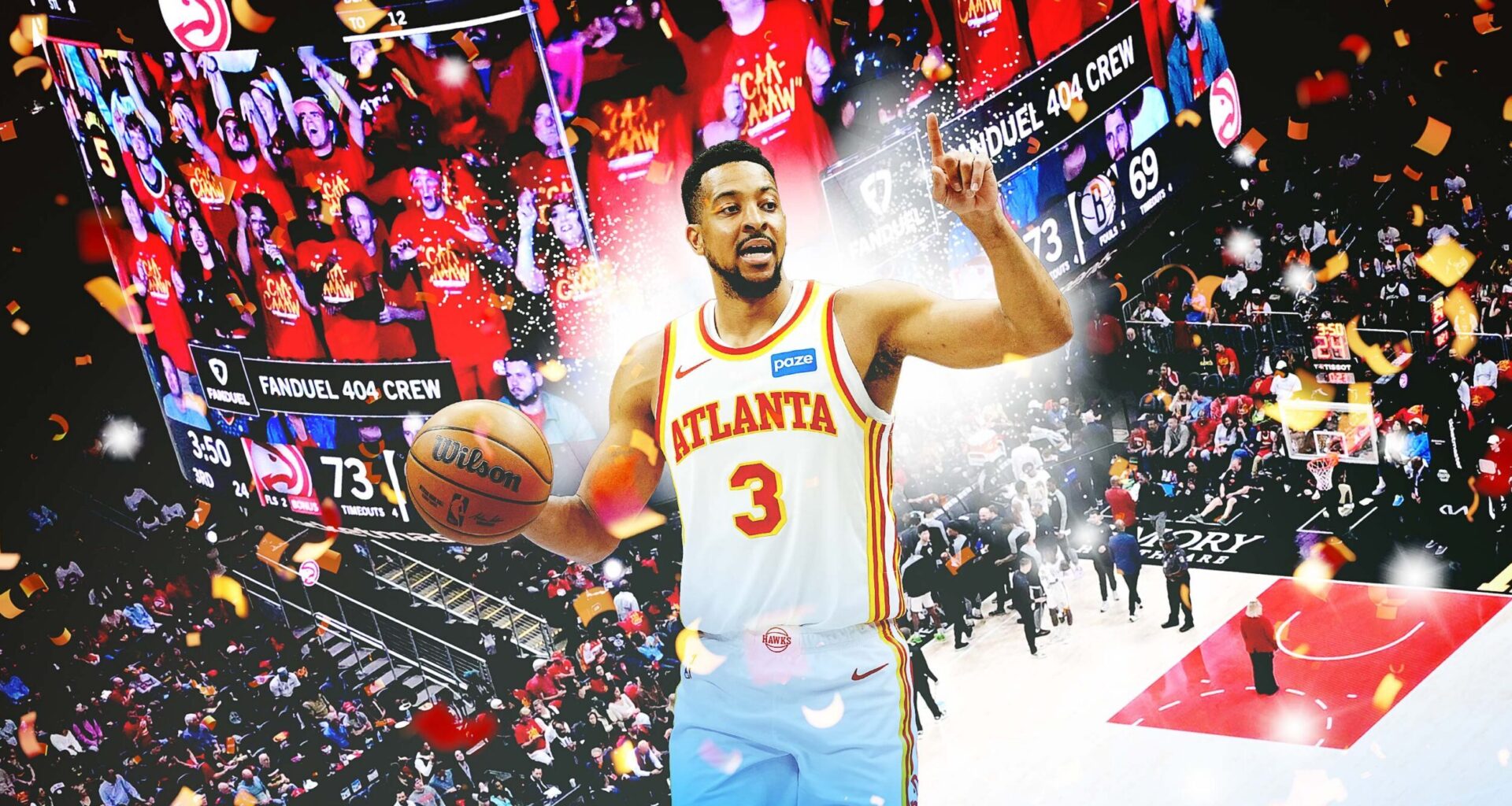
How did a “salary dump” become a playoff hero? “I’d be bullshitting if I was like, ‘Hey, this is gonna happen,’” said Hawks GM Onsi Saleh. NBAHow did a “salary dump” become a playoff hero? “I’d be bullshitting if I was like, ‘Hey, this is gonna happen,’” said Hawks GM Onsi Saleh.Getty Images/Ringer illustration
 By Howard BeckApril 23, 12:46 pm UTC • 7 min
Modern NBA executives have a wondrous array of tools at their disposal, all leveraged to create a cohesive, well-optimized roster with players of various shapes, sizes, and skill sets. But even the best execs, armed with the best data, metrics, and scouting reports, cannot predict the future. The tech nerds have not, as of yet, fashioned a crystal ball that can foresee wins or losses.
So no, the Atlanta Hawks did not exactly know in early January—when they jettisoned their franchise star, in a deal widely described as a salary dump—that the aging guard they acquired in return would power them to a thrilling playoff victory in April, at the World’s Most Famous Arena, amid booming chants of “Fuck you, CJ” from a chippy crowd of New Yorkers.
No, Hawks general manager Onsi Saleh conceded with a chuckle, he did not quite foresee that—no matter how much he’d admired CJ McCollum before acquiring him from Washington in that January 9 Trae Young trade.
And, to be sure, Saleh loved everything he knew of McCollum from the veteran’s long NBA career: his character, his leadership qualities, his steadiness, and yes, his skills as a scorer and playmaker. He was confident that McCollum’s scoring abilities and general presence would immensely benefit the young core of Jalen Johnson (24), Dyson Daniels (23), and Nickeil Alexander-Walker (27).
But this? A team-leading 58 points across two playoff games, at Madison Square Garden? A team-high 32 points in Game 2, including the shot that put the Hawks ahead for good? A tied series heading home? All orchestrated by the guy who was dismissed by pundits as an “expiring contract” three months ago? Well, no. Not quite this.
“I’d be bullshitting if I was like, ‘Hey, this is gonna happen,’” Saleh told The Ringer. “I was not expecting him to take over and be the type of player he’s been the last two games. It’s just been like, Damn! Like, this is pretty amazing.”
It is perhaps what Saleh hoped, but not entirely what he expected, when he made the trade—easily the most consequential transaction since he became GM last spring.
“I’m not surprised with his confidence and his ability to do what he’s doing,” said Saleh of the 13-year veteran. “I just didn’t expect the efficiency—like, everything has been so good, and he’s just taken over the series, and in such a dramatic way. It eases the pressure on some of our guys. It helps us understand how to win playoff games, which is a skill. He understands tempo and pace and mismatches and who to go at, who not to go at, clock situations, all that stuff he’s been phenomenal with.”
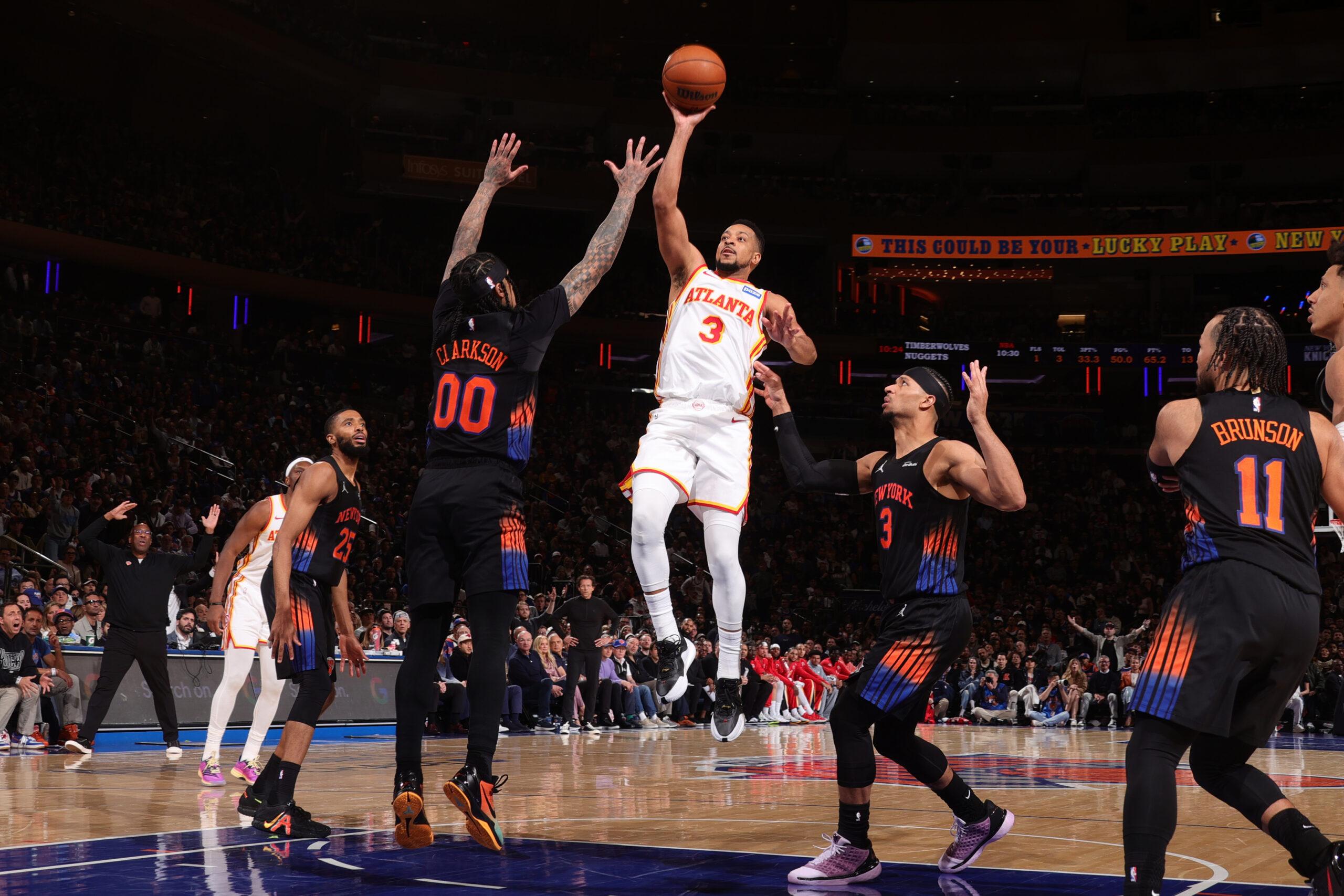
CJ McCollum drives to the basket during Game 2 in Madison Square Garden
Nathaniel S. Butler/NBAE via Getty Images
If we had ranked all of this year’s midseason trades by their potential to disrupt the 2026 playoffs, the Young-McCollum swap (which also included the Hawks’ acquisition of Corey Kispert) would surely have been near the bottom before the postseason—well below Cleveland’s deal for James Harden, Minnesota’s pickup of Ayo Dosunmu, and hell, even the Lakers’ acquisition of Luke Kennard.
Young, after all, was sent to the Wizards, who were firmly committed to losing as many games as possible in pursuit of a high draft pick. And McCollum was a 34-year-old with modest stats, stuck in NBA limbo, heading to the Hawks, who at the time were mired in ninth place in the East.
There were no other suitors for Young, despite his All-Star credentials. And no one was really chasing McCollum, given his age and his $31 million salary. It looked like a trade of convenience for both franchises. The Hawks were cultivating a new, defense-first identity around Johnson, Alexander-Walker, and Daniels; Young, despite his popularity in Atlanta, no longer made sense. The rebuilding Wizards—in need of a little star power to support their young core—took an opportunistic flyer on Young (and added Anthony Davis in a similar deal weeks later).
In effect, both franchises got what they could, nothing more. A blockbuster deal this was not. But it was also too quickly dismissed, Saleh said.
“It was funny when the narratives came out at the time,” Saleh said. “Because people just thought we’re just salary dumping, which wasn’t the case at all. We wanted CJ. We wanted Corey. These are two guys that fit. … It’s worked out even better than I would have expected.”
Atlanta needed a veteran like McCollum, who had been in more playoff games (67) than Johnson, Daniels, and Alexander-Walker combined (48). Hawks coach Quin Snyder needed a go-to scorer and shot creator to take some of the pressure off Johnson. And the locker room needed a vocal leader with the confidence to be critical and the gravitas to back it up. “He’s not afraid to say anything to the group,” Saleh said. “I feel like this guy could have a conversation with the president of the United States or a 10-year-old, and he’ll be great, because he just has such high emotional intelligence.”
McCollum, although never an All-Star, checked every box. He’d been a 20-points-per-game scorer for 10 straight seasons. He’d been a costar to Damian Lillard in Portland and a transformative leader in New Orleans, leading the Pelicans back to the playoffs in 2024. He’d served as the president of the players association. He’d made his share of clutch plays in the postseason—most famously in a Game 7 victory over the Denver Nuggets in the 2019 Western Conference semifinals. He’d seen just about everything by the time he landed in Atlanta.
“I’ve said it to him: It’s a different type of leadership, in my mind, than he’s had at other times in his career,” Snyder said, “because he’s got to find a balance of communicating and talking to the guys and thinking about everybody—but we don’t want him to lose his aggressiveness scoring the basketball. Sometimes it’s hard to balance those two things.”
Some players lead by example, with their play and the points they put on the board. Others lead with their voice. In McCollum, the Hawks got both, Snyder said. McCollum also quickly earned the respect of his coaches and teammates by willingly playing off the bench for most of his first month with the club.
“I think that says a lot about who he is,” Snyder said. “When you watch him play, and the things he does on the court offensively, that’s clear. Finding and wanting to set other people up, and then also the way he’s defended, you do those things and you demonstrate leadership.”
More on the NBA Playoffs



NBA Panic Rankings, NFL Draft Guesses, and a Michael Jackson Movie Review | With Todd McShay, Steve Muench, and Van Lathan
NBA Panic Rankings, NFL Draft Guesses, and a Michael Jackson Movie Review | With Todd McShay, Steve Muench, and Van Lathan
NBA Panic Rankings, NFL Draft Guesses, and a Michael Jackson Movie Review
NBA Panic Rankings and NFL Draft Guesses
More on the NBA Playoffs
NBA Panic Rankings, NFL Draft Guesses, and a Michael Jackson Movie Review | With Todd McShay, Steve Muench, and Van Lathan
NBA Panic Rankings, NFL Draft Guesses, and a Michael Jackson Movie Review | With Todd McShay, Steve Muench, and Van Lathan
NBA Panic Rankings, NFL Draft Guesses, and a Michael Jackson Movie Review
NBA Panic Rankings and NFL Draft Guesses
The Hawks went 27-15 after acquiring McCollum and had the league’s seventh-best point differential in that span, per Cleaning the Glass. The Hawks’ new starting lineup—with McCollum alongside Johnson, Alexander-Walker, Daniels, and Onyeka Okongwu—ranked as the second-best quintet in the league (minimum 600 possessions) and had a 21.4 net rating, per Cleaning the Glass. Atlanta also led the league in assists this season at 30.1 per game, a franchise record.
“He settles everybody down,” Hawks veteran Buddy Hield said of McCollum. “And when it’s time to get a bucket, we put the ball in his hands and we trust him to make the right play.”
No one, of course, was more pleased with the surprise trade than McCollum himself, given where he’s been the past two years. The Pelicans had fallen into irrelevance, undermined by bad luck and bad decisions. The tanking Wizards valued McCollum mostly for his expiring contract. But he was arguably winning them too many games. Trading him for the injured Young helped Washington get back to losing—and gave McCollum a chance to get back to winning.
“I’m just thankful to be able to play in the playoffs, on a good team, in a good situation,” McCollum said Monday. “You take the journey for what it is, in stride, and you just hope for the best. And I think when you do things the right way, you get rewarded at the end of the tunnel, and my reward is playing the Knicks in the Garden.”
The payoff has been a long time coming. Three years ago, when McCollum was adjusting to New Orleans, he called it “the most complex year of my life”—complete with a trade, a cross-country move from Portland, a new baby, a new business venture (an Oregon winery), and an intense cycle of labor negotiations, culminating in the 2023 collective bargaining agreement between the players association and the NBA.
This past year was perhaps not quite as arduous, but it was undoubtedly taxing, with a lot of losing and dysfunction and, of course, two unexpected moves in a seven-month span. Trades are never easy, especially for players with young families. McCollum and his wife, Elise, have two children, a 4-year-old and a 2-year-old.
“I think having gone through what I’ve gone through historically, we were just ready to weather the storm,” McCollum told The Ringer. “And we have a really good foundation in my household, where we understand what this life is going to entail. There’s going to be twists and turns, and my wife has a great understanding of what it takes for us to live this life. … But the basketball is always the easiest part. The family dynamic is always the hardest part.”
When the Knicks and Hawks last clashed in the playoffs back in 2021, it was Trae Young who simultaneously crushed and taunted Knicks fans with his clutch shooting, sparking a new rivalry and a caustic chant: Fuck Trae Young.
Now it’s McCollum playing the heel—tangling with Jalen Brunson and Jose Alvarado, getting booed on every possession, and inspiring a new chorus of f-bombs from the Garden faithful. New York has its new villain. But McCollum has firmly rejected the role.
“I’m just a father and a husband with two kids,” he told The Ringer, “and it’s a mutual blessing to be able to play in an arena where there’s so much admiration that they just cheer for you.”
Not long ago, Young incited and embraced the vitriol, taunting Knicks fans at every turn. But McCollum, a family man in his mid-30s and ever the diplomat, took the high road Monday—sounding every bit like the grown-up the Hawks always knew they needed.

Howard Beck
Howard Beck got his basketball education covering the Shaq-and-Kobe Lakers for the L.A. Daily News starting in 1997, and has been writing and reporting about the NBA ever since. He’s also covered the league for The New York Times, Bleacher Report, and Sports Illustrated. He’s a co-host of ‘The Real Ones.’