
Two weeks ago, we talked about a J. Kyle Mann mock draft that saw the Celtics use their first round pick on international prospect Karim Lopez, diving a bit into the film and numbers to see if the fit makes sense for a team that has a desire to add rim-attacking power and more interior strength.
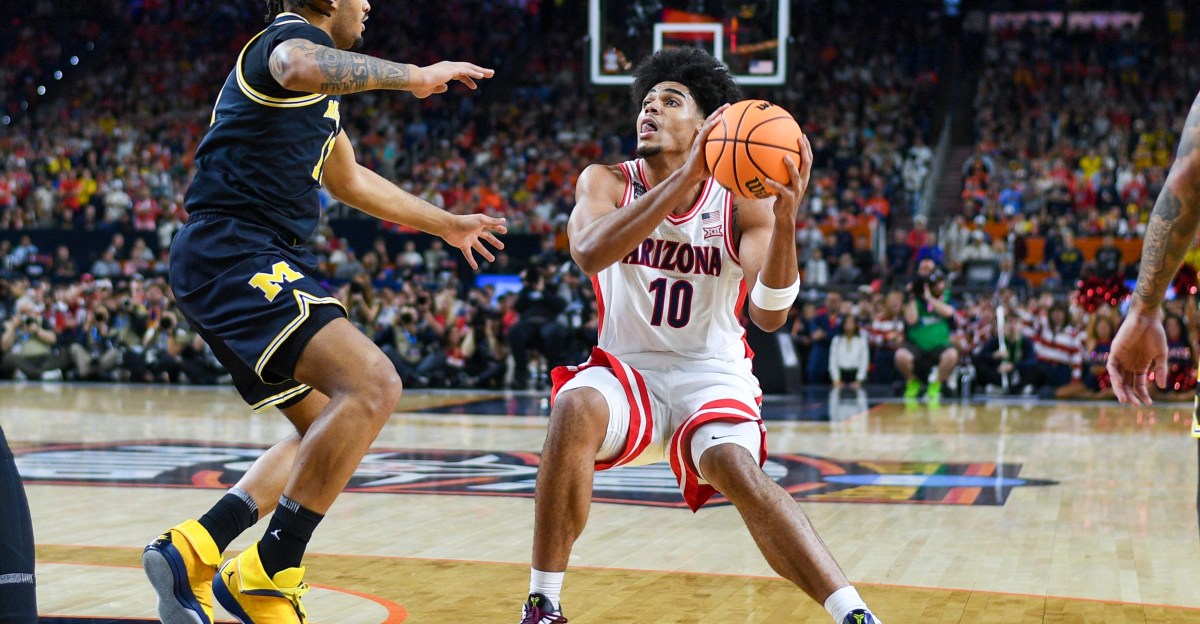
This time, we’re looking at a mock draft made by ClutchPoints’ Brett Siegel, who released his second mock on May 25. With the 27th pick, he sees Boston going for Arizona power forward Koa Peat.
Here’s what Siegel had to say about his mock draft selection:
“All the talk from the NBA Draft Combine was that Koa Peat should return to Arizona and work on his offensive game. However, Peat has made it clear that the draft is his priority and that he could very well forgo his NCAA eligibility. From a financial standpoint, this may not be the best decision for Peat, as he is projected to be a late first-round pick right now.
— -Brett siegel
We’ve commonly seen Peat’s draft value trend lower than the lottery predictions he had entering the season. There was a point where Peat was considered the poor man’s Cameron Boozer, the second power forward option for those unlucky enough to tank their way into a top-3 pick. Now, the separation between the two as prospects has widened significantly in the public eye: Boozer was the national Player of the Year and remains a surefire top-3 pick, and Peat’s at risk of falling into the 20s, or possibly out of the first round altogether.
Unlike our Karim Lopez dive, I have a good bit more familiarity with Peat’s game going into this. He made his presence known as one of the buzzworthy Americans to compete in the FIBA U19 World Cup last summer, and Arizona was one of the most impressive teams in the country before getting shellacked by Michigan in the Final Four. There’s tons of footage to watch on Peat.
Even with some familiarity, that doesn’t mean we should skimp on the process. I revisited performances against Florida, UConn and France in the World Cup, along with the same first step as last time: a full-fledged highlight reel.
Welcome to the Koa Peat Experience:
One thing that really stands out about Peat is the graceful footwork paired with grown-man strength. He’s roughly 10 pounds bigger than he was at the World Cup, yet that explosiveness off the dribble is unaffected by his growth. Packaged with a good handle and strong rim finishing (70% at the rim), he really packs a punch.
When I think about the type of power forward Boston could use to pair next to Neemias Queta, I don’t think Peat is that far off from what I’m imagining. He creates for himself but does well playing off other talented players as a cutter, he shows good habits as a ballmover that rolls hard to the rim and serves as a versatile handoff generator, and his driving burst translates defensively into his lateral movement.
You watch a highlight reel and you get why he entered this season as ESPN’s 10th-rated freshman. But of course, highlights don’t tell all, and in full games with a lot of data at our disposal, you start to see exactly why he’s in the conversation for a pick just inside the first round.
Peat, for his 6-foot-8 and 245-pound frame, is not that impactful on the glass or on defense. Sharing the court with a monstrous 7-foot-2 big in Motiejus Krivas may limit how those numbers look, but Peat just wasn’t a major shot-stopper or turnover-creator.
Peat’s 2.5% block percentage last season doesn’t hold up terribly well next to other forwards in this class, like Hannes Steinbach (3.9%), Yaxel Lendeborg (4.4%) or Allen Graves (5%). His 1.3% steal percentage also tracks lower than a majority of the top forward prospects in the class, such as Boozer (2.5%) or UNC’s Caleb Wilson (2.8%).
Not to say Peat is a flat-out bad defender. He’s not. He’s pretty switchable, navigates screens well, and has flexed that strength on some impressive blocked shots as a helper.
And on offense, one thing the tape really tells you is that Peat loves mid-range jumpers, but has not shown much willingness to test his shot out from deep. Peat attempted 9.5 mid-range shots per 100 possessions, and 121 attempts in total. In those spots he was just a 33.5% shooter, though was slightly better in the short mid-range, finding the basket at a 41% clip and flashing a nice turnaround move. From the 3-point line, he attempted just 20 shots, hitting seven of them. Add to that his 62% free throw shooting, and the current state of his jumper’s development is concerning.
That’s probably why he’s no longer considered a lottery prospect.
It makes projecting a ceiling on Peat pretty difficult, but also adds a lot of intrigue to what the puzzle looks like when you plug that final piece in. Can he grow into a creative, high-powered forward a la Julius Randle? Is he something closer to Guerschon Yabusele’s ceiling, where the athleticism flashes and the jumper becomes respectable but doesn’t move the needle for a team’s overall outlook?
For No. 27, it’s probably a worthwhile gamble to find out. If you’re picking in the top-14 in a class this good, the risk is certainly higher. Nothing like a boom-or-bust pick to drive our discourse through the Summer League.
What are your thoughts on Peat? Drop a player comp and let us know.