
Offseason Approach
Add size and backcourt depth for a deeper playoff push
Actual Cap Space
-$93.8 million
Practical Cap Space
-$75.7 million
Projected Luxury Tax Space
$46.2 million
Under Contract (10)
Nickeil Alexander-Walker
Dyson Daniels
RayJ Dennis (two-way)
Keshon Gilbert (two-way)
Buddy Hield ($3 million guaranteed)
Jalen Johnson
Corey Kispert
Asa Newell
Onyeka Okongwu
Zaccharie Risacher
Potential Free Agents (8)
Tony Bradley (unrestricted)
Mouhamed Gueye (restricted – team option)
Christian Koloko (unrestricted – two-way)
Jonathan Kuminga (unrestricted – team option)
Jock Landale (unrestricted)
C.J. McCollum (unrestricted)
Gabe Vincent (unrestricted)
Keaton Wallace (restricted)
Dead Cap (0)
None
Projected Signing Exceptions
Non-Taxpayer MLE ($15 million)
Bi-Annual Exception ($5.5 million)
Notable Trade Exceptions
Luke Kennard ($11 million)
Clint Capela ($6.7 million)
Kobe Bufkin ($4.5 million)
First Round Draft Picks
#8
#23
Notable Extension Candidates
Mouhamed Gueye (veteran extension)
Buddy Hield (veteran extension)
C.J. McCollum (veteran extension – through June 30)
Onyeka Okongwu (veteran extension – as of October 1)
Gabe Vincent (veteran extension – through June 30)
Analysis
The Atlanta Hawks offseason can go in a couple of different direction. The Hawks could be a cap space team with up to $32 million to spend in free agency. Or Atlanta can stay over the cap while focusing on re-signing a couple of free agents and making trades to improve the roster.
Whichever path the Hawks take, they need to add size to this team. They can also use some backcourt depth. The other pieces are in place for Atlanta to bolster their team for a playoff run.
The cap space route is less likely for Atlanta, unless they have a targeted acquisition in mind. To create that up to $32 million in spending power, the Hawks would have to decline the team option for Jonathan Kuminga. They would then have to renounce Kuminga, as well as C.J. McCollum, Gabe Vincent and a few other players. In addition, Atlanta would have to waive-and-stretch Buddy Hield’s $3 million guarantee over three years at $1 million a year.
That would leave the Hawks somewhat limited in the ability to retain McCollum, while also replacing Kuminga, Vincent and adding frontcourt depth. Unless there is a player the Hawks know they need roughly $30 million in cap space to go get, they’re better off staying over the cap.
In that scenario, the Hawks can pick up the $24.3 million team option for Kuminga. He’s either around as good forward depth, or that’s a nice chunk of salary to put into a trade down the line.
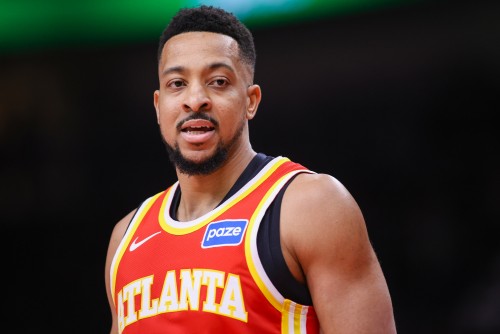
Atlanta would retain the Bird rights for McCollum and can re-sign him to a fair-market contract. Something in the range $40 million over two seasons, or $60 million over three seasons, with team protection (team option or light guarantee) on the final season makes sense. McCollum is still a valuable player, he fit in well with the Hawks, but he’s at the phase of his career where a transition to the bench is looming. Bench guards, no matter how valuable they are, have a set high-end price. For an older one, that number comes down even a little more.
The Hawks will probably waive Hield if they stay over the cap or go under it. Paying him $9.6 million just doesn’t make sense, given he has no spot in the rotation. He’s not really a trade asset at that number. The difference for Atlanta will be eating Hield’s $3 million guarantee this year or spreading it out at $1 million a year for the next three.
Of the team’s other free agents, Onsi Saleh should look to bring back Jock Landale. He was really productive before a season-ending injury. At worst, Landale is very nice third center, and he shouldn’t cost more than a veteran minimum deal. The Hawks should also try to re-sign Mouhamed Gueye to a long-term, team-friendly deal too. He’s proven to be a solid backup big. If they can’t reach a deal, Atlanta should pick up Gueye’s option to have him back for next season.
Gabe Vincent is probably headed elsewhere. He hasn’t shot the ball well enough over the last few years to be on much more than a minimum deal. For Vincent, if McCollum is coming back, he’ll probably want to land somewhere with a better chance of playing time.
At the draft and free agency, Saleh should be looking for size. By the end of the Hawks first-round series loss to the New York Knicks, Onyeka Okongwu was the team’s only playable big. Atlanta has to bring in more help around him.
In the draft, 7-foot-3 Michigan center Aday Mara has been linked to Atlanta. He’d be a fine selection with the eighth overall pick. If the team waits to address the center spot with the 23rd overall pick, they could look at players like Hannes Steinbach, Henri Veesaar, Jayden Quaintance, Luigi Suigo or Tarris Reed Jr.
One way or another, the Hawks should leave the draft with a first-round big man in the fold. If they go with Mara with the early pick, Atlanta could look at a development point guard option like Christian Anderson Jr., Labaraon Philon Jr., Ebuka Okorie or Bennett Stirtz. Coming away with Mara and one of those guards would be a homerun draft night for the Hawks.
In free agency, Atlanta can look at different options for veteran frontcourt help. The Hawks should have the full Non-Taxpayer MLE of $15 million to spend. Some, or all of that amount, is in the range for players like Nikola Vucevic, Jusuf Nurkic, Robert Williams III or Sandro Mamukelashvili. Guerschon Yabusele, Harrison Barnes or Dean Wade could also be targets using some of the NTMLE, should the Hawks want more of a power forward than a center.
In the backcourt, adding another veteran ballhandler would be good. Targets there could be Collin Sexton, Jordan Goodwin, Jevon Carter or Brandon Williams.
On the trade market, the Hawks should be able to get involved in conversations for just about any player who becomes available. Between Kuminga, Corey Kispert and Zaccharie Risacher, Atlanta can put together more than $52 million in matching salary. It might seem crazy to move Risacher so soon, but if the deal was bringing back another forward or wing, it’s hard to see a path to playing time for Risacher.
It’s way too early to call Risacher a bust, but he was out of the rotation by the end of the playoffs. He also didn’t take much of a step forward in his second NBA season. The skills are there, but Risacher needs consistent playing time to grow and play through his mistakes. With the Hawks on an upward trajectory, they might not have the developmental minutes to commit to the former first overall pick. Atlanta certainly doesn’t need to give up on Risacher, or give him away, but they should be open to moving him in the right deal.
On the extension front, the guy to watch is Onyeka Okongwu. He has two seasons left on his deal, but if Atlanta can lock him up early, they should. It doesn’t need to be anything extravagant. If the Hawks can add three years at an AAV of $22 to $25 million, that’s solid value for Okongwu.
The Atlanta Hawks are in a good place. New deals for Onsi Saleh and Quin Snyder have the team’s leadership locked in. They have a good core with Jalen Johnson (he’s a full-blown star), Nickeil Alexander-Walker, Dyson Daniels and Onyeka Okongwu. Now, is the time to add the right pieces around those guys to push further up the standings. The goal should be to host a first-round playoff series next year. With the right moves, the Hawks can get there.