
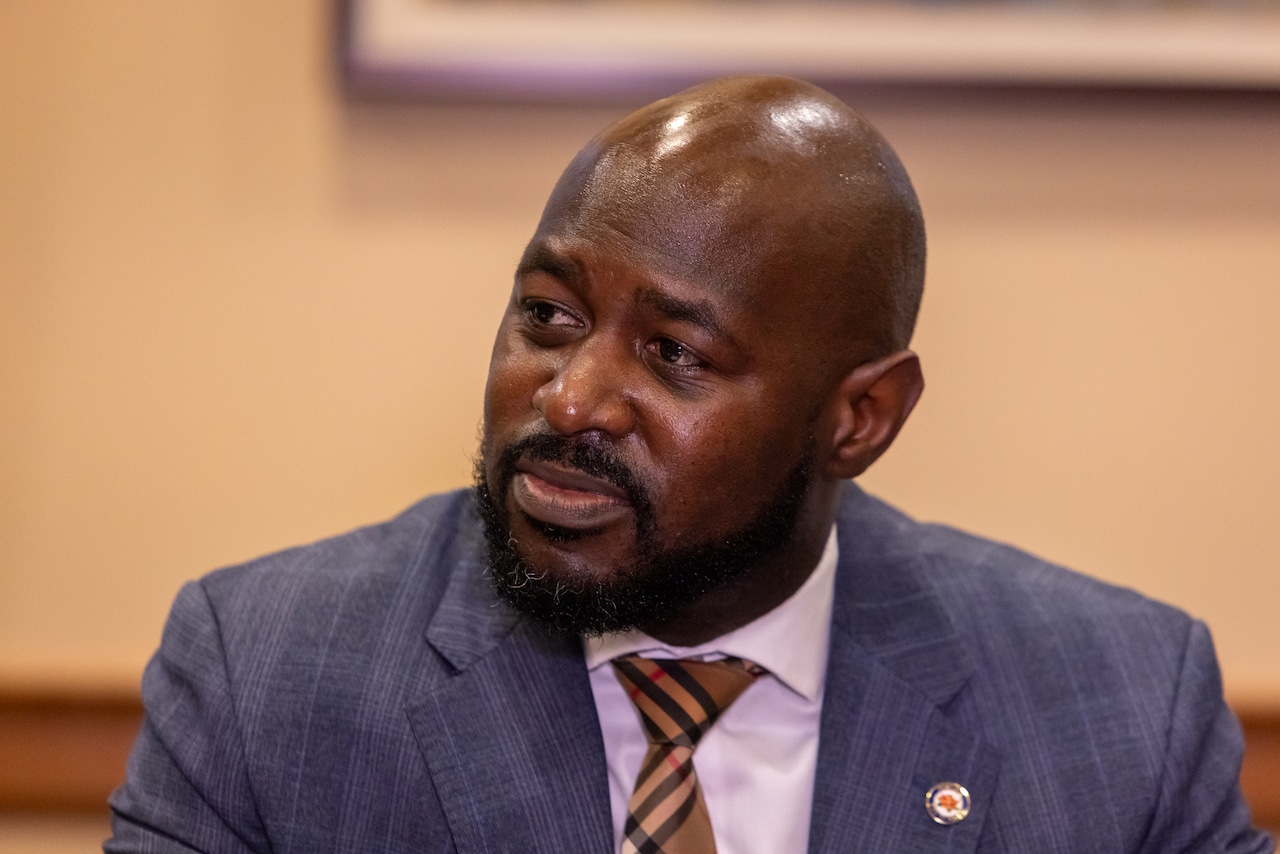
Facing a December deadline to secure state bonding for renovations to the city-owned Moda Center, Portland’s top administrator met this week with Trail Blazers owner Tom Dundon in Texas, a city spokesperson confirmed Thursday afternoon.
The meeting between Dundon and Raymond Lee, who was appointed as Portland’s first city administrator late last year, is a flicker of progress in fraught negotiations between the city and the NBA franchise in which Dundon has largely been absent.
“Until Dundon starts talking through what a plan would be,” one City Hall insider said this week, “we’re just spinning our wheels.”
Like others quoted in this story, the source was granted anonymity in order to provide a frank assessment of ongoing negotiations taking place behind closed doors.
Lee’s face-to-face with Dundon, the Dallas billionaire who led a group of investors that bought the Trail Blazers for $4.25 billion earlier this year, comes nearly a month after the City Council formally approved a term sheet for its contribution to the nearly $600 million proposed project and roughly three months before the council will need to vote on a final lease agreement that would ensure the Trail Blazers remain in Portland.
Dundon has had periodic conversations with city officials, including Mayor Keith Wilson and Deputy City Administrator Donnie Oliveira, multiple sources said, but his encounter with Lee is the first known in-person meeting between the Blazers owner and a city official in months.
While one source characterized the meeting between Lee and Dundon as a “decent conversation,” a second source chalked it up as more of an introduction than a formal negotiation. The city spokesperson only said that the meeting was “in relation to the future of the city-owned Moda Center.”
Lee did not immediately respond to a call seeking comment on Thursday afternoon.
Like Dundon, the 42-year-old Lee is a Texan. Dundon was largely raised in New Jersey but lives in the posh Dallas area of Preston Hollow; Lee is the son of a Dallas firefighter and spent years working within the city’s administration before moving to Amarillo and, most recently, Greeley, Colorado.
As the city manager in Greeley, a city of roughly 100,000 people, Lee championed a $1.1 billion mixed-use sports and entertainment district anchored by a proposed 10,000 seat arena for a minor league hockey team — although voters halted that project in a special election earlier this year.
By turning to Lee after an exhaustive public process, Portland now appears to be emulating the one that led to an arena deal in Raleigh, North Carolina, where Dundon, who also owns the NHL’s Carolina Hurricanes, secured $300 million in public funding for the aging Lenovo Center.
In that deal, which took three years and was finalized in 2023, Dundon dealt directly with a single negotiator for the Centennial Authority, the public governing body that runs the arena.
“That is the one thing that I truly believe I did right, is we never had negotiations in public,” Philip Isley, the Centennial Authority’s president, told The Oregonian/OregonLive last month.
One source said that Dundon needs a point person “he can trust and thinks they know what they are doing.”
Regardless of how the negotiations in Portland ultimately proceed, the sides have significant work to do before the end of the year. The city’s term sheet calls for the Trail Blazers to pay rent, as well as a property tax offset, a user fee on tickets and agree to pay union wages to arena workers.
“The conversations the city is having at the negotiation table are more meaningful and fruitful than they were two months ago,” city spokesperson Elliott Kozuch said in a statement. “And (the city has) received informal feedback on the initial term sheet.”
Even with that, sources close to the discussions have said that any progress that has been made has been around the edges, rather than with regard to the major sticking points of the deal.
The Trail Blazers, according to sources with knowledge of the deal, view that as a dramatic departure — and an expensive one — from the framework that top officials from the city, state, Multnomah County and the Trail Blazers were all seemingly on board with earlier this year.
In March, days before Dundon’s group was approved by the NBA’s owners, Wilson, Council President Jamie Dunphy and Council Vice President Olivia Clark sent a letter to the NBA that said all sides were “united and all-in on our commitment to renovating the Moda Center.”
Nothing about reaching an agreement has been as smooth as that letter seemed to promise.
City and team officials have grown increasingly concerned with the timeline, pointing to the many steps that are required to formalize a lease.
Even NBA Commissioner Adam Silver has grown alarmed. In July, he said the discussions had gone “off track” and that the league was “most focused (on) the deal we discussed when we were in Portland in March.”
The timeline
The City Council needs a proposed lease agreement in its hands by Dec.1 in order to approve it during its scheduled meeting on Dec. 14, which in turn represents the deadline for the state to issue the $365 million in bonds that form the bedrock of the $573 million funding package.
Neither the city nor the county, which committed roughly $101 million for the project last month, have finalized a funding mechanism, although county commissioners are expected to soon publicly discuss options, including possible combinations of hotel and rental car tax increases.
The Joint Authority established by the state earlier this year has yet to be finalized, with the city set to vote on the authority at the end of the month. That board’s seven members also have not been appointed. There has not been any known progress on a community benefits agreement that lawmakers want to see.
Similarly, the Blazers have not publicly shared the design or scope of the project, although Kozuch said the team “is moving forward with an architect and a contractor that will get us key details we need.”
“At some point,” the City Hall source said, “there is a deadline. At some point, this is dead because there isn’t time to get it done. That time may have passed.
“Are we really going to wait until Dec. 1 to say we aren’t able to get this done?”
A second source close to the deal was slightly more optimistic.
“It would take a huge lift to make it all happen,” the source said, “but I don’t think it’s impossible.”
If a deal is not reached by the end of the year, it would leave the Blazers with a lease that expires in four years and off schedule for renovations planned for the three summers leading up to the 2030 Women’s Final Four in Portland.
More critically, there would not be a clear path to funding such a renovation. State leaders, including Senate President Rob Wagner, have consistently said the Legislature is unlikely to reauthorize the bonds in the upcoming session and that there is not the political will to do so.
Scenarios for keeping the Blazers from relocating at that point become increasingly grim and would likely require a reversal from state lawmakers or, perhaps, unprecedented league intervention.
Next steps
The NBA’s Board of Governors will meet next week in New York, with Dundon expected to be in attendance. Among the topics likely to be discussed is expansion to Seattle and Las Vegas, which has a trickle-down impact on the Blazers.
Dundon has actively lobbied his fellow owners against voting for expansion, according to multiple league sources, arguing that the one-time windfall of expansion fees does not pencil out compared with long-term revenue loss created by adding two more slices to the overall pie.
He has taken a similar stance against expansion in the NHL, one source said, but that hasn’t stopped speculation among some NBA insiders that he wants to keep those two markets available to maximize the leverage of relocation.
That leads back to the urgency of getting a deal done on the current timeline and the man dispatched to try to move discussions along.
“The city is working with a sense of urgency and (is) cautiously optimistic about getting this thing over the finish line,” Kozuch said. “While recognizing that we have 90 days to get to a deal, finalize the paperwork for it, and pass it.”
The ability of Lee to bring Dundon to the negotiating table has emerged as a critical step in that process.