
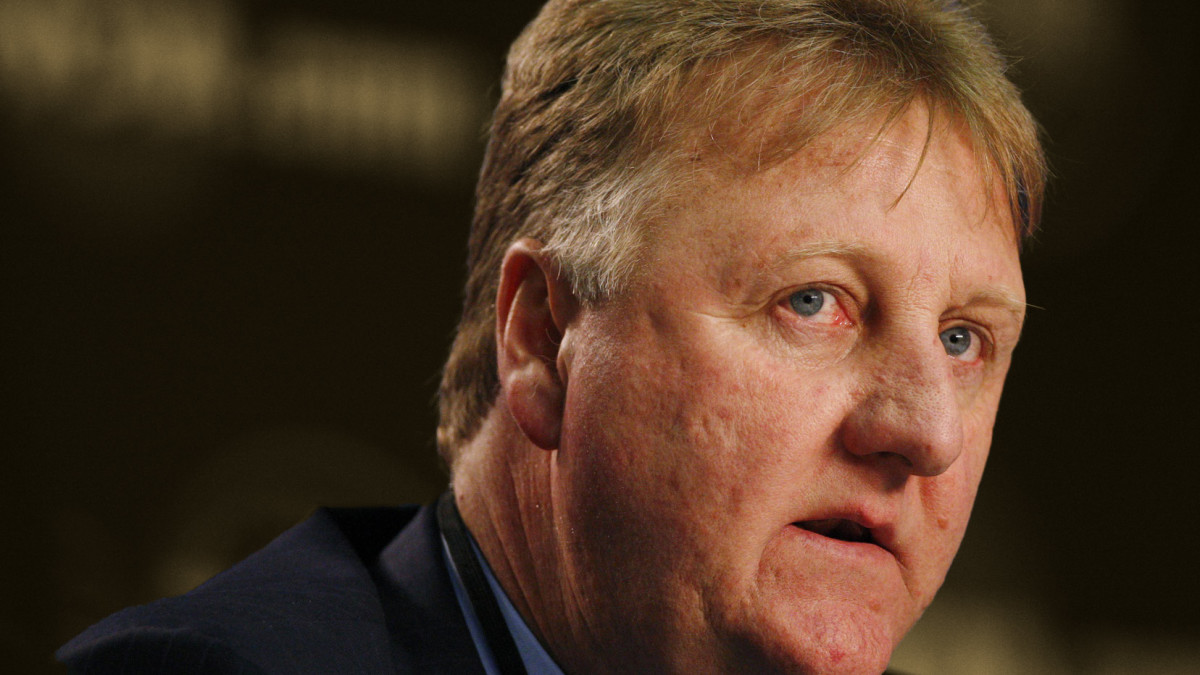
“Yeah, they’ll probably have to do something” – Bird says the NBA will be forced to move the 3-point line back if high volume continues originally appeared on Basketball Network.
Tracing the origins of the shooting game today, Larry Bird was one of the few who started shooting from a distance long before it became a cornerstone of basketball strategy. Back in the early 1980s, the 3-point shot was still a novelty, a calculated gamble rather than a central weapon.
Advertisement
Bird started shooting threes and began to understand the value of that shot. He didn’t rely on them the way modern guards do, but his willingness to step back and let it fly made him one of the first true floor spacers in NBA history.
In a league dominated by post-play and mid-range jumpers, Larry was quietly redefining how space could be used on the floor.
The evolution of shooting
Across his 13-year career, the Boston icon made 649 3-pointers at a time when teams were only taking about three to five threes per game. In today’s NBA, teams are putting up more than 35 a night. And now, as the game continues to evolve into a barrage of long-range attempts, Bird believes it will continue to grow as more shots are taken.
Advertisement
“If we start to get guys shooting 40-50 percent [from the 3-point line], multiple guys year after year, and you see centers shooting 40-50 percent, yeah, they’ll probably have to do something,” he said. “But right now, we’re not there.”
But the years between Bird’s era now seem like a very long time as the game has turned into a shooting spree, which might mean more evolution of the 3-point shot.
When Larry retired in 1992, the league leader in 3-point attempts was Vernon Maxwell with 503. Fast forward three decades and that number feels quaint — Stephen Curry shot 1,159 threes in the 2015-16 season alone.
In today’s NBA, the shooting landscape is unrecognizable from Bird’s heyday. Stretch fours and fives are now standard, spacing is sacred, and games are often decided by who gets hotter from downtown.
Advertisement
What began as a tool to break open zones or punish lazy closeouts has become the defining feature of modern basketball. The arc that once felt like a luxury is now the primary battleground. More than 40 percent of all field goal attempts in the 2024-25 regular season were from beyond the arc. That’s up from just 20 percent a decade ago.
Still, the league isn’t there yet.
While players like Curry, Damian Lillard, and even big men have expanded their range, the collective efficiency hasn’t quite tipped into the territory that would demand a fundamental court change. League-wide 3-point percentage hovered around 30-40 percent in recent seasons, a respectable mark but not quite the avalanche.
Making the game better
In a landscape where some of his peers reminisce a little too fondly about the so-called “real basketball” days, Bird isn’t interested in taking shots at the modern game. Instead, he sees the evolution for what it is, a response to athleticism, space, and pace. More importantly, it was a solution to a problem the league quietly faced years ago.
Advertisement
“I think it’s been better for our game,” Larry said of the 3-point shot. “One of the reasons is I know 10 or 15 years ago, they were talking about the court being too small, players getting too fast, too athletic, and they were sort of bunching in there, and there was not a lot of movement. But the way they changed the rules… and the 3-point shot, the court looks as big as it ever has, so I think it’s great for the game.”
There’s an understated clarity in Bird’s assessment. In the mid-2000s, the league grappled with declining scoring and sluggish offense. Paints were crowded, hand-checking still lingered, and elite athletes found themselves battling through traffic every possession.
The introduction of defensive three-second violations, along with the emphasis on freedom of movement, helped unlock new dimensions, but it was the 3-point explosion that cracked everything open.
By spreading defenders out and creating more room to operate, the game started to breathe again. Ball movement returned, spacing dictated strategy, and suddenly, every team was looking for their own version of a stretch four. The court didn’t get bigger, but it felt like it did.
Advertisement
For Bird, who once played the angles better than anyone, it’s not hard to see the poetry in that.
The very tool he once used to punish lazy defenders has become the lever around which modern offense turns. And even if the league eventually has to redraw the arc to keep things honest, Larry seems at peace with how the shot has changed basketball for the better.
This story was originally reported by Basketball Network on Jun 11, 2025, where it first appeared.