
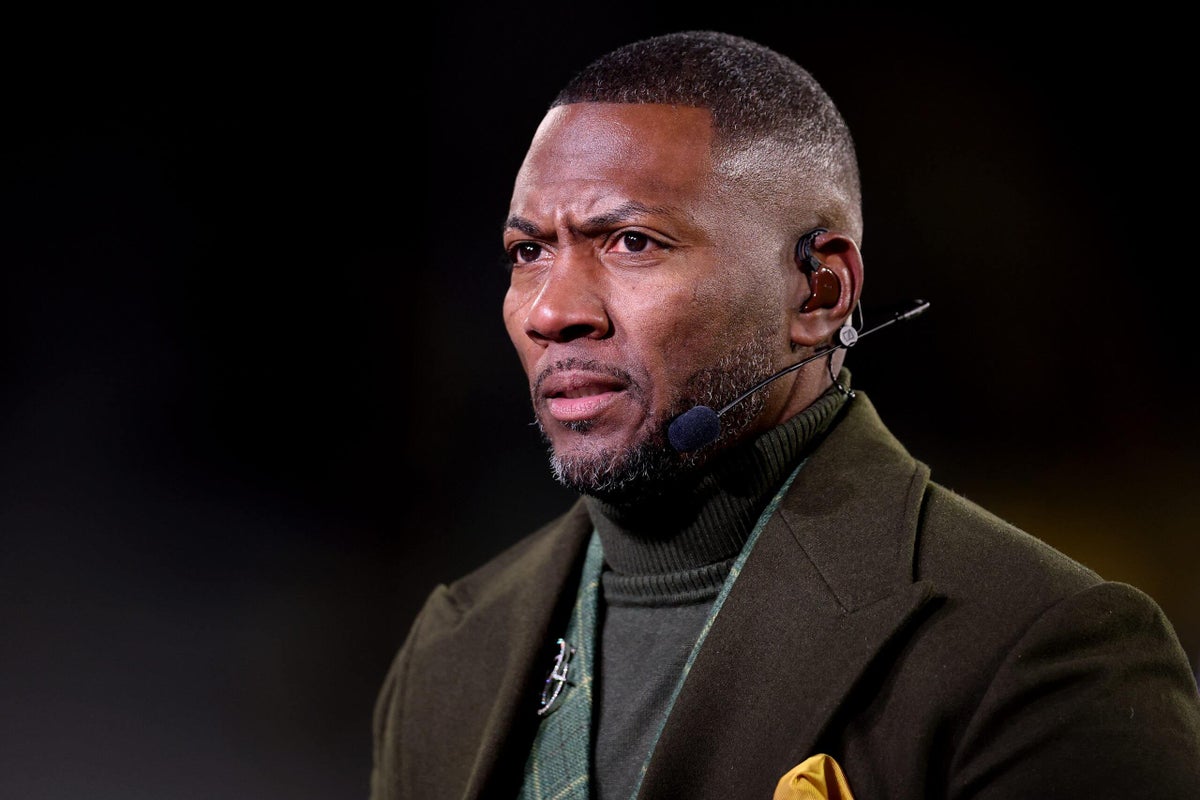
There’s nothing casual about a conversation with Ryan Clark. He gives you the full experience: empathy, humor, active listening, vulnerability, validation. Call expecting to chat for 30 minutes, and nearly an hour and a half later, he’s apologizing for talking so long.
I was just sorry the interview had to end.
As a human being, his range exceeds what he displayed as an NFL free safety. That is why, amid all the media bluster nowadays, he has become a marquee television analyst over the past dozen years. And with a new NFL season commencing without Clark on ESPN, there is a void.
He’s about to fill it himself.
On Monday, Clark announced his latest venture, a weekly studio show called “The Pivot Sports with Ryan Clark.” It is produced in partnership with NFL Films, and Clark will work with his podcast partners and former NFL players Channing Crowder and Fred Taylor. Starting today, it will stream on The Pivot’s YouTube channel every Monday at 2 p.m. Eastern time.
For Clark, who was a versatile and tireless force in ESPN’s sprawling programming around “Monday Night Football,” the day carries special meaning. Seven weeks after ESPN cut ties with him in the most humiliating way — notifying Clark of the layoff during an “NFL Live” commercial break — he doesn’t take talking ball for granted.
This is an ambitious project for a small team that includes touchscreen film breakdowns, interviews with players and coaches, and NFL Films sound and footage woven through the game analysis. Clark will be at the center of it all, as a host and analyst and entrepreneur, stepping outside the traditional TV structure but expecting to produce a polished and visually stunning digital show.
In an exclusive interview with The Athletic, Clark spoke in depth for the first time outside of his podcast.
“I think the tone, for me, is definitely a triumphant one,” Clark said. “And it’s not even in the sense that I’ve won, but more that I’m not lamenting what was lost.”
He said the word “triumphant” carefully, like a man who had tested out a few other descriptions and rejected them.
“I love a little bit of doubt,” Clark said, “because the doubt drives me.”
Offense takes center stage in Week 1
Mike Sando
In his passion, there is healing. As he sorted through the anger and pain and shame, the 46-year-old Clark found the fearless underdog he used to be. He was 22 again, undrafted again, the man who clawed his way to NFL relevance before retiring to a life of green rooms and Emmy awards.
By dawn Thursday, he had already broken down the All-22 film from Seattle-New England. It wasn’t for an immediate segment, just for himself, because a retired safety still needs to know who missed his run fit. By dawn Friday, he had done the same with the San Francisco-Los Angeles Rams game.
He’s building something new out of the wreckage of a job he wanted until retirement. He’s not sure if that means he’s healed. But he’s standing.
“People always say, ‘Hey, go start your own thing.’ But without that layoff at ESPN, I don’t believe, to be honest with you, that I ever take this step,” Clark said. “I don’t think people realize the intimidating factor of that. There are a lot of unknowns, and so there was a level of fear. Being laid off unlocked all of that. I think the important thing is it paralleled my playing career.”
Throughout our conversation, Clark kept saying three words: “I can’t miss.” The refrain landed a little heavier each time. There is no flagship anymore. There is no shield.
“If it sucks,” Clark said, “they’re going to understand where it came from.”
He laughed, but he was serious. Even though he essentially works for himself now, even though he’s not desperate for money, Clark needs to succeed on his own. He felt he was the best in the business at his role, and his combination of substance and personality at ESPN clearly moved the needle. Still, that wasn’t enough.
No one at ESPN ever gave him a professional reason. Clark searched for one anyway. He combed through it so many times, and finally stopped, because the search wasn’t going to produce an answer that made sense.
Clark remembers heading to the airport after it happened. He was scheduled to do SportsCenter before flying, and his phone buzzed with a text message from a producer checking in about the live hit.
“I just got fired,” Clark texted.
“I don’t believe you LOL,” the producer wrote back.
When it became clear Clark wasn’t joking, they both got emotional.
Clark can tell that story now with resignation instead of rage. After the initial shock, he underwent a painful self-inventory. What did I do? Who did I let down? Was there a version of me that could have stopped this?
“There was an awareness and an accountability that I had to have,” Clark said.
Clark wouldn’t change much about the work. But he’d change how he managed the relationships around it. There were executives he never quite won over, and politics he’d assumed his talent and productivity would handle. He thought the job was doing the job well. But the job was also managing the room.
The last two months haven’t been all about processing grief. During a training camp tour for the podcast, Clark learned how much his voice mattered within the NFL. Executives who had never spoken to him found his number and called. A general manager drove a golf cart across his own facility to shake his hand. A coach pulled him aside to talk for 20 minutes about what happened to him. His son, Jordan, who is 25 and raised by a father who didn’t curse much around the house, sent him some words that lifted his spirits: “F— them pops, you got this.”
Clark reached for a movie reference that seemed strange at first.
“I felt like Augustus Waters,” Clark said, referencing a scene movie The Fault In Our Stars where the dying boy insisted on hearing his friends give his eulogy while he was still alive. “Because people got to, in real time, declare their support for me.”
His voice changed as he recalled the support. He didn’t realize how much he needed the love.
During a recent session with his therapist, Clark opened up about the new show. He isn’t worried about creating quality content. He’s worried about what happens after that.
“I don’t have a fear that this doesn’t work,” he said. “My fear is that I will hold on to pieces of that last experience — both good and bad — and that this works in an amazing way, and I’m still not content.”
He can’t seek payback or restoration. He’s practicing subtraction. There are people from his old ESPN life he will never make peace with, and that’s just how life is sometimes. Messy. He doesn’t need to carry them with him.
“They were, in truth, never close to me anyway,” Clark said without naming names. “What’s important to me now is where my feet are.”
Most likely, he’s in a room, staring at a screen and trying to figure out new ways to analyze football. Seven weeks ago, he thought he would be sidelined for the 2026 season. Now he has a new challenge, one that came together remarkably fast. One that asks him to do what he has always done: bet on himself.
“This isn’t about what happened to me,” Clark said. “It’s about what’s happening to me.”