
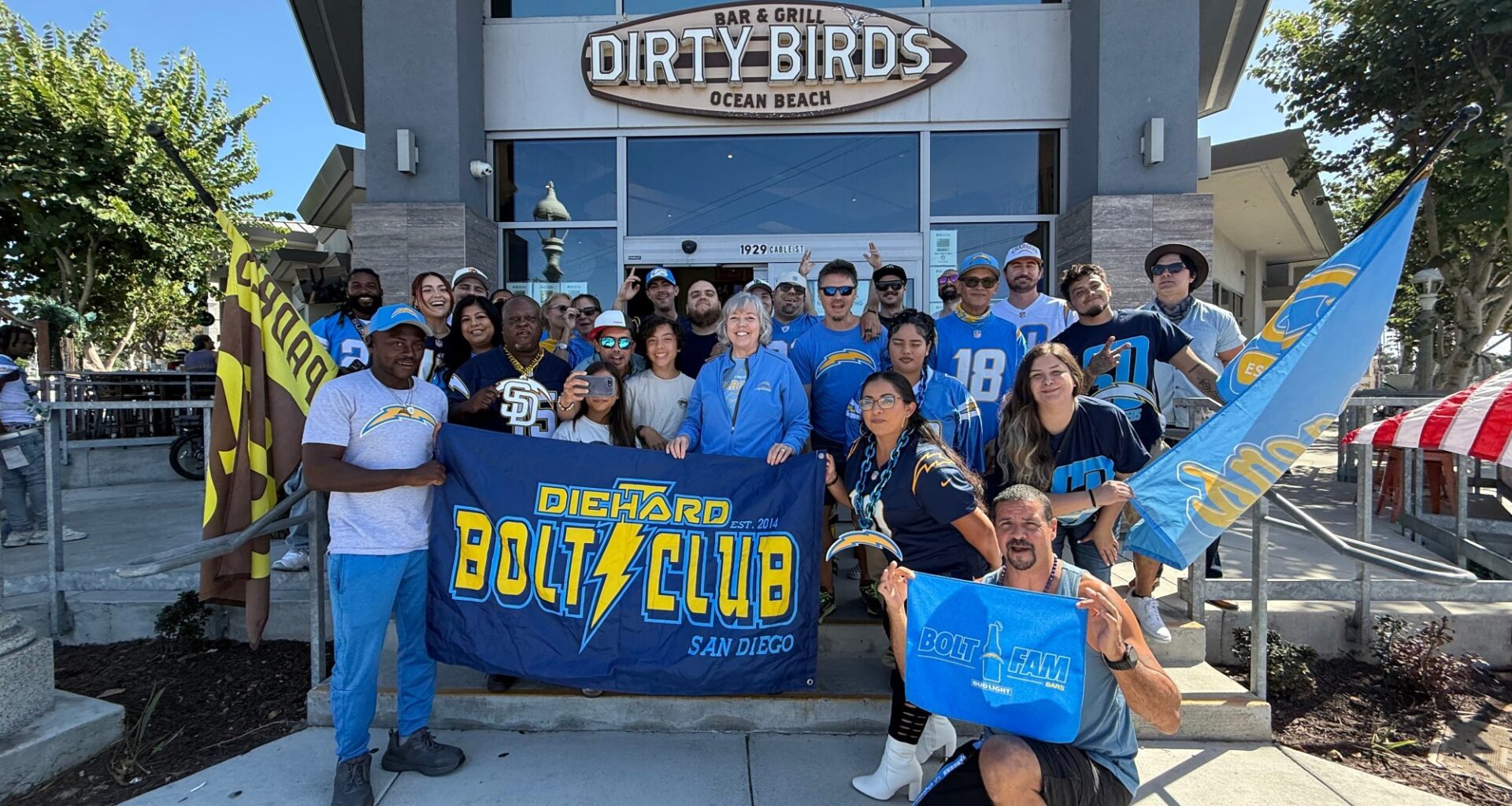
By the time the Chargers kicked off their season last Sunday afternoon, Dirty Birds in Ocean Beach had undergone a change of ownership.
The fans who came for the early games started clearing out, and in came a whole lot of powder blue. Junior Seau, LaDainian Tomlinson and Justin Herbert jerseys filled the room. A Die Hard Bolt Club flag hung prominently above the steps leading to the bar.
A little over 120 miles from where their team now plays its home games, the old rituals were still alive.
Mario Lopez, 45, had arrived early in a Tomlinson jersey. Terrell Cooper, 38, was there, too, wearing a David Njoku shirt.
Up Interstate 5 in Inglewood, Matthew Guccione, 52, had begun his morning in Thunder Alley, the sprawling fan-run tailgate outside SoFi Stadium. He would watch the game inside, then make the long drive back to San Diego.
Nearly 10 years after the Chargers bolted for Los Angeles, these men remain devoted.
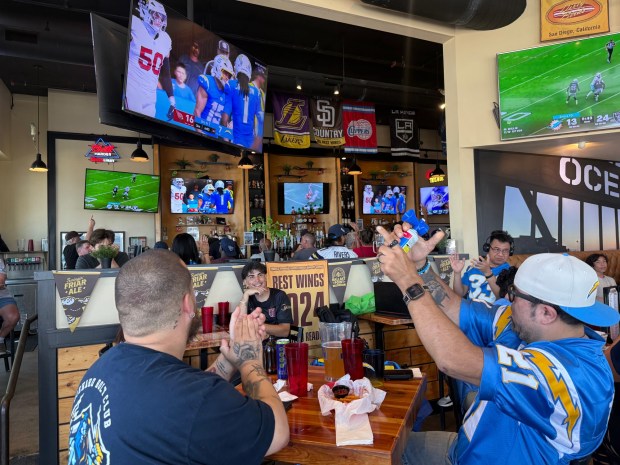 Chargers fan Mario Lopez (right, in jersey) blows an air horn following a Los Angeles touchdown during last Sunday’s watch party at Dirty Birds in Ocean Beach. Lopez is a member of the San Diego chapter of the Die Hard Bolt Club. The group gathers to cheer on a team that moved to L.A. nearly a decade ago. “We’re still here,” Lopez said. (Eddie Brown, The San Diego Union-Tribune)
The ones who stayed
For many San Diegans, that distinction remains impossible to reconcile.
Dan Wellington, the subject of this series’ first installment, became a viral symbol of the city’s anger in January 2017 when he pelted Chargers headquarters with eggs after the relocation announcement.
He no longer follows the NFL closely or supports a Los Angeles team or the Spanos family. For Wellington, the relationship ended when the Chargers left.
Lopez couldn’t imagine ending his.
A Chula Vista native who lives in Paradise Hills, Lopez inherited his Chargers fandom from his father, Mario Lopez Jr., a fan for more than six decades.
And before anyone asks, he said: “I’m a Mario Lopez. Not the Mario Lopez.”
The other one — the actor and television host — is also from Chula Vista.
This Lopez remembers Dan Fouts and Stan Humphries, endured Ryan Leaf, watched Drew Brees, Philip Rivers, Tomlinson and Antonio Gates, and now Herbert. Changing teams because the Chargers changed addresses never made sense.
“I don’t have the time or the energy to invest in another NFL team,” he said.
Lopez understood the relocation as a business decision, even if he disliked the outcome. Some of his friends abandoned the NFL. One became a 49ers fan and another went all-in on the Bills.
Those who stayed loyal hear about it.
“They’re gonna choke. They’re gonna Charger. They’re gonna continue Chargering,” Lopez said, reciting the familiar taunts.
His commitment now costs more. He makes the trip to SoFi Stadium only once or twice a season, citing tickets, gas, food and the drive. The Die Hard Bolt Club gives him people to watch with.
“It’s to show people that Chargers fans are still here,” Lopez said of the San Diego chapter. “We’re still here.”
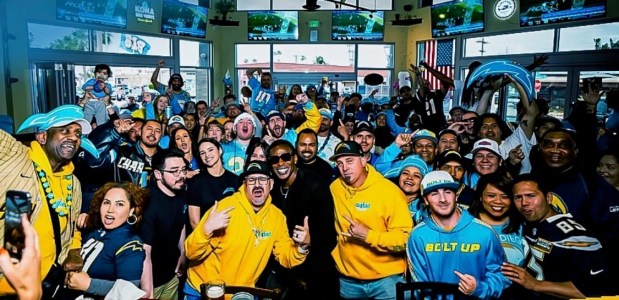 Members of the Die Hard Bolt Club pack Dirty Birds on Ocean Beach to watch this spring’s NFL Draft. (Courtesy of Matthew Guccione)
‘It was just electricity in my heart’
Cooper’s relationship with the team began much later.
An independent musician and videographer from Minneapolis, he moved to San Diego in 2013 and promptly ended his allegiance to the Vikings.
“I broke up with my old team,” Cooper said.
The Chargers became part of the life he was building. Four years later, they left.
Cooper stepped away from football for roughly a season. When he returned to watching the NFL, he discovered his attachment to the Chargers had survived.
“I got that old feeling in my heart,” he said. “It’s just some things that are never gonna be erased, and Chargers football is one of them.”
The harder part was finding others who felt the same way.
Some San Diego bars wouldn’t show Chargers games, Cooper said, and remaining fans were scattered. He joined the Die Hard Bolt Club roughly four years ago.
Cooper attended his first NFL game as a paying fan in 2021. After a COVID-testing delay, Cooper hurried inside to the first opening where he could see the SoFi Stadium field.
The first Chargers play he saw in person was a touchdown, Herbert throwing to Mike Williams and breaking Rivers’ single-season franchise record.
Soon after, a young fan standing nearby looked at Cooper and screamed: “Bolt Up!”
Cooper still remembers how it felt.
“It was just electricity in my heart,” he said. “That’s how I knew I had family, in a sense.”
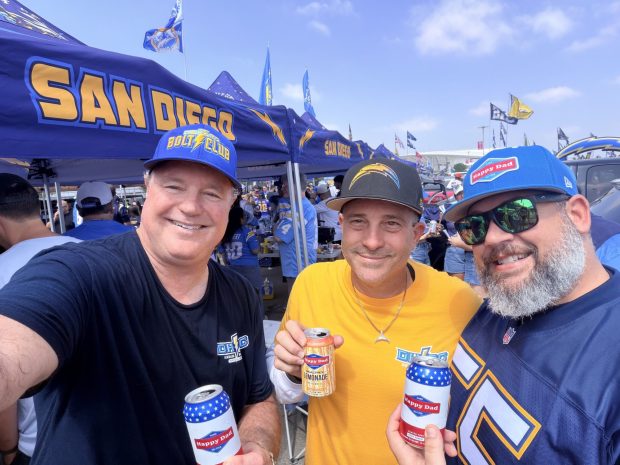 Matthrew Guccione, center, smiles as he tailgates before last week’s Chargers-Cardinals game at SoFi Stadium. Guccione is president of the Die Hard Bolt Club; he was joined at the tailgate by Jonathan French, left, president of the Orange County chapter; and fellow Chargers fan Joe Bootow, who wore a Junior Seau jersey to L.A. (Matthew Guccione)
From fan to president
Guccione’s roots with the franchise run deeper.
His father, Chris, introduced him to the Chargers and the broader pleasures of ABC’s “Wide World of Sports” when he was young. After the infamous “Freezer Bowl” loss in Cincinnati, Chris had his son write Fouts a letter, stuck it in the freezer, then wrote back pretending to be the Chargers quarterback.
Guccione was born in Los Angeles but moved to San Diego when he was 1.
“Kind of like the Chargers before they left,” he joked. “Except I’m not moving back to L.A.”
Through his childhood friend Willie Tucker Jr. and Tucker’s family ties to longtime sponsor Sycuan Casino Resort, Guccione experienced the franchise from a proximity few fans ever enjoy.
For roughly two decades, he watched from a Qualcomm Stadium skybox, with sideline and locker-room access and the occasional road trip. On draft night in 2015, he was at Chargers Park when San Diego selected Melvin Gordon and offensive coordinator Frank Reich emerged celebrating.
“He was high-fiving, hugging all of us because they got their guy,” Guccione said.
Guccione’s youngest son attended his first preseason game as an infant, and never missed a San Diego home game before the move.
He has held SoFi season tickets since it opened.
“My feeling was they could go to Nome, Alaska, and I would still root for them,” he said. “Who else am I possibly going to root for? I watched them my whole life.
“I’m definitely not going to root for the Raiders.”
He discovered the Die Hard Bolt Club online.
Founded in 2014 by Brian Boltz, the organization gave displaced fans somewhere to gather. Guccione and his wife, Andrea, joined, and he eventually became president of the San Diego chapter.
This offseason, he became president of the entire club, an international network of roughly 40 chapters stretching across the United States and into Mexico, Europe and Australia.
There are no membership dues. There are tailgates and watch parties, but Guccione wants the club to mean more than that.
Each chapter is encouraged to support a charity in its community. In San Diego, the club raises money for SOMBFAB — Some of My Best Friends Are Bald — which supports children battling cancer and helps provide special experiences, including trips to Disneyland.
His favorite gathering might be the chapter’s annual Friendsgiving, when members spend hours eating, drinking and enjoying one another’s company.
Football brought them together, but it no longer has to be the occasion.
 Los Angeles Chargers fans cheer from the stands on Sunday, Sept. 13, 2026, during the season opener against the Arizona Cardinals at SoFi Stadium in Inglewood, CA. The Chargers hosted the Cardinals at home to open their season. (Luke Johnson / The San Diego Union-Tribune)
The ritual survives
Back in Ocean Beach, the first celebration came before the Chargers even played. Former receiver Joshua Palmer caught a 34-yard touchdown pass from Josh Allen to lift Buffalo past Houston, and the room erupted for a player who no longer played for them.
Omarion Hampton’s bruising first-quarter touchdown set off an even bigger celebration. A waitress handed Lopez a miniature air horn that he blew with abandon. Someone fired a confetti popper, sending blue paper fluttering across the dining area.
At halftime, with Arizona leading 13-7, Cooper gathered members outside for the club’s traditional group photograph.
The Chargers were losing, but almost everyone smiled anyway.
Herbert’s third-quarter touchdown pass to Ladd McConkey triggered more confetti. Then the afternoon sagged. The Cardinals pulled away, 26-14, and the fourth quarter dissolved into pleading — “Come on!” — followed by groans.
“They were just flat,” Lopez said afterward.
What was lost (and gained)
What began as a club gathering at Dirty Birds has become a Chargers bar where membership isn’t required to belong.
“One of the big missions for me has been to reunite the San Diego fan base,” Guccione said.
He is reminded of what was lost every time he drives home from Inglewood.
Qualcomm Stadium once sat about five minutes from his house. He could take Mission Gorge Road and avoid the freeway altogether. It was old and deteriorating, but Guccione loved it anyway.
Even if it was a dump, he said, it was their dump.
Lopez misses the civic pride. He sees what happens when the Padres are playing well and an entire city seems to wear the same colors.
Cooper lives and works downtown. He watches crowds swarm toward Petco Park and imagines Chargers jerseys filling trolley cars bound for Mission Valley.
That makes the prospect of another NFL team in San Diego complicated.
Cooper wouldn’t switch. Too much of his life is embedded in the Chargers.
Guccione says he would probably attend games if another franchise came to town, but the powder blue and gold “run through the veins.”
Lopez has wrestled with the question and still doesn’t know what he’d do.
On Sunday, the Raiders come to SoFi, another franchise followed by generations of Southern Californians despite migrations from Oakland to Los Angeles, back to Oakland and eventually Las Vegas.
It is an old rivalry between franchises whose geography has proved less permanent than their fans.
Wellington found a measure of peace by walking away.
Lopez, Cooper and Guccione found theirs by staying.
Remaining loyal has meant longer drives, pricier Sundays and ridicule from people who believe the Chargers forfeited their affection nearly a decade ago.
Nobody got back what San Diego lost.
But nearly 10 years after Wellington threw those eggs, San Diego’s remaining Chargers fans are still gathering on Sundays, still celebrating touchdowns and still suffering through defeats.
The stadium is gone, and the team plays somewhere else.
But the community has proved considerably harder to move.
Editor’s note: Almost 10 years have passed since the Chargers ended their 56-year run in San Diego and moved to Los Angeles. Over the course of this NFL season, this series will trace the stadium fight and decisions that led to the move, revisit the fans and community left behind, assess the Chargers’ decade in Los Angeles and San Diego’s life without them, and explore whether the NFL could ever return.