
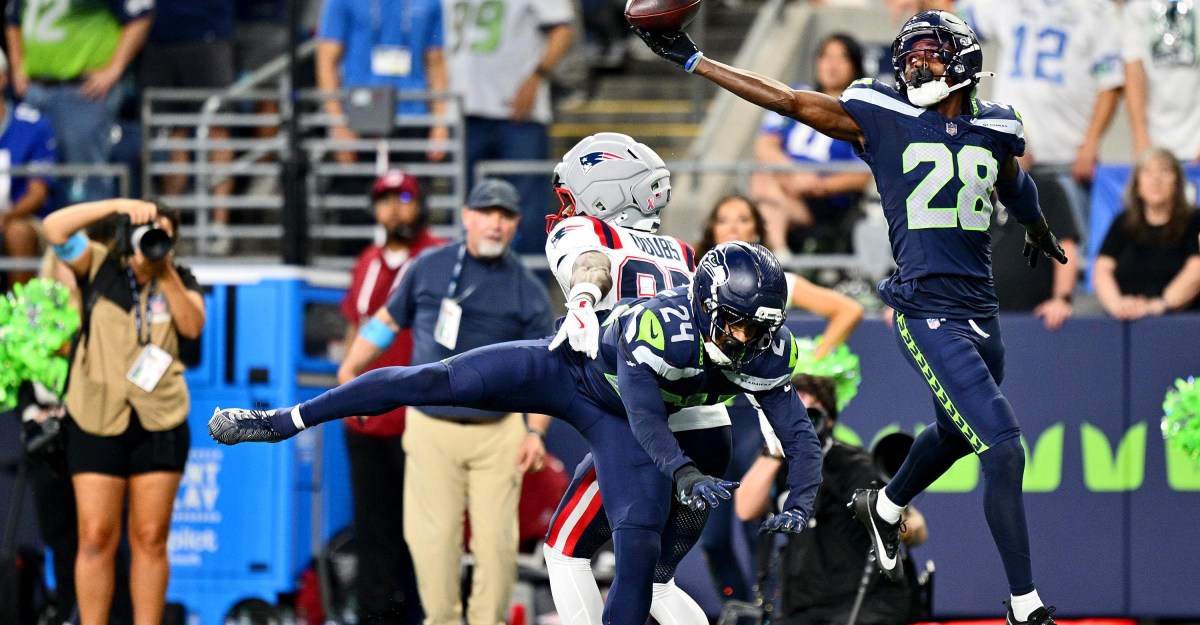
After months of waiting to finally see this version of the Seattle Seahawks on the field, the season opener quickly looked like it might turn into a disaster.
The Seahawks had spent the offseason trying to maintain the defense that carried them to a Super Bowl title, only to see injuries hit the secondary before the game. Then, just five plays into the season, Sam Darnold went down with a glute injury and suddenly Drew Lock was running the offense.
Seattle eventually rallied for a 13-10 victory over the New England Patriots, but the final score doesn’t tell the whole story.
There were plenty of things to like on the tape, particularly from Mike Macdonald’s defense, but there were also some issues that could become much more costly against better opponents.
Let’s get into the good and bad from Seattle’s season opener.
Too many self-inflicted wounds
Seattle committed 10 accepted penalties for 98 yards against New England. That is a difficult number to overcome under any circumstances, but it becomes even more concerning when you consider how those penalties affected the scoreboard.
The Patriots scored all 10 of their points with the help of Seattle penalties.
The first touchdown drive was extended by a defensive pass interference penalty on Josh Jobe, while another drive that could have ended with Seattle getting the football back was revived by a penalty on the punting unit by Chazz Surratt. Those mistakes gave New England extra opportunities and helped turn what should have been defensive wins into points.
That’s the kind of thing that can be brushed aside when you win 13-10.
It becomes much harder to overlook when you’re playing a team that can actually punish you consistently. And there were other penalties that didn’t directly produce points but still put Seattle behind the chains or erased positive plays.
For a team that was already dealing with injuries in the secondary and eventually had to play without its starting quarterback, giving an opponent free yardage and extra possessions was about as close to shooting yourself in the foot as it gets.
Seattle’s defense was good enough to overcome it this time.
Keep the quarterback in the pocket
This was another issue that stood out on tape. Drake Maye finished the game with seven carries for 47 yards, including five first downs on the ground. That’s far too much production from a quarterback who was already struggling to consistently create through the air. And this wasn’t simply about Maye being a good athlete.
Seattle occasionally lost contain while trying to collapse the pocket, giving Maye opportunities to escape rather than forcing him to throw from a shrinking pocket. Those extra yards kept drives alive and put additional stress on a defense that was otherwise doing a very good job of limiting New England’s offense.
Maye ultimately finished with 178 passing yards and three interceptions, but the rushing production was one of the few ways New England consistently created positive plays. This is something to monitor going forward, particularly against quarterbacks who are even more dangerous as runners.
Abe Lucas was not quite himself
The offensive line overall had a pretty solid night.
That might sound strange considering Seattle’s offense struggled for long stretches, but the unit did enough to keep the offense functional after Drew Lock entered the game. Lock was sacked only once (Sam Darnold was also sacked on the play in which he got injured), and Seattle finished with 200 gross passing yards and 188 net passing yards.
But if there was one offensive lineman who looked a little below his usual standard, it was Abe Lucas. That’s notable because Lucas has generally been one of the more consistent pieces of this offensive line when healthy. His ability to quietly win reps on the edge has made him one of the more dependable players up front.
Seattle runs a play-action concept with a simulated pull from right guard Anthony Bradford, something Brian Fleury has gone to fairly often. I think Lucas’ approach here should be to block No. 5 (Dre’Mont Jones) from the inside out. After losing on his first step, Lucas can’t recover quickly enough and ultimately gives up pressure.
This was the fateful play that ended Sam Darnold’s day. Lucas starts well: good posture, clean pass set and solid contact on Dre’ Jones. The pressure isn’t immediate, but as the rep develops, Lucas gets turned around and ends up trying to block Jones with his back. That’s where the rep goes wrong.
This was a great effort sack by Gabe Jacas. Abe Lucas takes an inside set while keeping his eyes on the blitz threat from No. 4. Maybe he loses his vision at some point, but his hand placement is wrong, forcing him to let Jacas go to avoid a holding penalty. Jacas finishes the play.
It wasn’t a disastrous performance, and I wouldn’t read too much into one game. But compared with what we’ve come to expect from Lucas, this was a step down.
Mike Macdonald is still finding new ways to attack quarterbacks
One of the hardest things about staying at the top of the NFL is finding ways to remain unpredictable. Defenses eventually get studied. Tendencies get identified. Opposing quarterbacks become more comfortable recognizing your structures.
Mike Macdonald still found ways to make Drake Maye uncomfortable.
Macdonald repeatedly sent pressure from the slot, something that worked well in the Super Bowl. New England countered by having quick flat options for Drake Maye to get the ball out before pressure arrived.
Here, Seattle crowds the line, showing a heavy blitz with the LBs and Julian Love. It initially looks like Spoon won’t rush, and the defense executes with great communication. Derick Hall and DeMarcus Lawrence occupy the OL until they see Love and Spoon coming, then drop into coverage. New England keeps seven in protection but has no answer for Spoon, who comes free and forces Maye to throw it away.
Brian Fleury had a good debut, all things considered
I’ll admit it: I wasn’t a fan of the decision to hire Brian Fleury.
That was never because I thought Fleury was a bad coach or that he couldn’t run an offense. My concern was more about the risk involved in handing the offense to someone entering his first season as an NFL offensive play-caller after Seattle had just won the Super Bowl.
Then, five plays into his first regular-season game, his starting quarterback was injured.
Fleury wasn’t brilliant against New England. Seattle’s offense was stagnant for much of the afternoon, and the Seahawks had only 13 first downs while converting just 2-of-11 third downs.
But he was assertive when the game demanded it. And, perhaps more importantly, he adjusted. There were also moments where Seattle appeared to identify and attack tendencies in New England’s defensive structure, creating favorable looks for its receivers.
Brian Fleury leaned heavily on outside zone, which makes a lot of sense with rookie RB Jadarian Price. Seattle’s offensive line looked well prepared for the concept, and AJ Barner was a key part of making it work. On this snap, Barner motions across the formation, forcing the defense to adjust its front and revealing how the second level is fitting the run. He works with Abe Lucas to secure the edge before climbing to the second level, effectively removing the force defender and helping create the lane Price needs to put his foot in the ground and get north.
Fleury later showed the counter to that same tendency. After repeatedly using Barner’s motion as part of the run-game structure, he sent Barner into the flat on a similar look. The defense initially reacts as if Barner is going to be involved in the blocking scheme, creating just enough hesitation for him to slip into space and pick up a first down late in the game. It’s a good example of how Fleury can use the same motion to manipulate the second level in completely different ways.
With the run game working effectively, Seattle can open up one of the biggest elements of Fleury’s passing attack: play action. It’s also a great tool for the quick passing game and an effective way to create easy answers when the defense brings pressure.
That could be especially important in a division with the 49ers and Rams, where Seattle will have to consistently find ways to neutralize aggressive fronts and pressure packages. If the Seahawks can establish the run and force linebackers and safeties to respect the play fake, play action can give the passing game cleaner windows while helping the offense stay ahead of the pressure.
Fleury showed some creative answers throughout the game, and one area I’ll be watching closely as the offense develops is how he creates space through route combinations. This is the play where Seattle had a touchdown wiped out by a penalty, but the call itself was excellent. Given New England’s tendency to bring pressure in the red zone, Fleury puts JSN and Kupp in man coverage and uses JSN’s route to effectively “protect” Kupp’s route, creating separation for what would have been an easy touchdown.
We also saw Fleury get creative with personnel and alignment. Here, he lines up JSN as the left tackle with Charles Cross on the opposite side of the formation for a pin-and-pull concept. The execution from the blockers wasn’t particularly good, but the idea itself was interesting and shows Fleury is willing to create unusual looks to generate leverage and angles in the run game.
JSN’s touchdown play is another example of Brian Fleury’s impact on the game plan. New England had repeatedly shown a tendency to send its outside cornerbacks on blitzes when Seattle aligned its receivers in tighter splits, and Fleury found a way to attack that tendency.
On the fourth-down play that ultimately changed the game, Seattle takes the shot, and JSN recognizes what the defense is giving him. Christian Gonzalez initially comes on the blitz but recognizes Emanuel Wilson’s route and changes his assignment, leaving JSN with an opportunity underneath. I’m not completely convinced this was the intended defensive call, though, because the safety never rotated quickly enough to replace Gonzalez on the outside. JSN reads it perfectly, throttles down his route and gives Darnold an easy first-down option. From there, he turns the catch into a touchdown, with AJ Barner and Eric Saubert doing an excellent job blocking downfield.
For a first game, under those circumstances, that’s a pretty encouraging starting point.
Heroes you weren’t necessarily expecting
If you had asked me before the season whether Josh Jobe would be someone I trusted in a big moment, I’m not sure I would have given you a confident yes.
And yet Jobe ended up making the biggest play of the game.
The irony is that he wasn’t perfect.
Jobe was beaten vertically on the play that eventually resulted in the defensive pass interference that helped New England score its touchdown. He was targeted, tested, and put in difficult situations.
But when Seattle needed one final play to close out the game, Jobe was the one who made it. His end-zone interception with 21 seconds remaining sealed the win and turned what could have been a brutal season opener into a victory.
Also there was Nehemiah Pritchett.
Pritchett had not exactly established himself as a player who could be relied upon to make splash plays during his first three seasons in Seattle. Against New England, he delivered one when the team desperately needed it.
Pritchett’s interception came on a play where Rodney Thomas made an excellent read and helped create the opportunity. Pritchett not only secured the ball but returned it 30 yards, putting Seattle in position to immediately change the momentum of the game.
Drew Lock being Drew Lock
There were plenty of reasons to be concerned when Drew Lock had to enter the game. He hadn’t been asked to do much in Seattle last season, and suddenly he was playing in the first game of the post-Super Bowl season after his team lost its starting quarterback.
The first part of his performance looked like exactly what you’d expect from a quarterback entering unexpectedly.
He was cautious. He took the checkdowns. He didn’t consistently push the ball downfield. But he also didn’t panic.
Lock finished 16-of-22 for 187 yards, one touchdown and zero interceptions, posting a 113.3 passer rating. He also added 13 rushing yards, including a 14-yard scramble.
Those aren’t superstar numbers. They didn’t need to be. The most important thing Lock did was avoid turning a difficult situation into an impossible one.
He protected the football, made the throws that were available and, when Seattle needed him to make a big play, he delivered.
As mentioned, Lock had a fairly quiet game—nothing particularly spectacular, but also no major mistakes. This is one of the plays where I think he left something on the field. He gets locked onto JSN and, while the ball placement could have been better for the receiver, I think he had a much better opportunity to make a big play by working back to Rashid Shaheed, who had a pretty quiet game himself.
Shaheed had a chance to turn this into a potential touchdown, and Lock appears to miss that opportunity by staying with JSN too long. It’s the kind of play that won’t necessarily show up as a major mistake in the box score, but it’s exactly the type of progression and field-reading detail that will be worth monitoring as Lock gets more reps as the starter.
The concept itself looks good here. New England’s defense communicates well and passes off the routes, but Kupp clearly has a chance to make a play. The problem is the ball placement: instead of putting the pass in a spot where Kupp can make a play on it, Lock leaves it in a much better position for the defender to intercept.
But Lock showed that he learned from that mistake later in the game. This is one of his best throws, resulting in a great catch by Kupp. Pay attention to Lock’s progression and, more importantly, where he places the ball this time. Before Kupp even makes his break, Lock recognizes the leverage Kupp has on the defender and anticipates the window, putting the ball exactly where his receiver can make a play. This time, Lock and Kupp are completely on the same page. Amazing.
I believe the intended read here was a quick throw to Elijah Arroyo. The Patriots’ linebackers don’t bite on the play action, leaving Lock with the option to pull the ball down. He doesn’t force anything, recognizes the space in front of him and takes off, coming very close to picking up the first down.
It’s a simple play, but a good example of Lock making the right decision once the initial concept isn’t there. Rather than forcing the throw into coverage, he uses his legs and nearly creates a positive result on his own.
This was not a perfect season opener, far from it.
Seattle committed too many penalties, allowed Drake Maye to create too much with his legs, and had some offensive inconsistencies that will need to be cleaned up. But the Seahawks also showed something that matters just as much this early in the season: they can win when the script completely falls apart.
The starting quarterback goes down. The secondary is dealing with injuries. You’re trailing 10-0 in a Super Bowl rematch. And somehow, you still find a way.
That’s not sustainable as a weekly formula, but the ability to respond when things go wrong is a pretty good foundation for the 2026 season.
Now comes the harder part: fixing the bad while finding ways to keep the good.