
The Detroit Lions showed incremental improvement in their Sunday afternoon win over the New York Jets. Do they look like some obvious Super Bowl contender through three games? No, there’s far too much work to do on defense. But if they can continue trending in the right direction over the next couple of months, who knows?
Here are my positional grades for the Lions in their 31-24 win over the Jets:
Early in the game, Jared Goff looked a little rattled from the pressure, particularly up the A-gap. It hurried some of his early throws and essentially ran him into a sack.
But second-half Goff was nearly perfect. I mean that quite literally. In the final two quarters, Goff was 19-of-22 for 214 yards, two touchdowns, and a 137.5 passer rating. For the second straight week, his accuracy was on display, posting a +7.6% completion percentage over expected, the fifth-best mark of Week 3 thus far (MNF not included).
Aside from an early missed pass protection by Jahmyr Gibbs, the Lions’ running backs had an outstanding day. Gibbs continues to be one of the most unstoppable weapons in football, be it on the ground (99 yards, 5.2 YPC, 2 TDs) or through the air (seven catches, 58 yards, TD).
But this was also a revelation game for Sione Vaki. His pass protection was a weapon for Detroit’s offense, because the Jets defense was relentless in their A-gap pressure. But Vaki was versatile enough not to give away the play call when he was in there. He toted the rock six times in the run game—producing a successful run on four of them. And he did a nice job maximizing his yardage on an 11-yard catch.
I can’t help but think about how much of a bonus Vaki’s pass protection will be against a team like the Vikings, who were able to essentially take Gibbs out of the game by exploiting his weakness as a pass protector.
Sam LaPorta and Brock Wright combined for five catches and 51 yards, but upon initial viewing, their blocking wasn’t necessarily the best. LaPorta was one of a few players who blew their block on Detroit’s critical fourth-down failed run, and it wasn’t the only time LaPorta’s man made a big play in the run game.
I reserve the right to change my opinion upon replay of the game, but I was underwhelmed by the perimeter blocking by the tight ends—unless you’re talking about secret tight end Skyler Gill-Howard.
I am also intrigued by the new usage of Jackson Meeks. He played just 10 snaps, but it seems like there’s potential for another versatile piece in the offense.
Amon-Ra St. Brown didn’t have his best game, catching just four passes for 19 yards and having at least one drop. But the beauty of this offense is its depth of weapons. It’s not surprising Aaron Glenn tried to take away St. Brown, but that just meant feeding Jameson Williams (4 for 49) and Isaac TeSlaa (3 for 66). That duo caught all seven of their targets, and TeSlaa, in particular, came up huge. He converted a first half fourth down that led to a touchdown, and his 49-yard grab late in the fourth quarter led to Detroit’s game-winning score.
The only reason this isn’t an A is because of a Penei Sewell holding call and a Blake Miller false start. Otherwise, I thought the offensive line was fantastic in all aspects of the game. In pass protection, I would argue neither of the sacks were on the offensive line, and Goff was otherwise hit just three times on 35 dropbacks. That pass protection gave Goff enough time to find receivers on long-developing plays, as well as go through all of his progressions.
In the running game, they were constantly moving the Jets backward. The Lions produced 2.82 yards before contact in the running game, the fifth-highest mark of Week 3, and a 56.7% success rate (fourth).
The stat line looks better than the eye test. Detroit’s defensive line produced four of the team’s five sacks, but the pressure came late to Geno Smith. The Lions opted to scale back the aggressiveness, blitzing on just 22.7% of dropbacks (season average is 33.6%). That left the front four to generate pressure on their own, and it was mixed results most of the game.
Still, the defensive front deserves a ton of credit in the run game. The Jets were stuffed on 26.3% of their rushes, the third-highest mark of the week.
Upon initial viewing, I thought it was a sloppy day from the Lions’ linebackers. Coverage appeared to be an issue, yet again. While this isn’t 100% on the linebacking unit, the Jets tight ends produced 13 catches for 164 yards and two touchdowns. Tackling wasn’t at its best against the elusive Breece Hall, either.
Still, Barnes continues to look improved from his 2025 play (8 tackles, 1 TFL in this game), and this group deserves at least some of the accolades for a strong run defense game.
Let’s start with the good: Christian Izien was out there doing Brian Branch-like things. He blew up at least four plays on his own by the line of scrimmage, including three tackles for loss. In Lions history, going back to at least 1950, a Lions defensive back has produced three tackles for loss only five times in history. Branch has done it twice; Izien has done it once in his first career Lions start; DeShon Elliott and Tavon Wilson are the other two.
Additionally, Ennis Rakestraw finally looked the part in a situational role as the outside cornerback 2 in nickel sets. Finally, Chuck Clark made the most important play of the game, sacking Geno Smith and forcing the game-clinching fumble.
But the outside cornerback position continues to be a big mess. D.J. Reed isn’t winning many of his one-on-ones, and while Roger McCreary wasn’t terrible in terms of positioning, he, too, struggled to make plays on the ball. If the Lions weren’t allowing completions, they were committing penalties. And there were at least a handful of miscommunications (still) that resulted in wide-open receivers.
It’s progress, and some credit goes to the Jets’ receivers for making incredible plays on the ball. After all, Geno Smith produced a whopping 21.1% completion percentage over expected—suggesting that Detroit was in the right position to make more plays on defense, but the Jets made a perfect pass or an unbelievable catch. But it also means the Lions were in position to make a play and didn’t.
Jacob Saylors finally provided the spark that Detroit’s kick return had been missing this year. Jacob Saylors had returns that set the Lions up at the 38-yard line and the 47-yard line. Tom Kennedy had an 11-yard punt return to Detroit’s 39-yard line.
Meanwhile, the coverage units were solid, as well. The furthest the Jets returned a kickoff was the 32-yard line, and they had no returns in the punt game.
Special teams only got dinged for one penalty that erased a decent return from Kennedy and a Jake Bates kick that went for a touchback—although he deserves credit for placing most of his kicks almost exactly at the goal line.
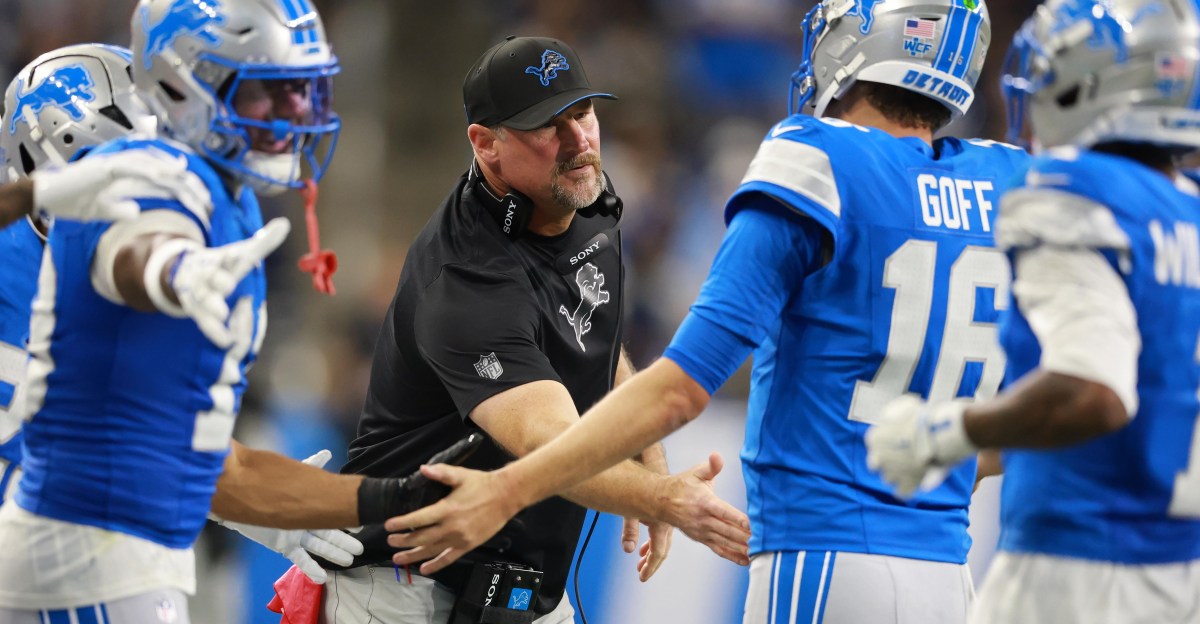
No real issues with how Dan Campbell managed the game. Clock management was fine, and I was very much okay with Detroit’s two decisions to go for it on fourth down.
On offense, Drew Petzing continues to look very promising in the way he calls games. There’s enough variation and sequencing to put the Jets in a bind, and I really like how they adjusted to the Jets’ initial success at a-gap blitzing. The fourth-down run stuff probably could have used a little more creativity in it, but it was also just blocked up horribly.
Defensively, at least a little credit goes to Kelvin Sheppard for making adjustments from the first two weeks. The Lions toned down the blitzing to help their back end a little more, and while there were still too many missed assignments, it was better. The personnel changes all seemed pretty smart, too. McCreary for Rock Ya-Sin was at least a push, Malcolm Rodriguez was fine as a full-time starter—and credit for using Trevor Nowaske, who was very solid. Sheppard also did a great job leaning into Izien’s strengths to make his first start a great one.
But Detroit is still seeking answers to their biggest problems: explosive plays (Jets had six plays of 20+ yards) and third-down defense. The Jets converted 6-of-12 third downs, including a third-and-6, third-and-7, and a third-and-17 (via penalty)—and a fourth-and-6. Detroit stops any of those plays, and this is a much more comfortable win.
Also, I have to talk about the hail mary defense. It was indefensibly reckless from the Lions. A one-man pass rush was bad enough, but they also had several defenders covering the intermediate and boundaries of the field. Those are quite literally wasted players covering parts of the field that the Jets couldn’t and wouldn’t attack. Either put 10 guys in the end zone or give your pass rush a chance to force a bad throw.