

The Chargers didn’t leave behind an economic crater.
They left holes.
At McGregor’s Bar & Grill near the old Qualcomm Stadium, Sundays remained busy, but no longer delivered the same windfall as when crowds of 50,000-plus gathered nearby at Qualcomm Stadium.
At Oggi’s Pizza & Brewing Co., the team helped transform a small regional chain into a recognizable Southern California brand.
At Cali BBQ in Spring Valley, owner Shawn Walchef remembers sales climbing 30% to 40% whenever the Chargers played.
Up close, the impact was easy to see: fewer customers, weaker sales, diminished game days.
From farther away, it nearly disappeared.
San Diego County kept adding jobs. Its economic output kept rising, taxable spending increased and tourists kept coming.
Los Angeles County, which gained the Chargers in 2017, followed a broadly similar trajectory.
Nearly a decade later, that contrast offers perhaps the clearest way to understand what San Diego lost: not a regional economic engine, but a concentrated stream of customers, spending and attention flowing through particular businesses on particular days.
The regional economy absorbed much of the spending.
Individual businesses absorbed the loss.
Looking for the Chargers in the numbers
The relocation created an imperfect economic experiment, complicated by the fact that Los Angeles had already regained the Rams a year earlier.
Still, if losing the Chargers created a meaningful regional drag, some deterioration might be expected in San Diego. If gaining them provided a meaningful boost, some acceleration might appear in Los Angeles.
Neither is obvious.
According to the Bureau of Economic Analysis, San Diego County’s inflation-adjusted gross domestic product increased 8.6% from 2016 through 2019, the last full year before the COVID-19 pandemic complicated comparisons. The Los Angeles metropolitan area grew at 10.3%.
San Diego metropolitan employment increased 5.7% over the same period, compared with 4.2% in Los Angeles, according to the Bureau of Labor Statistics. The labor market that lost the Chargers actually expanded somewhat faster than the one that gained them.
Taxable transactions increased 10.3% in San Diego County and 11.4% in Los Angeles over the same period, according to the California Department of Tax and Fee Administration.
Even industries most likely to feel the loss of football crowds showed no obvious break. San Diego leisure-and-hospitality employment grew 11.4% from 2016 through 2019, compared with 6.7% in Los Angeles. Restaurant employment increased from about 130,100 jobs to 144,300.
San Diego’s tourism economy kept growing, too. Tourism Authority data show visitor spending rising from roughly $10.4 billion in 2016 to $11.6 billion in 2019.
None of that proves the Chargers had no economic effect. It shows that whatever effect existed was too small to produce an obvious rupture in a regional economy encompassing millions of people and hundreds of billions of dollars.
Andrew Zimbalist, professor emeritus at Smith College and one of the country’s leading sports economists, cautions against treating simple before-and-after comparisons as causal proof because too many other forces are moving simultaneously.
Still, broader research, he said, has repeatedly found little evidence that adding a professional football team produces substantial metropolitan growth.
“The general finding of economists who have looked at this is that adding an NFL team to your city doesn’t have a positive economic impact,” Zimbalist said. “And therefore, if you lose an NFL team, it won’t have a negative impact.”
A 2023 survey of more than 130 studies spanning three decades found similarly limited metropolitan economic effects from professional teams and stadiums. Researchers point to the “substitution effect” as a key reason.
Money that once went toward Chargers tickets, parking, beer, jerseys or pregame meals doesn’t necessarily disappear when the team leaves.
A San Diegan might spend it at a Padres game, a brewery, a movie theater, another restaurant or someplace else in the local economy.
“The substitution effect means that the activity is displaced,” Zimbalist said. “It’s displaced from one area of the city to another.”
There also can be leakage when money flows to a national sports enterprise, highly paid players or wealthy owners who live elsewhere rather than circulating locally.
At county scale, those shifts can be almost invisible.
At street level, they weren’t.
The losses were scattered
One year after the Chargers left, the Union-Tribune examined what had disappeared with them.
The losses were scattered, but substantial.
Revenue at downtown’s Barley Mash fell by $1 million in 2017. The Verant Group said business was down about 10% on weekends that previously benefited from Chargers games and traveling fans.
Sports Fever at Westfield Mission Valley reported a $250,000 revenue decline. Good Time Design said its downtown establishments lost hundreds of thousands of dollars in weekend business.
Hotels felt it, too. The Handlery Hotel in Mission Valley estimated that losing NFL games cost $50,000 to $75,000 in 2017. Raiders weekends could fill nearly half its 217 rooms with traveling fans.
Yet the broader hotel market grew. San Diego hotel occupancy and room revenue increased in 2017, and the Tourism Authority counted more than 17 million countywide room nights.
The pattern was the same one now visible in the longer-term data: concentrated losses without an obvious regional downturn.
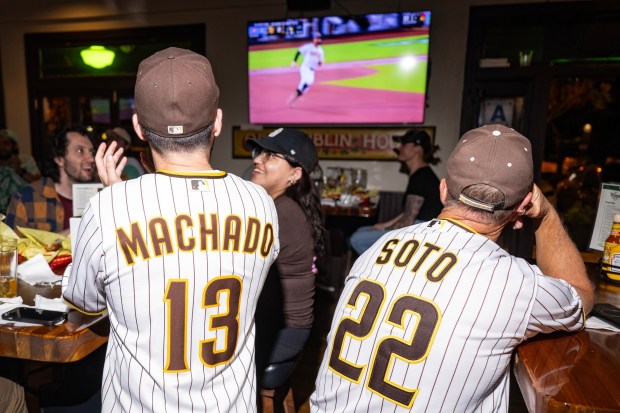 Padres fans watch the Wild Card Series from McGregor’s Bar & Grill on Rancho Mission Road. (Luke Johnson / The San Diego Union-Tribune)
The sky remains intact
Ian Linekin, owner of McGregor’s Bar & Grill on Rancho Mission Road, never expected his business to live or die with eight Chargers home games.
“Anybody that bases their business off of eight games a year shouldn’t be in business,” Linekin said.
McGregor’s opened in 1996, when both the Padres and Chargers played down the road at Qualcomm. Losing 81 baseball dates when the Padres moved downtown after the 2003 season was challenging, but the bar became easier for neighborhood customers to reach — and got busier.
By the time the Chargers left, McGregor’s had built a broader customer base. The game-day windfall diminished, but the bar retained regulars, 30 televisions and a city full of transplanted football fans.
“I wouldn’t say it’s on par,” Linekin said of NFL game days after the move, “but it’s definitely not like the sky is falling.”
Then came COVID-19.
The pandemic reduced McGregor’s at one point to Linekin and his longtime kitchen manager Chuey running takeout and drinks themselves. Employees eventually returned to help keep the business alive, some initially unsure whether Linekin could pay them.
Compared with that, he said, losing the Chargers “doesn’t even come up on the radar.”
Snapdragon Stadium, built on the old Qualcomm site, has since restored a busier event calendar to the neighborhood. There’s San Diego State football, professional soccer, concerts and other events.
“We knew we were going to lose some business on those eight days,” Linekin said. “But … there’s a whole year you got to deal with.”
 The Hadjis family outside of Oggi’s Del Mar in Carmel Valley:
(l-r) Tommy Hadjis, Dora Hadjis, Estella Ferrera, and Shawn Hadjis.
(Courtesy of the Hadjis family)
‘It put us on the map’
Estella Ferrera saw the Chargers differently.
When Ferrera helped establish a relationship with the team in the early 2000s, Oggi’s was still a small regional chain. She viewed sports as a way to expand the brand beyond the neighborhoods surrounding its restaurants.
Oggi’s sold pizza inside Qualcomm, staffed concession locations and put its name throughout the stadium. The concessions were not especially profitable, Ferrera said. The value was exposure.
“It put us on the map,” said Ferrera, now the company’s president and CEO.
Before the partnership, customers tended to know Oggi’s only near its restaurants. Afterward, “everybody knew who Oggi’s was.”
The chain had grown to 16 locations by the time the Chargers left, including seven in San Diego County. So when Ferrera learned by email in January 2017 that the move was official, the loss was about more than eight home dates. Oggi’s was losing a marketing platform that had helped build its brand, and Ferrera worried public anger toward the Chargers might spill onto the company.
Oggi’s moved quickly, redirecting its Chargers marketing dollars elsewhere. By 2018, it had become the official pizza of San Diego State athletics.
“We did a lot of really big things, so that we didn’t feel it as a chain,” Ferrera said.
Individual restaurants were another matter.
Oggi’s recently reacquired and remodeled the Mission Valley location, installing massive televisions and trying to rebuild its football business. But Ferrera estimates its current NFL-Sunday traffic at roughly 30% to 50% of what those Sundays once produced.
Snapdragon events create their own surges, but they’re not the same thing.
“We were the Chargers bar,” Ferrera said.
‘Probably a blessing in disguise’
Walchef understood that identity better than most.
Before the Chargers left, he created the San Diego Love Letter Challenge, using social media to encourage fans and businesses to explain publicly why they wanted the franchise to stay.
He had built Cali BBQ around the culture of sports rather than proximity to the stadium.
His argument was never strictly about the team.
It was about the tailgates and national television shots of San Diego. Visiting fans promising to make a trip when their team came to town. A civic ritual attached to the country’s biggest sports league.
“It’s bigger than football,” Walchef said of what he was trying to preserve.
Cali BBQ remained a Chargers bar, and Walchef a season-ticket holder, following the team first to Carson and then SoFi Stadium.
But his business could not follow the old model forever.
Before the move, he said, a typical NFL Sunday generated roughly $18,000 in sales. When the Chargers played, revenue could rise significantly. A busy NFL Sunday required a staff of roughly 45. Today, his Sunday operation might use about 22.
That is not a clean measurement of the Chargers’ departure. COVID-19 changed restaurant habits, labor and food costs soared, and streaming fragmented sports viewing.
Walchef adapted to all of it by leaning harder into digital ordering, takeout and delivery.
The Chargers’ departure, he said, revealed that Cali BBQ had invested disproportionate time and effort in “something that was only 18 days out.”
Looking back, he called it “probably a blessing in disguise.”
“We had to figure out how to keep a restaurant in business that doesn’t depend on the NFL.”
A rhythm harder to replace
San Diego gradually filled the gaps with other teams, events, customers and new ways of doing business.
What proved harder to reproduce was the predictability.
For years, the Chargers gave businesses a recurring calendar they could build around.
Home games brought tens of thousands of people toward Mission Valley and away games still gave fans a reason to gather somewhere.
Restaurants could staff for it, and bars could market around it. Hotels could identify the weekends most likely to draw traveling fans. Retailers knew when demand for jerseys and other merchandise might rise.
After the move, that activity became less concentrated and less predictable.
Some fans kept following the Chargers, but others found different teams, different sports or different ways to spend their time.
The broader economy absorbed the change because the spending was redistributed across a much larger region.
For individual businesses, the adjustment was more personal.
What disappeared was not simply one afternoon’s receipts. It was the confidence that whenever the Chargers played, a familiar group of customers would again have a reason to show up.
Editor’s note: Almost 10 years have passed since the Chargers ended their 56-year run in San Diego and moved to Los Angeles. Over the course of this NFL season, this series will trace the stadium fight and decisions that led to the move, revisit the fans and community left behind, assess the Chargers’ decade in Los Angeles and San Diego’s life without them, and explore whether the NFL could ever return.