
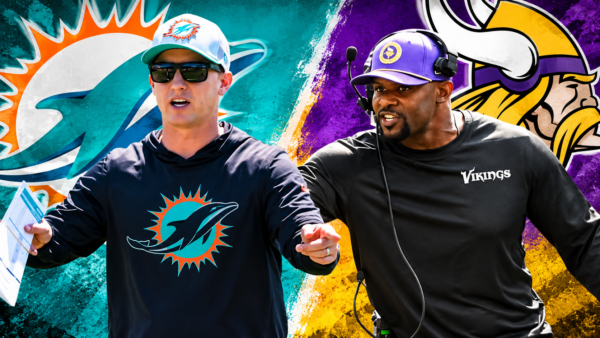
Bobby Slowik on Replacing Achane and Preparing for Brian Flores
Miami Dolphins offensive coordinator Bobby Slowik sees progress from his offense through three games, but the next challenge may be one of the most difficult they have faced.
Miami must move forward without De’Von Achane while preparing for a Minnesota Vikings defense coordinated by former Dolphins head coach Brian Flores. Slowik discussed both challenges this week, along with the continued development of quarterback Malik Willis and an offensive line that took a noticeable step forward against Kansas City.
Slowik Credits Offensive Line for Improvement
After acknowledging earlier this season that Miami could do more to help its offensive tackles, Slowik was asked whether the Dolphins provided additional assistance against Kansas City.
According to Slowik, that wasn’t necessarily the case.
Instead, he believes Miami simply played better up front.
“I wish I could tell you that it was my designs, but it was not, we played better,” Slowik said.
Miami emphasized getting the football out quickly against Kansas City, which helped reduce some of the pressure on the tackles. But Slowik credited the entire offensive line for improving, saying the tackles, guards and center all took a step in the right direction.
That’s an encouraging development for an offense that will need its offensive line more than ever following the loss of Achane.
Dolphins Looking to Get Malik Willis Into a Rhythm
Getting the ball out quickly also appeared to help Willis.
Slowik explained that easy completions can help a quarterback establish a rhythm early in a game. Once a quarterback begins stacking completions, Slowik believes it can improve everything from his confidence to his eyes, footwork, and willingness to get the football out on time.
The problem is manufacturing those easy completions against NFL defenses.
“You’re only limited to maybe one or two of those, and then it’s up to the quarterback: can you carry that over into the other plays,” Slowik said.
Against Kansas City, Slowik believes Willis did exactly that.
Willis bought into Miami’s emphasis on playing on time and consistently getting the football where it needed to go. Slowik thought Miami executed its offensive plan well for roughly three and a half quarters.
Replacing De’Von Achane Will Be a Group Effort
The biggest change for Miami’s offense going forward is losing Achane.
Slowik made it clear no single player can replace everything Achane brought to the Dolphins.
“You can only do so much to make up for a player of the caliber that De’Von Achane is,” Slowik said.
Slowik spoke highly of Achane not only as a player but as a person and leader. Even after suffering his injury, Achane remained on the sideline supporting his teammates and coaches.
But Miami now has to move forward.
That creates an opportunity for Ollie Gordon II and Jaylen Wright, along with potentially other players in the Dolphins’ backfield.
Slowik wasn’t ready to reveal exactly how the workload will be divided.
“You’re probably going to see a few faces back there and we’ll see where it goes,” Slowik said.
The offensive coordinator also stressed that replacing Achane isn’t solely the responsibility of the running backs. Miami’s offensive line, tight ends and receivers will all have roles in making the transition easier.
Dolphins Won’t Completely Change Offense for Gordon and Wright
Gordon and Wright have different physical attributes than Achane, but that doesn’t mean Miami is preparing to completely overhaul its rushing attack.
Slowik pointed out that Gordon and Wright have practiced the same concepts and plays as Achane.
The Dolphins will naturally emphasize what each player does best, but the foundation of the offense should remain intact.
All three backs possess the vision and one-cut ability Miami wants in its zone-running scheme. The differences come in how they create problems for defenses.
“J-Wright obviously is very fast, Ollie is obviously very big and hard to tackle,” Slowik said.
Miami can therefore take advantage of Wright’s speed while allowing the 6-foot-1, 226-pound Gordon to bring a more physical dimension to the running game.
Slowik doesn’t anticipate a dramatic schematic change. Instead, Miami will tweak its approach to emphasize the strengths of the backs now carrying the load.
Brian Flores Presents a Major Challenge
The Dolphins now have to make those adjustments while preparing for a Flores defense that Slowik considers one of the most challenging in football.
“Flo does a phenomenal job,” Slowik said. “I think he’s one of the more challenging guys to go against in the NFL.”
Slowik praised Minnesota’s ability to create difficult looks and then provide variations off those looks.
That places pressure on everyone involved in Miami’s offense.
The offensive line, running backs and tight ends must be sound in protection, but Slowik stressed that Willis and his receivers also need to recognize what Minnesota is doing and react accordingly.
Picking up the pressure is only one part of the equation. Willis must also know where and when to deliver the football.
For Miami, communication will be critical.
Slowik said there are different philosophies around the NFL for identifying pressure looks. Regardless of the terminology Miami uses, the most important thing is making sure all 11 players interpret what they’re seeing the same way.
The quarterback, offensive line, backs, tight ends and receivers can’t have different interpretations of the same defensive look.
That’s been a significant part of Miami’s preparation this week.
Slowik Encouraged by Willis’ Development
Slowik also continues to see progress from Willis.
The quarterback’s running ability was an important component of Miami’s offense against Kansas City, and Slowik thought Willis generally made good decisions about when to run and when to protect himself.
His biggest mistake was the fumble, something Miami has emphasized correcting this week.
Beyond one game, however, Slowik believes Willis is becoming a better quarterback.
“It’s been fun to watch,” Slowik said.
He described Willis as a reflection of Miami’s entire young offense — a group that remains hungry to learn and improve.
Slowik believes Willis has embraced the areas he needs to improve while still maintaining the traits that make him dangerous.
More importantly, Slowik sees a quarterback who isn’t solely focused on his individual development.
“He doesn’t want it to just be himself, he wants everyone to kind of come along with him,” Slowik said.
The Dolphins remain winless, but Slowik believes the offense is moving in the right direction.
Now comes the next test.
Without Achane and facing a Flores defense designed to create confusion and pressure, Miami will find out whether the progress it showed against Kansas City can carry over into Week 4.