
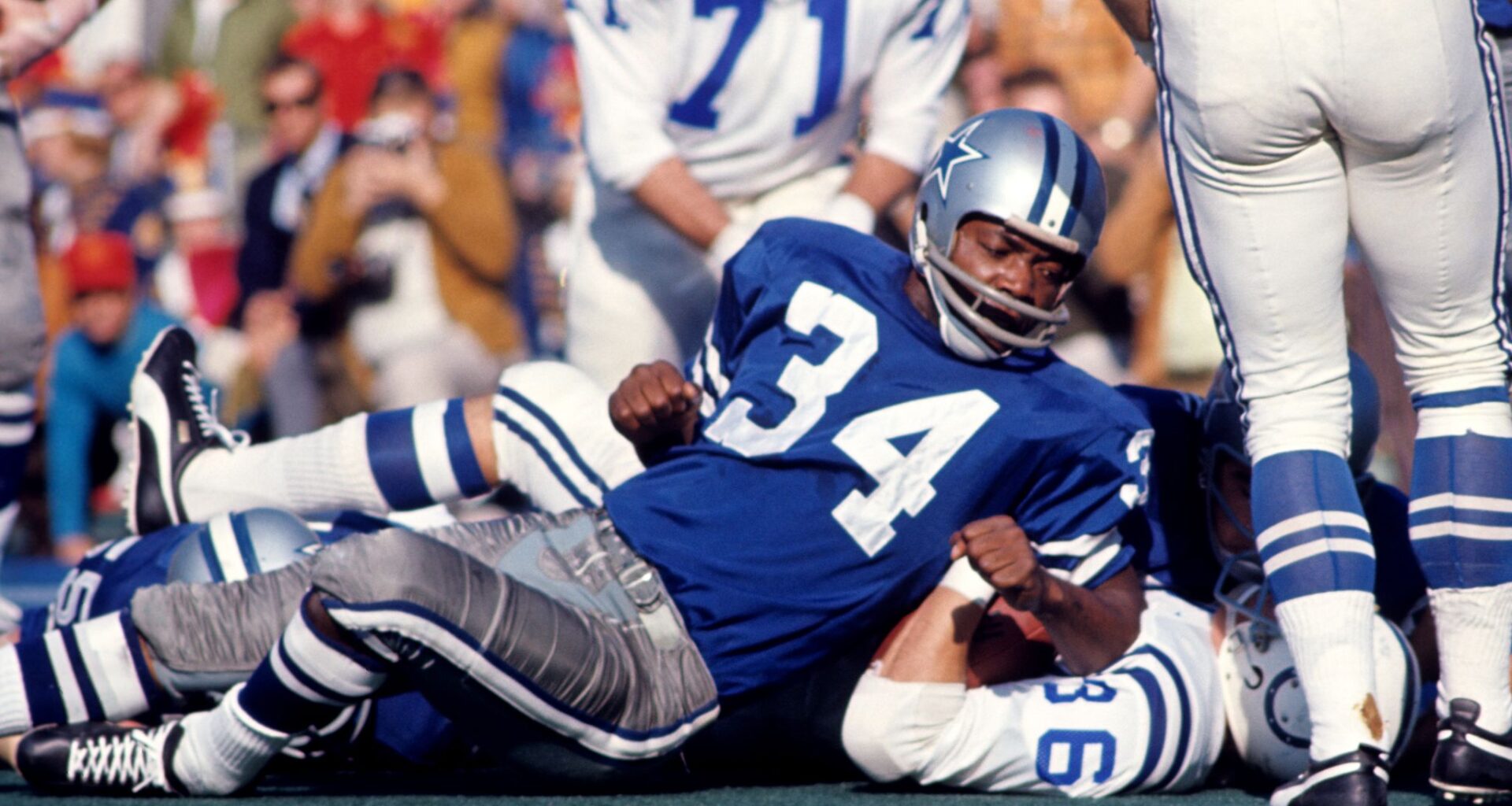
Safety Cornell Green (34) of the Dallas Cowboys tackles running back Norm Bulaich (36) of the Baltimore Colts during Super Bowl V on January 17, 1971 at the Orange Bowl in Miami, Florida.
Diamond Images
Before making five Pro Bowls as a cornerback and safety and certifying the Cowboys’ bona fides as an organization that left no stone, or ball, unturned, Cornell Green had played exactly one season of football. And that was his junior year at El Cerrito High. He only played then so he could letter in something other than basketball, the sport that earned him All-American honors at Utah State twice over.

In fact, the Aggies’ all-time leading rebounder had just been named a fifth-round draft pick of the Chicago Zephyrs, now the Washington Wizards. The only reason he took Gil Brandt’s offer of a free agent tryout in 1962 was the $1,000 bonus he’d wheedled out of the Cowboys’ talent guru.
He figured he’d last a week with the Cowboys, then take his money to Chicago and live it up a little before hoops started.
Article continues below this ad
Green, who died Wednesday at 86 after a long slog with dementia, became instead one of the most unlikely success stories in the history of the NFL, let alone the organization that afforded him a shot.
“Any time you have a guy come into the league and does what no one else has ever done,” said former NFL lineman and long-time Cowboys executive John Wooten, “you’d have to think of this guy as a Hall of Famer.
“This guy should be in the Hall of Fame.”
Green isn’t in Canton and he’s not a member of the Cowboys’ Ring of Honor, either, though the organization released a statement Wednesday noting his status as a “trailblazer” as well as his inclusion on the 25th Anniversary Cowboys Team. The condolences also included a reference to the fact that he “remarkably” never missed a game in 13 years, “becoming one of the best and most dependable teammates to ever wear the star.”
Related: NFL pioneer John Wooten makes a case for Cornell Green’s entry into Cowboys Ring of Honor
Article continues below this ad
Of course, if you know your Cowboys history, you know even all that didn’t cover what he meant to the organization. He arrived at a time when they’d won a total of four games in two years. They were also young and brash and willing to try something new, attributes the old guard found unamusing.
Brandt upped the ante on the Cowboys’ arrogance by declaring the draft “overrated” as a source of talent. Talent could be found anywhere. Size and speed were paramount. He developed a nationwide network of contacts and hit the road, investigating tips.
Former Dallas Cowboys defensive back Cornell Green speaks after receiving the Tom Landry Memorial Legend Award during the Cowboys Kickoff Luncheon Wednesday, August 28, 2013 at Cowboys Stadium in Arlington. (G.J. McCarthy/The Dallas Morning News)
G.J. McCarthy – Staff Photographer
When Utah State’s basketball coach called in ’62, Brandt didn’t require much persuasion. Besides the fact that, at 6-4, 215 pounds, he would be big for an NFL defensive back, then or now, he was also fast. Came from good athletic stock, too. His oldest brother, Pumpsie, was the first African-American to play for the Boston Red Sox. Another brother, Credell, was a member of the first recruiting class at the University of Washington to include Black football players.
Still, even though Tex Schramm had given the former baby photographer plenty of rope in scouting, Brandt knew he was risking his budding reputation.
Article continues below this ad
“When I brought in Green and introduced him as a basketball player,” the Hall of Famer once said, “nobody said anything, but I could tell there were skeptics.
“After Cornell made good, it was easy for me.”
Green’s immediate success led to the signing of the World’s Fastest Man (Bob Hayes), another basketball player (Pete Gent) and even a soccer player (Toni Fritsch), not to mention the legions of undrafted free agents who filled out the Cowboys’ Super Bowl rosters and a few Pro Bowl cards.
Hard to question the personnel guy’s whims when, his first swing out of the box, he hits on a guy who starts three games as a rookie and all but one in the 12 years to come. As a cornerback, Green made three Pro Bowls and two first-team All Pro lists. In ’67, he paired with Mel Renfro to form arguably the greatest pair of corners in Cowboys history.
He made two more Pro Bowls after Tom Landry shifted him to strong safety in 1970, Cliff Harris’ rookie season. The free agent out of Ouachita Baptist quickly learned Green was his best friend in the secondary. Unlike some of the other veterans, he was quick to help the kid whenever possible.
Article continues below this ad
“You could tell he wasn’t brought up in football,” said Harris, who started next to Green at safety as a rookie, “because he had his own technique, which worked very well. He probably could have played all three positions back there.
“I was just a young guy, 21, in the backfield, and here were all these guys… Cornell was just so helpful to me.”
Green’s 34 interceptions are tied for fifth-most in Cowboys history, well short of Renfro’s team-record 52. Brandt once said if Green had had better hands, he’d have three times as many picks. The personnel man couldn’t understand why a great rebounder had such trouble snagging a football.
Cornell Green / Dallas Cowboys, 1962-1974
Dallas Cowboys
Green once offered a simple explanation.
Article continues below this ad
“A football,” he said, “is not a basketball.”
Green’s oldest son, Randy, who lives in Carrollton, fondly remembers that story and a host of others. Among them was his father’s assertion that, on a good day, he could outrun Hayes, his best friend.
“I don’t think that’s true,” Randy said, chuckling.
Growing up under the roof of a Cowboys star had its perks. Also hardships. Only when the Greens set out to buy a house in Dallas in the ’60s did they discover accommodations weren’t available to Black families north of the Trinity.
Green made his home here, nonetheless, remaining in Dallas long after his career as a player and scout with the Cowboys was over and throughout his 27 years in player personnel with the Denver Broncos. Until February, when the family moved him to California to live with his late wife’s sister, he spent his last six years in assisted living.
Article continues below this ad
His sons, Randy and Ronney, as well as his five grandchildren, will hold a memorial service in Dallas in January to celebrate a life well-lived.
“You’d never know my father was a football player,” Randy said. “He stayed away from the limelight. His friends feel he should be in the Ring of Honor and Hall of Fame. But my dad sat me and my brother down once and said, ‘Listen, I’m not going to go out there and politic for this. If I don’t get in on my own merits, I’m good with that.’
“We felt like he should be in. Especially the Ring of Honor.”
Especially given everything he did for the Cowboys and all the outside-the-box notions his success sanctioned afterward. None was ever so unlikely as the first.
One last story about that: His first three days in training camp, he showed signs that he got what they were teaching. But where was the speed Brandt boasted about? So they asked Green straight up. He explained he couldn’t run because of an irritation caused by his hip pads. A subsequent investigation revealed the basketball player had them on backwards. He straightened out things soon enough.