
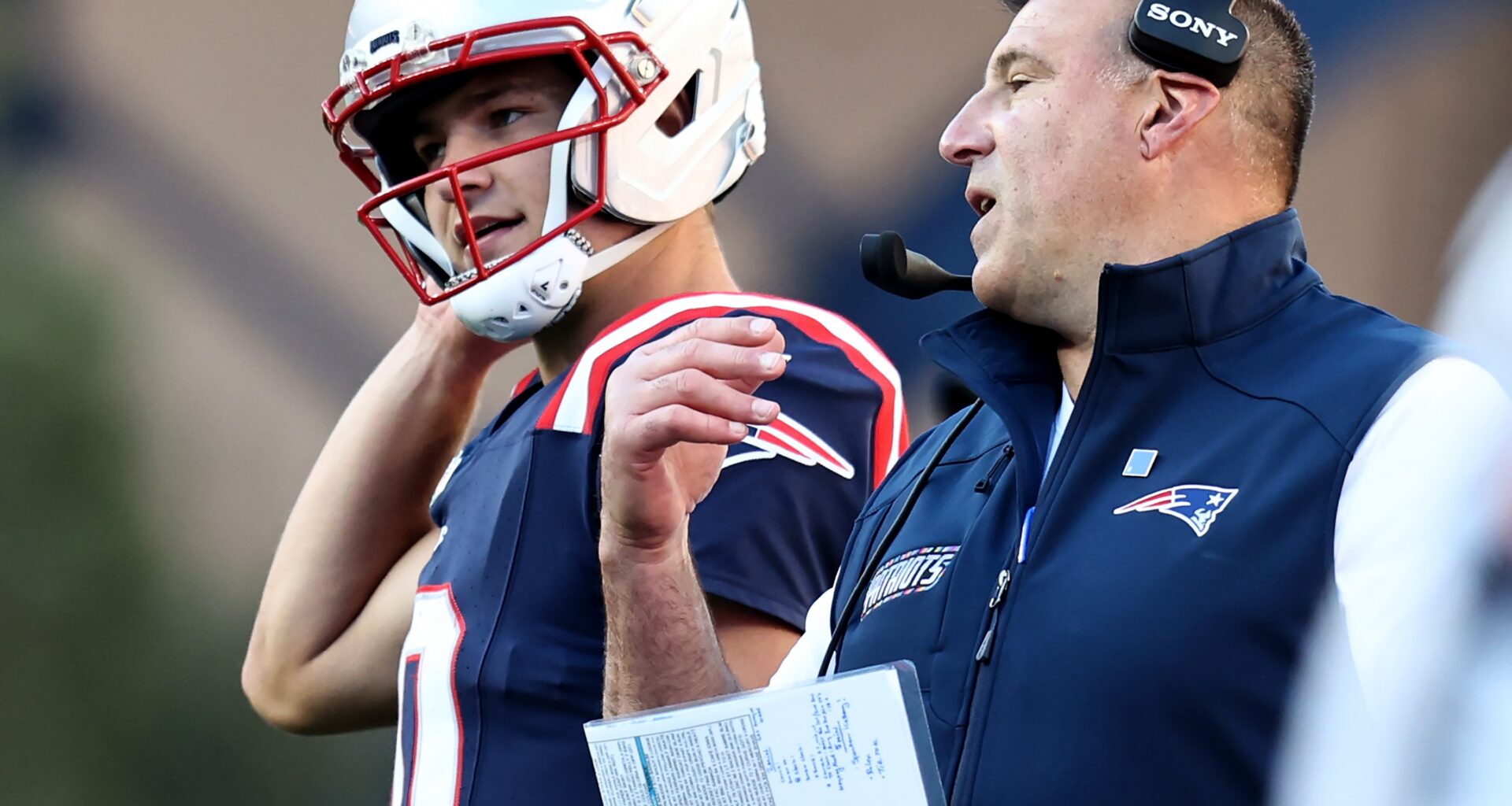
Since they returned from Chicago last week, the Patriots have been busy.
Not typical in-season busy.
More like, in-season self-care.
First, they took a long weekend. Then, eight starters sat out Monday’s practice, presumably a day of veteran rest, and players were off again Tuesday. As for the coaches, Mike Vrabel and staff split their time between preparing for Miami and self-scouting, a process that doesn’t require nearly the time as it used to.
Because when reporters and paying fans have access to thousands upon thousands of metrics and all-22 film on every player and team, coaches no longer need extra days to sort out their own mess. Smart teams, like the Pats, do this every week, updating themselves on their own tendencies while they study their opponents’. Plus, anyone who watched the Patriots miss 17 tackles in Chicago could have told you what Kevin Byard did Monday when asked what the most important piece of intel was on the defense’s self-scouting report.
“We pride ourselves on being a really good tackling secondary,” Byard told reporters. “We haven’t been doing that the past couple games, so that’s something we definitely have to improve on.”
No kidding.
How to maximize self-care — sorry, self-scouting — is less obvious now in an era of abundant information. There are at least two non-negotiable steps:
No. 1: Separate the metrics that matter and weigh them accordingly.
No. 2: Decide what to fix and how. Vrabel spoke to this during a Monday morning interview on WEEI.
“Some things that we can reasonably improve on, and some things we’re just going to have to be OK that we’re probably not going to be able to improve on,” he said.
Considering they ranked among the NFL’s better tackling defenses last year and carried over most of the same roster, tackling ought to be fixable. Just drill it Herb Brooks-style: again. Again. Again. Again.
The worst offenders — Christian Barmore, Cory Durden, Gabe Jacas, Marcus Jones and Robert Spillane — are all missing tackles at rates higher than their career averages, per Pro Football Focus, which indicates positive regression should be coming. Jones, for example, whiffed a career-worst seven times in Chicago. That’s a piece of history that won’t repeat itself.
The benefits of tighter tackling are significant. The Patriots have allowed the third-most yards after the catch in the NFL (887) and are allowing an average of 3.38 rushing yards after contact, which is fourth-worst, per Next Gen Stats. If their defense instead ranked 16th in both categories, the Pats would’ve saved close to 30 yards per game; the difference between ranking 10th by total yards allowed (where they are now) and cracking the top three.
 Foxboro, MA – New England Patriots defensive tackle Christian Barmore sacks New York Jets quarterback Geno Smith during the first quarter of the game at Gillette Stadium. (Nancy Lane/Boston Herald)
The Patriots should also expect improvement with their turnover trouble, though perhaps not as much. The Pats have the second-most giveaways in the NFL through Week 7, but Vrabel-led teams have historically finished with fewer turnovers than the majority of the league, which suggests there’s potential to coach away their butterfingers. Last year, the Patriots ranked ninth at the end of the regular season.
Now, a few reasons for doubt: fumbling may be a permanent bug of Drake Maye’s game. He’s fumbled 20 times since the start of last season and has small hands. Rhamondre Stevenson, Romeo Doubs and DeMario Douglas all have higher-than-average fumbling rates for starters at their respective positions, according to SumerSports, and have already fumbled this year.
A few reasons for optimism: Maye’s interceptions declined sharply over the last four games when his play under pressure stabilized. Interceptions are not a long-term concern based on his history, and may not even matter as much as you think. Despite his turnovers, Maye is currently a top-10 starting quarterback by success rate, multiple accuracy metrics and Expected Points Added (EPA) per play.
The Patriots also have a winning record, despite facing the NFL’s third-hardest schedule to date and Maye being tied for the league lead in turnovers. That’s how good he’s been. Imagine what will come next if Maye continues on his current trajectory while their schedule eases up.
Let’s stop here. Already, after examining only tackling and turnovers, we have arrived at a truth the Patriots lived last season right up until the playoffs: they will go as far as Maye takes them. If Maye turns the ball over, they’re cooked. If he cooks, like he has the past four weeks, so do they.
 New England Patriots quarterback Drake Maye (10) throws during an NFL football game against the Chicago Bears in Chicago, Thursday, Oct. 22, 2026. (AP Photo/Melissa Tamez)
The Patriots trust Maye, but a self-scout of their offseason would reveal a front office motivated to better support him, so the team no longer lives in a world where Maye has to play Atlas. They poured most of their resources into the offense: trading for A.J. Brown, signing three new starters in free agency and drafting Caleb Lomu and Eli Raridon. Because when Maye was at his worst in the playoffs, the offense tanked, but the defense successfully undertook most of the heavy lifting, and kept the Pats marching to the Super Bowl.
How is that defense now?
Lagging as of late, and showing fundamental cracks separate from their tackling.
Right now, the Patriots’ pass defense is a pitcher with a 101 MPH fastball opponents generally can’t touch, and several off-speed pitches that good hitters (read: quarterbacks) are smashing. That fastball is man-to-man coverage, which the Patriots play at the league’s second-highest rate and more effectively than all but one other team by EPA/play, according to SumerSports. On the flip side, the Patriots are the NFL’s second-worst zone coverage team by that same metric.
The gap between their success in man and zone coverage is not tenable for a contender, no matter how much man-to-man the Patriots want to play and especially considering certain teams have been able to spook them out of playing it before kickoff (Jacksonville and Buffalo). The good news is, there are reasons to believe this gap will close because coverage choice and success are directly tied to other factors that should change soon.
One example: the Patriots’ run defense is downright average by most metrics, splits and the eye test. But over the last two weeks, the Pats were forced to adjust mid-game to stop some early bleeding and play heavier base personnel (seven combined linemen and linebackers). All that did was open up another wound via the play-action pass.
Bears quarterback Caleb Williams and Jets quarterback Geno Smith went a combined 8-for-8 for 127 yards and two touchdowns on play-action passes against base personnel, a slower grouping where the Patriots are least likely to play their preferred man-to-man. Those plays hurt the Pats’ overall zone numbers, which can be ameliorated if they better stop the run out of nickel personnel in the first place.
But getting beat deep in base defense is one piece of the Pats’ bigger zone problem statistically. This is another: struggling to create pressure without blitzing.
The Pats generate the fifth-lowest pressure rate and allow the seventh-highest EPA/play on dropbacks where they don’t blitz, according to Next Gen Stats. Fixing their four-man rush could be as simple as making a trade (Khalil Mack, anybody?) or reallocating snaps to their better pass rushers or diversifying their rush plans or simply banking on development from Jacas and Elijah Ponder. Or it could mean leaning even more into the blitz than they do already (41.7%, third-highest in the league).
Bottom line: there are some solutions here, even if not al are as clear or will provide the same direct benefits as tighter tackling.
One area that won’t improve dramatically, if at all, however, is the run game.
The Patriots’ best run-blocker, right guard Mike Onwenu, is out for the year. Their starting left guard just landed on injured reserve. Their new fullback is on IR, and has an injury he’s been managing since last season.
No one is making defenders miss outside of Rhamondre Stevenson. TreVeyon Henderson’s Year 2 leap has been a step backward. The Pats are also running into the NFL’s heaviest boxes by average number of defenders inside the box, per FTN Fantasy data. This is a major problem.
One prominent study demonstrated NFL rushing outcomes are determined mostly by defensive box count and offensive line performance on a given play. So if the Patriots’ banged-up offensive line cannot reasonably be expected to improve this year, Josh McDaniels must manipulate defenses into stepping back through his use of personnel, motion or both. Otherwise, he risks putting the entire offense on Maye, which more or less means putting the Patriots’ fate once again in his hands until the defense comes around.
Good luck, kid.