

Winnipeg’s Stanley Cup-winning window is open. It has to be, given the Presidents’ Trophy winners’ heavy veteran investment.
But how long will it last? And what has to go right to keep Winnipeg on the winning track?
Our June mailbag focuses on the Jets’ urgency — the best way to keep the Cup contention window open, Winnipeg’s path to second-line centres and big, mobile defencemen, a thought on aging curves, Logan Stanley, Dustin Byfuglien, Elias Salomonsson and more.
How do the Jets go from 2024-25 second-round exit to a Stanley Cup?
Note: Submitted questions have been edited for clarity and length.
Based on your analysis, how would you assess the Jets’ current window for Stanley Cup contention? What key factors or best-case scenarios would need to align for them to continue making a serious push? — Ryan F.
Winnipeg is heavily invested in star players — Mark Scheifele, Connor Hellebuyck, Josh Morrissey — on the wrong side of 30 years old. If reading that sentence doesn’t create a heightened sense of urgency, read the latest work on aging curves in the NHL. If Scheifele ages like the average NHL forward has aged from 2007-2025, he may have two seasons of No. 1 centre quality left in him before a dramatic decline.
But Scheifele’s a freak of nature! He’ll stay great way longer than the average NHL forward!
I mean, that could be true. Scheifele is freakishly dedicated to off-ice rehabilitation and plays a more cerebral game than one that depends on explosiveness. But I’ve heard those arguments before. They were made about Blake Wheeler, who affected five-on-five play like a middle-six winger from age 34 onward, after a decade as one of the best five-on-five players in the world. Scheifele just turned 32.
Winnipeg needs to address its second-line centre issue now. Not at the trade deadline, not next summer, not in the form of Brayden Yager or Kieron Walton or their first-round draft pick. The Jets don’t have time to waste, because their ability to contend depends on top-quality centres who win their minutes. Scheifele is doing that now — and so is Adam Lowry, who also just turned 32 — but Winnipeg needs its next wave to arrive while Scheifele and Lowry are still at the top of their game.
One best-case scenario on this front: What if Gabriel Vilardi or Cole Perfetti are the answer, despite the Jets’ concerns about their footspeed?
Another depends on Connor Hellebuyck delivering his regular-season results — or close to — in the Stanley Cup playoffs.
Those are wishful, passive suggestions. Another option is striking for a second-line centre this summer, while I think a key to unlocking Hellebuyck is augmenting Winnipeg’s cerebral top-four defence with a Byfuglien-esque bulldozer to open up his sight lines.
How can the Jets address their recurring need for a second-line centre? Trading a first-round pick at every deadline significantly depletes their assets. — Travis R.
What about trading a first-round pick at the draft?
What are the odds the #NHLJets make their first round pick this year? @hustlerama asked @wpgmurat earlier this week@BenMossJeweller pic.twitter.com/O9b3QbYtco
— Winnipeg Sports Talk (@SportsTalkWPG) June 2, 2025
Murat, you mentioned that Chevy seems to have admitted he overestimated Logan Stanley’s ceiling based on some plays in the playoffs against Montreal. Does this signal the Jets may be ready to move on from him either via waivers, trade or make him a press box regular? — Andywpg
You’ve characterized Kevin Cheveldayoff’s comments correctly, Andy, but let’s start by making sure everyone has the context.
In January, I was one of a couple of reporters who had the chance to sit down with Cheveldayoff for about an hour at the Jets hotel in Denver. Logan Stanley was a huge talking point for fans at the time — he’d been booed by a smattering of fans at Canada Life Centre after a mistake helped end Connor Hellebuyck’s shutout bid against Vancouver. Cheveldayoff was asked several questions about Stanley’s status in the lineup.
Cheveldayoff was adamant that he doesn’t tell his coaches who to put in the lineup. He acknowledged no NHL player is perfect and pointed out Stanley played several games during the Jets’ 15-1 start to the season.
I made the point that Cheveldayoff may not tell his coaches who to play in the lineup, but he does control who Winnipeg has available on the roster. I noted that the Jets protected Stanley in the 2021 expansion draft and lost Johnathan Kovacevic and Declan Chisholm to waivers at consecutive training camps.
Cheveldayoff rooted his response in Winnipeg’s decision-making heading into Seattle’s expansion draft.
“Everyone seems to forget the role that he played (in the 2021 playoffs) in winning four straight against Edmonton. He was a regular shift player, he played all the games. We go into Montreal, he’s the one that scores the two goals in Montreal. So he’s on a pretty good trajectory as a developing player at that point in time,” Cheveldayoff said. He went on to talk about Stanley’s injuries, suggesting that they may have stalled or at least changed Stanley’s development path.
I bristle at this, given how clear it was that Winnipeg kept Stanley miles from top-six competition, but that’s beside the point. Cheveldayoff’s estimation of Stanley’s ceiling was higher coming off his 2021 playoffs than it is now.
I don’t share your conclusion, though. (And do I detect notes of hopefulness in your question?)
Stanley played 63 games this season and was a fixture in Winnipeg’s April roster until injuries derailed his playoffs. He’s one of seven defencemen under contract for next season (eight when Dylan Samberg signs), and he’s played 70 more games than his closest competition (Heinola) at the edge of the roster. If somebody gets traded or committed to the press box, I think it’s Heinola, who went over a month between games multiple times, even after returning to full health.
One of Stanley’s roles on the Jets roster is to take a few fights each year off Adam Lowry’s fight card, especially following Brenden Dillon’s 2024 departure.
By the way, if you’re looking for a surprise on defence, this one might count: Heinola is just 24 years old but is on track to become an unrestricted free agent next summer. The Jets need to play him in 27 or more games next season to retain his rights, lest he become a Group VI UFA. Heinola’s trade value is negligible, given his lack of NHL games this far into his career, but the Jets may soon add Heinola to the list of players outlasted by their belief in Stanley’s potential.
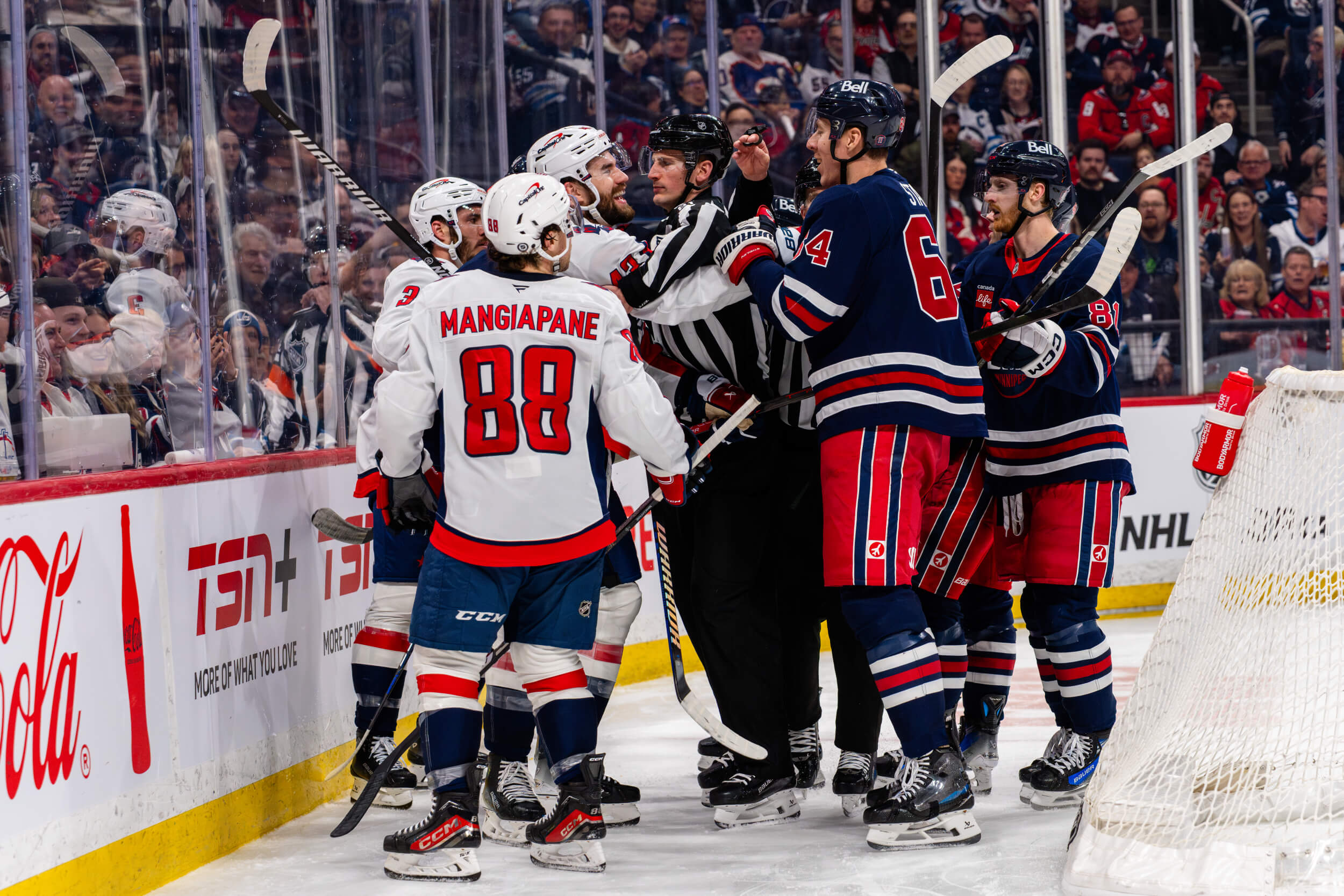
Logan Stanley and Washington’s Tom Wilson exchange words in a March regular-season game. (Cameron Bartlett / Getty Images)
You have mentioned that the Jets need a “Byfuglien-esque” player a few times. Big Buff is a unicorn, but: Can you identify some players who fit this mold currently in the league who could be available (including asking price, no-trade clauses, and realism?) — Duane W.
What a wild needle to try to thread. There isn’t a modern-day Dustin Byfuglien available, but we can try to recreate him in the aggregate.
So, a big, mobile, offensively talented, defensively imposing right-shot defenceman. We could also force Josh Morrissey or Dylan Samberg to play on their off-hand side, if you’ve found a way to pry Victor Hedman from Tampa Bay. (I wish you’d let me use Miro Heiskanen as a solution here — he’s a left-shot D but excels on both sides.)
Vladislav Gavrikov is a left-shot pending UFA who plays with the right combination of snarl and smarts to keep a clean defensive zone while playing heavy minutes against top competition. His impact is exactly what you want from a top-four defenceman: Gavrikov makes it painful to get to the front of the net and hard to win pucks on the boards — all while moving the puck well enough to play in the modern NHL.
A scroll through our latest trade board yields names like Rasmus Andersson, K’Andre Miller and Connor Murphy.
Murphy is a big right-hander who has one year left on his $4.4 million contract in Chicago. He has more defensive quality to him than poor counting stats in Chicago imply, with strong underlying numbers protecting the middle of the ice and plenty of hits and blocks. However, he has a 10-team no-trade clause and might not feel like a substantial enough upgrade on Neal Pionk or Dylan DeMelo in the top four, despite playing a more rugged style.
Rasmus Andersson’s recent defensive numbers are porous, but he’s produced a lot of points from the Flames’ right side. He has a six-team no-trade clause on his $4.55 million contract, which ends next summer. (My ideal Flames acquisition for Winnipeg would be MacKenzie Weegar, who is a right-shot defenceman who plays both sides well, protects the middle of the ice, and has all of the talented truculence I’ve been campaigning for … but he has a full no-trade clause and Calgary is heavily invested in him.)
K’Andre Miller is a big, mobile, Minnesotan who needs a new RFA contract this summer and is eligible for UFA status in 2027. The 25-year-old is a productive, elite skater whose career arc seems worthy of long-term investment, although he’s not the right-shot defenceman you seek. He doesn’t have no-trade protection, which helps, but his proximity to UFA status comes with some risk.
The more words I write on the topic, the more ready I am to see what Elias Salomonsson looks like in a third-pairing role this season, with occasional bumps up to Josh Morrissey’s side as performance merits. It seems more likely that the Jets want Salomonsson to keep developing in the AHL, given the number of defencemen they have under contract and Salomonsson’s two remaining ELC years.
If you believe that there is a time crunch on Winnipeg’s window to win, you’d want to take that chance. Salomonsson may be “only” 21 years old, but the Jets were just beaten in the playoffs by a team with a 21-year-old (Lian Bichsel) on its third pair.
(Top photo of Mark Scheifele, Adam Lowry and Josh Morrissey: Nick Wosika / Imagn Images)