
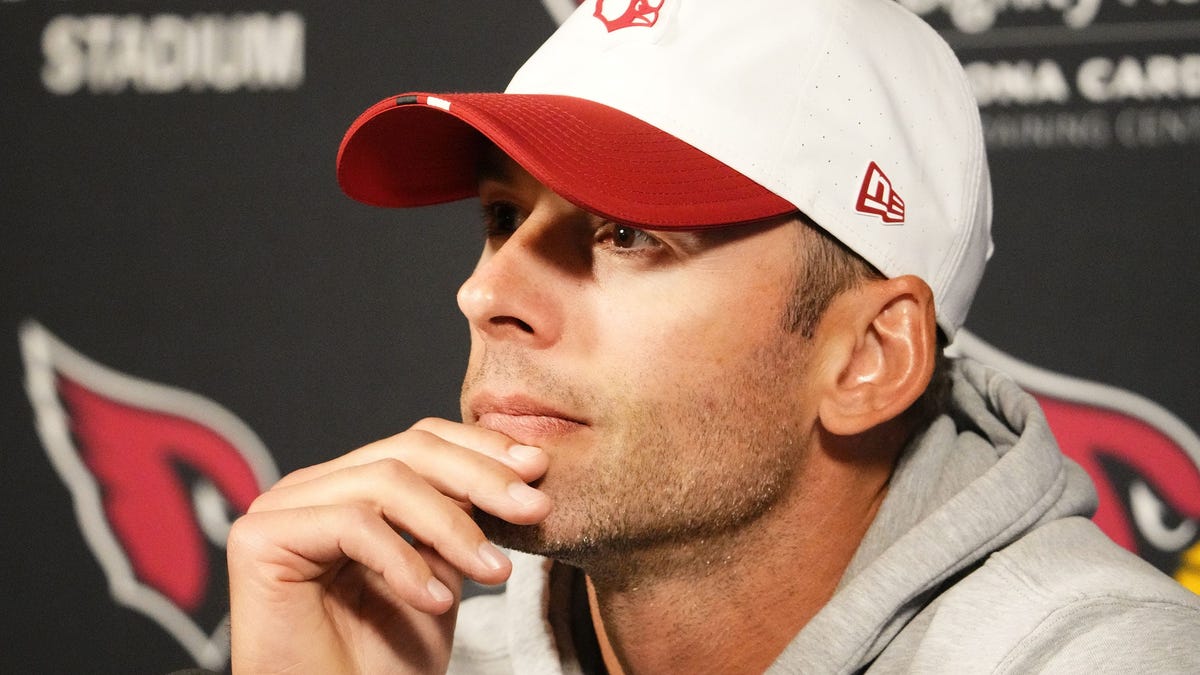
Cardinals coaches explain what level-three work is and how it helps the players improve and practice.
It was during an explanation this week about the hands-on work Arizona Cardinals position coaches do in practice that head coach Jonathan Gannon went deep into the weeds of teaching techniques to the team that are labeled level three.
Gannon began by saying he was going to get “a little scientific” by spelling out the “teaching progression” implemented by Shea Thompson, who was hired as the team’s director of sports performance after the arrival of Gannon and general manager Monti Ossenfort two years ago.
Gannon said, “When you talk to a guy and you’re like, ‘Hey, your improvement plan, you need to get out of your break faster to make more plays, right?’ And what he has in his body is what he has in his body. And you can improve those metrics. Force him to the ground and with three-point extension from your ankle to your knee to your hip to where you put your feet to your sensory process of how you’re doing that. I think there’s ways to train the actual techniques that helps them out physically and mentally.”
He explained that level three “is either assisted work or resisted work. So, I’m sure you guys see bands sometimes held on their waist and you see coaches resisting them or helping them pull them. Getting out of your stance in a pass setting with resistance to it. I love level-three work because I think the point is if you can’t get out of your break fast enough to make more plays, you’re going to get cut. You can’t play here. Well, how are we doing to help him get out of his break rather than just saying get stronger and faster? That’s actually helped the movement.
“It’s critical for our guys and all of our positions do it. When (offensive line coach Justin) Frye got here, because typically we have to build that in with each coach what you’re doing, but he didn’t even know (we did that) when he got here. We’re like, ‘Hey, we do level-three work here.’ He’s like, ‘Great, I’ve been doing it for 10 years. Pretty cool.’ So that’s why you see him in individual drills he does a lot of that.”
It is also is a way for players not able to participate fully in practice to get important work.
“Guys that are not healthy enough to play, it’s a cool way to train them, as in their return to play because they’re actually doing football movements, not just rehabbing in the training room and in the weight room,” Gannon said. “So, I think that’s one of the better things we do here with developing players is our level-three work.”
Gannon mentioned Thompson’s role as well as head strength and conditioning coach Evan Marcus, while suggesting the media should ask defensive coordinator Nick Rallis about it later that day.
“It’s like his baby,” Gannon said. “He knows more about it than anyone I’ve ever met.”
For good reason. Rallis was introduced to level three when he began his college playing career at Minnesota in 2013, one year after Thompson became the school’s assistant strength and conditioning coach. He had interned at the United States Olympic Training Center the year before that.
Rallis said, “That’s a model that we use. Shea and JG worked pretty tediously about how we program from a load management standpoint and how we progress and the intensities and the densities and the volume that we work.”
Rallis said the foundation derives from “an old throws coach, Anatoly Bonner Chuck, who would set up his training with a pyramid that essentially was working backwards from the sport. So your most specific exercises; the game is at the top of the pyramid and then at the bottom is the most general further away from the sport. And so right in the middle is what we call level three, because it’s the third level of that pyramid. But it’s essentially working your technique stuff with resisted or assisted or even isometric holding those positions.
“We like to use that pyramid as a structure to make sure that we’re always working backwards from the game, because we never want to do things just because we’ve always done it this way. And everything has to correlate to the game. And so essentially, when you think about this sport, a lot of things what we do on the practice field is we’re trying to teach how to drive that car better throughout the track. And we’re manipulating the tasks when we do drills and stuff like that to force them to drive that car in certain ways that gets the task done.”
Rallis continued the car analogy by saying, “Sometimes you need to improve that engine. You need to get more horsepower in that engine too. And so essentially when you do those position-specific drills, they serve their different purpose, whether you’re doing them holding those positions or doing them resisted or assisted; you’re trying to improve the athlete, the player. How much horsepower do they have to go stick their foot in the ground, apply force and go A to B? It’s, how can I get them to have more output to get that job done? And sometimes it’s not just about putting them through that task and getting them to do that task. Sometimes you got to increase that engine so that they can accomplish that task.
“We’ve done a lot of that over the three years here and players love it.”
Linebacker Zaven Collins said, “It’s something that we do every offseason and a little bit in the preseason. For me, that’s really been helpful. I might continue into the season depending on how the body feels and stuff like that. But it’s actually been really helpful across everyone. The explosiveness and how guys get out of their stance and stuff like that. That’s really where you see it. DBs for them getting out of a break. Whenever you see them putting their foot in the ground and turn in the other direction. How do they do that? It’s just stuff like that.”
As Rallis continued, “It’s all structured to maximize development and maximize health. And so that’s just something that we do to stay on track with, make sure that we’re working backwards from the sport, understanding what parts of the training day are specific and close to the game that have high nervous-system demands and then kind of work backwards from that into more of your general training throughout the day and how to do those volumes and stuff shifts throughout the calendar year.”
Gannon often emphasizes how important it is to explain to the players why things are done a certain way.
Rallis said that’s especially crucial with level-three work.
“Sometimes I’ll get into the defensive room and we’ll talk about it,” he said. “And I usually have to slow myself down and be like, look, if you want to know a little bit more detail about the why, because everything we do, I want to explain the why behind it. But I can get a little nerdy and a little too scientific in there. And I feel like I start to lose some guys. But to put it simply, let’s increase our horsepower.
“And so once they see that and they feel that out there; it’s easier in Year 3. They’ve been doing it for three years, some of those guys, and they know the benefits of it. But yeah, we’ll go through that and explain that. And I like to say, I’m never going to ask you to do something if I can’t tell you why we’re doing it and how it relates to winning. And, you know, the example I like to give is, if I tell you you need to brush your teeth with your left hand in the morning, I better not say just do it because I’m telling you to do it. There better be a reason behind it.”
He then joked, “I don’t actually ask them to do that.”
Continuing, Rallis concluded, “If I don’t have the answer, I’ll say I gotta research that and I’ll get it to you. But I want them to understand that every single thing that we do is geared towards winning. Because they can only fill their cup up with so much within a day, and so we better be maximizing what we’re putting in that cup.”
Get more Cardinals and NFL coverage from Cards Wire’s Jess Root and others by listening to the latest on the Rise Up, See Red podcast. Subscribe on Spotify, YouTube or Apple podcasts.