
DETROIT — Jahmai Jones has three words stitched on his outfield glove. Flip the switch.
That’s one of the mantras his late father, Andre, always preached. He taught his children to be kind and compassionate off the field. But when the lights came on, when the game started, he wanted them to be focused and intense.
Like that glove, there are other reminders. Jahmai still has a Bible verse in his social media bios. Matthew 10:16, a verse Andre often recited to his children. I am sending you out like sheep among wolves. Therefore be as shrewd as snakes and as innocent as doves. He owns a pendant inscribed with a message that reminds him of his father.
Those are the small things. The daily reminders of who Andre Jones was and what he stood for.
“I don’t know,” Jahmai said this weekend, “if I’ve had a single day when I haven’t given thought to something or something hasn’t come up that I’d love to share with him or talk about or ask for advice. Doesn’t matter. It’s every day.”
Andre was a football player at Notre Dame from 1987 to 1990. He won a national title with the Fighting Irish, then played as a defensive end for the Detroit Lions in 1992.
Jahmai was 13 the day it happened, the day everything changed. Andre passed out in the bathroom. The ambulance came and whisked him to the hospital. At first, the family hoped it was something minor. Then they learned Andre suffered a brain aneurysm. There was no brain activity.
Like that, he was gone at age 42.
“It’s just a hard thing to explain to someone who hasn’t experienced it,” Jahmai said. “It was just very foreign. It was very foreign to me until it happened. Once it happened, you’re like, ‘Man, there’s all these emotions that come with it.’ All these experiences you have to go through.”
Jahmai, one of six children, was about to start his freshman year of high school in Georgia. He was old enough to understand, to process, to remember. But the thing about grief is that it’s an ongoing emotion. No set endpoint. Not a linear progression. It’s a loop, one that can go back or forward or repeat without warning. The feelings and memories might fade. Then it can catch you out of nowhere, hitting all fresh and new again.
It’s not always sadness. Not even pain. Maybe just a thought, an idea, a reflection and a reminder of something no longer there.
“I think now, especially, I’m 27,” Jahmai said. “Thirteen years later (my understanding) is a lot different. But the thoughts, still thinking about him, have not changed from 13 to now.”
It’s there in the lonely quiet of daily life. Thoughts, mantras, pendants. Sometimes it’s more palpable in the big moments, when you want to share something with someone who is gone.
Jahmai thought of that a lot on Friday when he was called up to play for the Detroit Tigers, here in the same city where his father and older brother, T.J., both played for the Detroit Lions. T.J. was a receiver from 2015 to 2018, had 64 receptions over four seasons. That’s the last time Jahmai was in Detroit, across the street at Ford Field watching his brother play. Another brother, Malachi, played in the Arena Football League and the CFL.
“Detroit’s got a special place in my heart just because of the family side,” he said. “Being able to do it myself and add to it, it’s everything I can ask for.”
Jahmai thought of Dad soon after he got the call and learned he was coming to Detroit. A car service picked him up from a minor-league series in Columbus, Ohio. He scrambled to pack his hotel room, grab his baseball gear and pack it all in the car.
“I got all the necessities,” he said. “I got my wallet. Got my phone. Got my keys. Got my baseball stuff. Everything else, I’ll figure it out later. If the clothes get left, the clothes get left.”
He thought of his father as he finally arrived at Comerica Park and dove straight into preparing for the game. He credits his parents as the primary reason he is here. Andre was a larger-than-life influence. His mother, Michele, raised the kids as a single mother after Andre’s death. For all the tiny reminders, Jones said he honors his father the most by the way he tries to live his life.
“How he wanted his kids to carry themselves throughout the world, it’s a testament to him and my mom,” Jones said. “Love the people that I love and be caring to others. That’s all a reflection of him.”
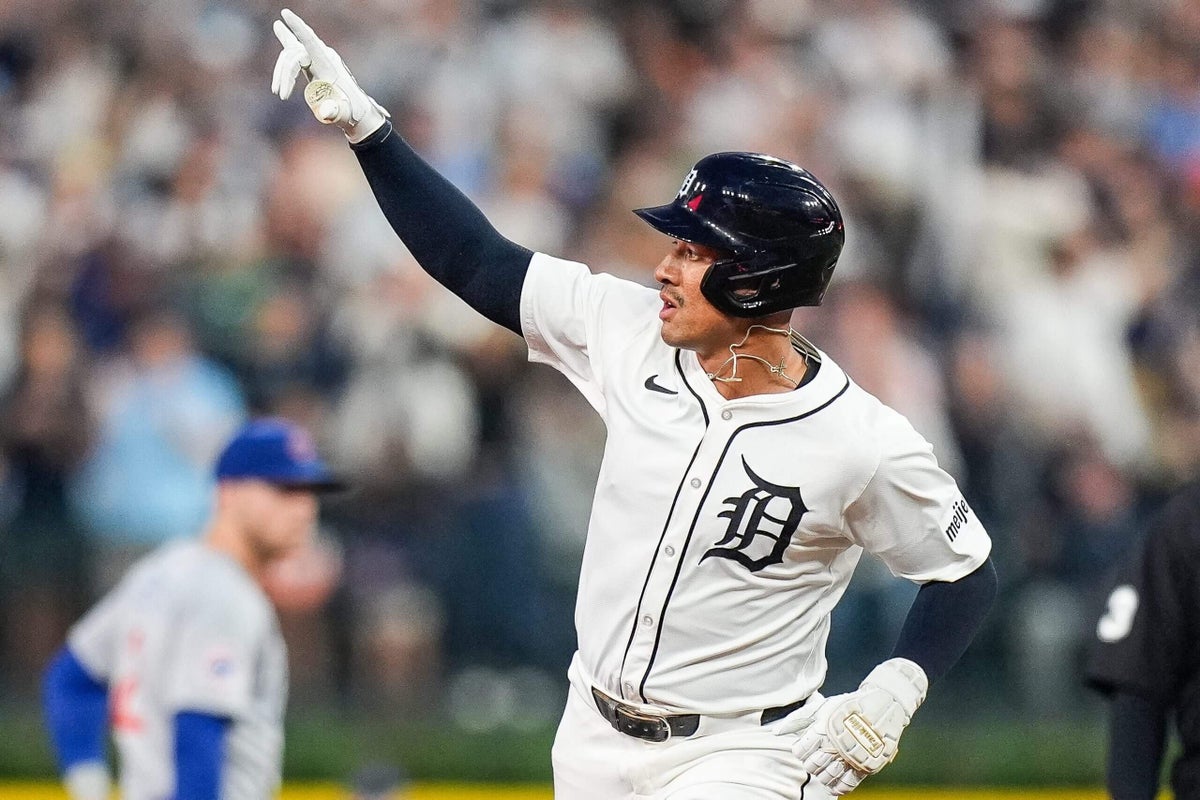
And he surely thought of his father in the aftermath of a thrilling game Friday night, one when he was summoned from the bench to pinch hit in the eighth inning. He hit a home run on the first pitch he saw. The Tigers beat the Chicago Cubs 3-1 in a matchup of two of the league’s best teams.
In a series in which the Tigers took two of three from the powerful Cubs, Jones was the prevailing story of the weekend.
“I thought about it a lot last night,” Jones said Saturday morning. “Talking with my wife, talking with my family. It’s kind of a full-circle moment.”
It’s been a strange year for Jones. There was the serendipity of signing a minor-league deal with the Tigers, of having the chance to carry on his family’s Detroit sports legacy. The Tigers identified Jones as a valuable right-handed bat who could play all over the diamond, the type of player who very much fits their M.O.
“We chased him hard from the very beginning of minor-league free agency,” Tigers manager A.J. Hinch said. “Our front office did a nice job of identifying him but also seeking him on how we could maximize his skill set.”
Jones showed up to spring training on the fringes. A second-round pick in 2015, Jones is now playing for his sixth organization. He quickly impressed and made a case for himself. He appeared, for a moment, to have a very real chance of making the team as injuries hit the rest of the Tigers’ outfield. It didn’t work out that way. The Tigers broke camp without him. Jones went down to Triple-A Toledo.
“He arguably had the best spring to not break with our team,” Hinch said. “We didn’t configure the roster with him, and in typical Jahmai fashion, didn’t get bitter, didn’t get mad, didn’t waste his time in the minor leagues.”
Indeed, Jones kept grinding and working away. He saw a chance in this organization, even when others got called before him. Maybe there’s another lesson intertwined with all this. Maybe one that — kind of like grief — won’t fully make sense until years down the road. Because when the Tigers sent down Andy Ibáñez to find his swing and the chance finally came, Jones was ready.
On the field before Friday’s game, he bounced around with a smile.
“All I want to do is contribute,” he said.
He waited on the bench all game. Talked with injured Tiger Matt Vierling about how to stay ready. Hinch called his number, inserted him for powerful left-handed hitter Kerry Carpenter in the bottom of the eighth inning. The first pitch was a curveball, hanging and ripe. Jones connected, sent it looping toward the left-field fence. For a moment, he didn’t think he got enough.
“(Ian) Happ was going back on it and was jogging, jogging, going back to the fence,” Jahmai said. “I was like, ‘Dang, I really got too under it.’”
But Happ kept running. He finally reached the wall and ran out of room. The ball kept soaring, too. It cleared the fence.
“I’m proud of him,” Hinch said. “I’m happy for him.”
No matter what happens from here, Jones will have that moment. Another memory. A legacy that continues, in ways big and small.
“I’m still able to enjoy every single big moment I’m able to have,” Jahmai said. “It’s just when you’re wanting to share it with people you love, the people you love are always at the forefront. No matter if they’re here or not, you always think about them.”
(Photo: Junfu Han / USA Today Network)