
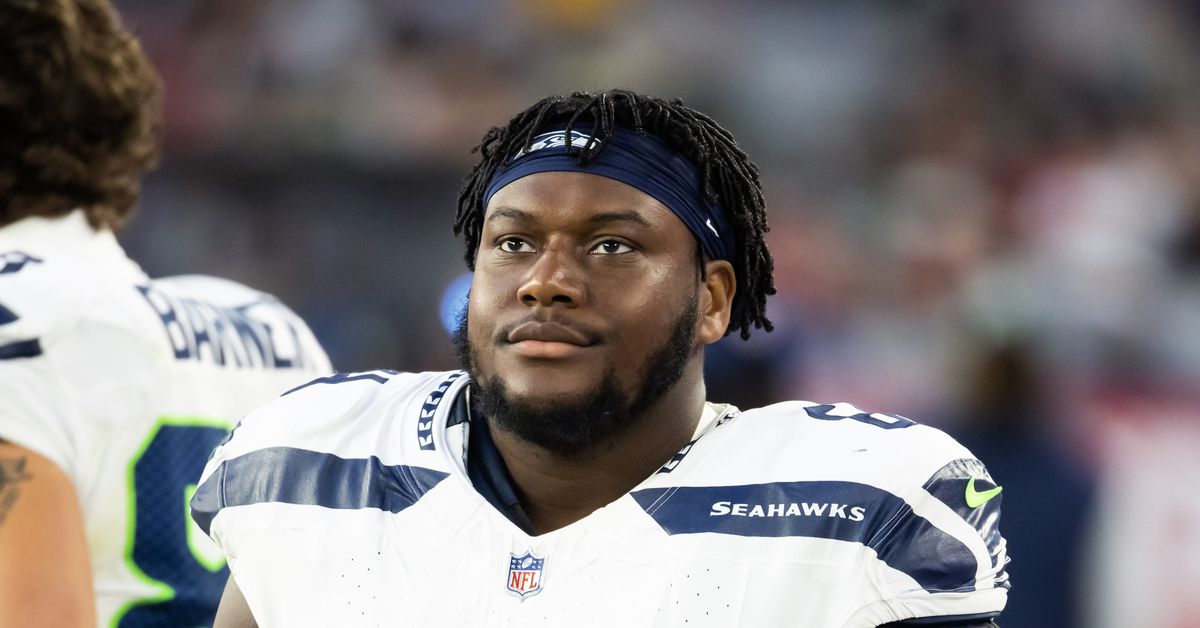
The term “disappointing” may be a bit of an exaggeration. One year is too short to evaluate a player, especially a rookie. However, this word was used to illustrate more the narrative of Christian Haynes’ first year than his performance on the field. The Seattle Seahawks had to wait a long time after the first round. Seattle waited patiently and managed to draft one of the best guards in the class. The expectation was that Haynes could be the new RG, but he ended the year as a backup to sixth-round pick Sataoa Laumea. Could we expect a jump in production in his second year?
Christian Haynes’ 2024 season in review
Anthony Bradford starts training camp as the starter. Many head coaches prefer to keep the players who were already in the group, out of “respect.” However, Bradford gets injured and what seemed like the perfect time for Haynes to take over the position does not happen. Who becomes the starter? McClendon Curtis. If you watched Seattle’s preseason games, you’ll notice the concern that Haynes wasn’t be able to beat him.
The season starts and Haynes starts sharing snaps with Bradford. Even though Laken Tomlinson and Bradford form one of the worst guard duos in the league, Haynes can’t get the starting job. That’s until Ryan Grubb and Mike Macdonald say that Haynes was missing snaps due to strength and technique issues.
Bradford gets injured and is placed on IR. Once again, it seems like the perfect time for him to take over as the starter, but that’s not what happens. The team prefers to use Sataoa Laumea, a player who has been inactive all year. This reflects well on what the coaching staff thought of him and, therefore, is a concern for his future.
He finished his rookie season with 167 snaps, 6 pressures allowed, 5 hurries and 1 sack, in addition to 2 fouls. His PFF Pass Block Grade was 51.9 and his Run Block Grade was 49.8.
Why didn’t Christian Haynes have a chance?
The Seahawks won this game in Week 2 by a hair. This play would have been a TD for DK Metcalf on a deep pass, but Geno Smith didn’t have time and to make matters worse, it almost turned into an interception. The problem is all from a technical standpoint. Haynes stops moving his feet and tries to make contact with just one hand.
Once again, the pressure he gives has an impact on the pass. This time Geno didn’t have a window, but the pressure made the pass go badly. Haynes has his head up but simply takes too long to get from one defender to another and can’t recover.
Lining up against Dexter Lawrence is not an easy task for anyone. He tries to win with leverage with a technique similar to the forklift, but the DT is very strong. Haynes fails to establish the base and is thrown into Geno Smith.
It’s rough seeing how he loses against this hump move and commits the holding. He loses his balance very easily for someone of his weight/size.
Blocking Fred Warner is a tough task, but Haynes takes a terrible angle, making life easier for the LB. It’s worth noting that he also doesn’t receive any help from Laken Tomlinson who finishes the play without blocking anyone.
Is there any hope for his future?
The first reason is the arrival of Klint Kubiak and John Benton. His wide-zone scheme is very similar to the one Haynes had at UConn and that’s where he really stood out.
He punches off the line of scrimmage to help the RT and advances to the second level and takes the perfect angle to neutralize the LB on the run.
This is a perfect example of how to execute the reach block. It is the fundamental block in Kubiak’s zone scheme. In college, Haynes executed it masterfully.
As mentioned above, the ability to take favorable angles is very good. This was his skill that caught my attention the most coming out of college.
Olu Oluwatimi ends up redirecting him during the snap, but he has good mobility to switch between the crasher and the looper.
He will help the OT by moving a lot laterally to execute the block, but he keeps his eyes open and catches the edge when attempting a stunt.
The play starts and he is looking at Alex Anzalone as a potential blitzer. While blocking the DL, he keeps an eye on the LB, realizes that he is like a kind of spy and in fact the other LB, #44 who comes in the blitz with a stunt, but Haynes blocks well.
This snap shows some positive and negative points of Haynes. Good lateral mobility to mirror the pass rusher, but his hands are outside the pads (which could cause a holding penalty) and at a certain point his base is very short and he almost loses his balance.
Final Thoughts
Since he was drafted, there was hope that Haynes would also get snaps as a center. He was always a right cuard at UConn, but he was tested as a center in the Senior Bowl. Since Seattle didn’t draft or bring anyone in free agency, I thought that would be where Haynes would have the best chances. In OTAs, he had positional drills as a center, but he never lined up as such in any of the units.
In his favor, he has a fit with John Benton’s scheme, but the competition is tough. In addition to Bradford, Sataoa Laumea, who has lined up as a reserve LG in OTAs, was a starter last year. In addition, Bryce Cabeldue, who is one of the best reach blockers in this class and one of my bets, is also part of the group competing for the RG role.
Haynes is an older prospect and Seattle chose him based on his floor, not his ceiling. The change in scheme favors his qualities and is his chance to be a starter. If he fails to do so, his continuity in Seattle will be in jeopardy.