
Jim Polzin | Wisconsin State Journal
The first 20 picks had been made in the 1985 NFL Draft when Bob Ley, anchoring the coverage for ESPN that day, decided it was an appropriate time to give the University of Wisconsin football program a well-deserved shoutout.
“There’s got to be a great party going on in Madison,” Ley said. “Wisconsin has three selections, leading the way so far in this first round.”
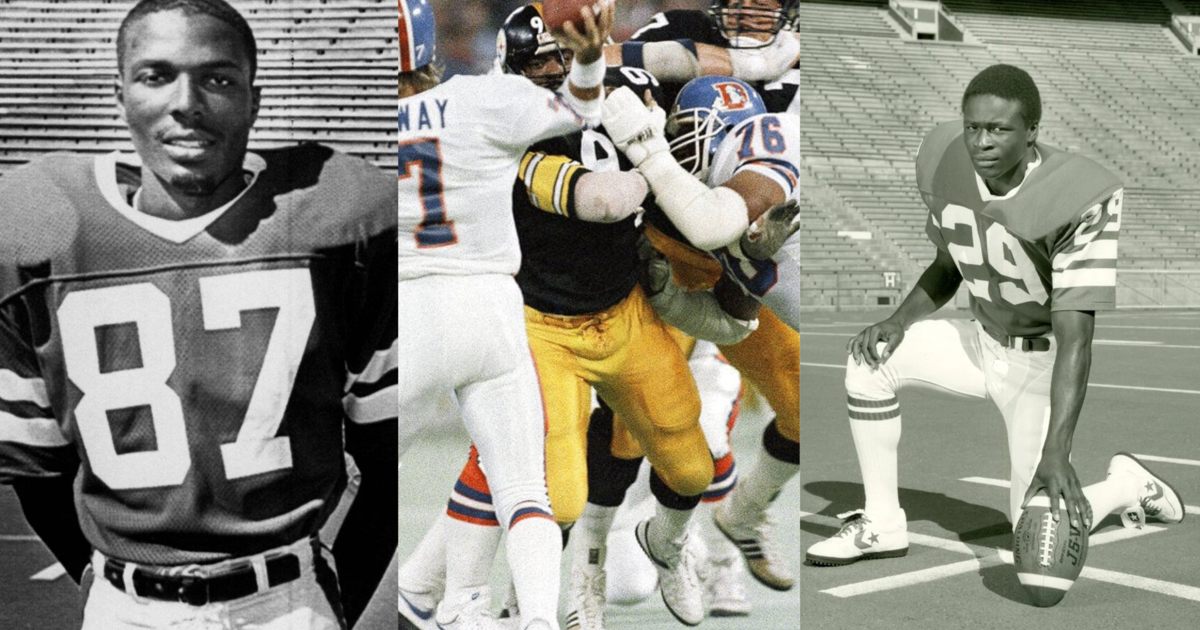
Defensive end Darryl Sims had been selected a little while earlier by the Pittsburgh Steelers. He joined a pair of former teammates — wide receiver Al Toon and cornerback Richard Johnson — on what remains a record-setting draft for the Badgers in more ways than one.
It’s the only time in program history that Wisconsin has had three players selected in the first round. To say it was out of the norm for the school is an understatement: Wisconsin produced only two other first-round picks over the other nine drafts in the 1980s, and that decade was bookended by the Badgers having one first-rounder in the ’70s and two in the ’90s.
People are also reading…
Or consider this modern-day comparison: The Badgers had more players selected in the first round in 1985 than they did in the entire 2025 draft that ended Saturday in Green Bay.
Wednesday marks the 40th anniversary of that banner day, and even some of the participants can’t believe how quickly time has flown.
“How many years ago was that?” Johnson said during a recent phone interview. “Golly, man, you make me sound old. Don’t say that no more.”

To evaluate how much the draft has evolved over those 40 years, all you need to do is jump on YouTube and watch ESPN’s coverage from the 1985 event.
For starters, the first round kicked off on a Tuesday morning, not in prime time. We’re coming off a successful spectacle in and around Lambeau Field in which 600,000 fans were in attendance over three days; the one 40 years ago was held at the Omni Park Central Hotel in New York, where most of the those in the room were NFL employees, team officials or media.
When then-NFL commissioner Pete Rozelle announced Sims had been selected, you could hear a pin drop on the telecast.
Speaking of which, ESPN’s coverage has come a long way in terms of quality of production. The one constant is Mel Kiper Jr., who, at the time, was a 24-year-old who still had plenty of opinions but was much more subdued. However, he did manage to throw some shade at a Wisconsin player who wasn’t even drafted.
That great party in Madison? Sorry, Bob, it didn’t happen. In fact, none of the Wisconsin’s three first-rounders even watched the draft together.
‘I wish it was more dramatic’
Toon was watching with his girlfriend-turned-wife Jane at the apartment of Fred Jackson, who was Wisconsin’s wide receivers coach at the time.
It was a special day in more than one way for Toon: He turned 22 the day he was drafted.
Toon’s name came up early in the broadcast when the ESPN crew started talking about how much influence agent Ralph Cindrich, who counted Pittsburgh offensive linemen Bill Fralic and Toon among his clients, could have on the draft. Kiper played the role of news-breaker when he reported that Cindrich had written a letter to Indianapolis owner Robert Irsay informing him Toon didn’t want to play for the Colts.
The details are hazy 40 years later, but Toon doesn’t remember it going down quite that way.
“I didn’t send anything,” he said recently. “That was 1985, I don’t remember 100% of the details. A lot of life has happened between then and now. But I do know that there was some interest from a lot of teams. My goal was, if possible, to have Ralph talk to the teams that were the highest on my priority list. Ralph handled the rest.”
That included discussions with the Tampa Bay Bandits of the USFL, in part to create some leverage, but Toon decided to stick with the NFL. The New York Jets weren’t among the teams on that aforementioned priority list, and Toon didn’t even know how interested they were in him, though he did a pre-draft physical with the team.
One of the storylines heading into the draft was where a trio of receivers — Toon, Eddie Brown of Miami (Fla.), and Jerry Rice of Mississippi Valley State — would end up, and in what order.
Those questions took some time to be answered. Big men dominated the early part of the draft, starting with Virginia Tech defensive end Bruce Smith going No. 1 to the Buffalo Bills. The first nine picks included four offensive linemen, four defensive linemen and a linebacker, a run that included the Green Bay Packers trading up to select Southern Cal offensive tackle Ken Ruettgers with the seventh pick.
Was Toon getting impatient while he waited? Not really.
“I had never watched the draft, so I didn’t know what to expect,” he said. “I didn’t have any anxiety about it. They said OK, you’re going to be a first-round pick. But I didn’t know anything about Jerry Rice. I didn’t know anything about Eddie Brown. Nor did I care at the time, because I was just looking at, OK, where the hell am I going? What’s going to happen now? My life is going to change apparently, and I was kind of focusing on doing the things that I needed to do to prepare for my new change in life.”
Toon’s wait ended in the strangest of ways. Right after NFL commissioner Pete Rozelle announced that Philadelphia selected Indiana offensive tackle Kevin Allen with the ninth pick, he remained at the podium and was handed a card. Immediately after saying Allen’s name, Rozelle announced the next selection.
The Jets didn’t need their allotted 15 minutes. They knew they wanted Toon.
“The story was it was the fastest first-round draft pick ever,” Toon said. “It was like 15 seconds or something crazy like that. Who knows if that was true or not, but that’s what they were saying.”
When the ESPN crew broke down the pick, they noted how Toon’s speed and size (6 foot 4, 200 pounds) would be an asset to the Jets. They showed video clips of his time at Wisconsin, where he caught 131 passes for 2,103 yards and 19 touchdowns over three seasons.
Kiper even managed to toss a dig at the man throwing Toon passes in those clips. “Mike Howard was just a scatter-arm type quarterback,” Kiper said. “Toon was open, but the ball wasn’t there.”
The Cincinnati Bengals took Brown three picks later and, three picks after that, Rice went to the San Francisco 49ers at No. 16. There’s no debate about who ended up being the best of the three: Rice’s Hall of Fame career included 1,549 receptions for 22,895 yards and 197 touchdowns over 20 seasons.
Toon was a three-time Pro Bowl selection who posted career highs with 1,176 receiving yards and eight touchdowns in 1986, his second season. He led the NFL with 93 receptions two seasons later, but concussion issues forced Toon to retire in 1992 after eight seasons.
He’s the type who focuses on what’s in front of him, not the things in his rearview mirror. Toon said he doesn’t spend a lot of time thinking about what might have been.
“I felt pretty lucky to beat the odds and ended up being able to do what I did for part of my career,” Toon said. “And earned a little bit of money, and it gave me an opportunity to kind of sit back and make some choices that most others don’t. Just leveraged that into a bunch of other things that I did after I retired from football.”
That list is long and, in no particular order: He was one of nine founding members of Capitol Bank, developed a commercial real estate portfolio, became a franchisee for businesses that included Taco Bell, Hilton Garden Inn and Burger King, served as the president of the National W Club and on the Packers’ board of directors and is a part-owner of Olson Toon Landscaping.
While he’s not quite ready for retirement, Toon devotes much of his time to family these days. His daughter, Molly Lillard, a former Michigan volleyball player, was killed in a murder-suicide in Arizona in 2021, leaving behind a young son.
“Something like that happening is pretty life-changing for a family, and making the adjustment afterwards was difficult,” said Toon, whose family includes a son, Nick, who also played wide receiver for the Badgers and surpassed his father’s totals in receptions and receiving yards. “We stuck together as a family, and my wife and I focused on the balance of our kids and we’ve gotten a lot of support from the community and our friends, which has helped us move forward and continue to live life.”
Toon looks at the draft now and chuckles about how much it’s changed since April 30, 1985.
“Nowadays, there’s a lot of pomp and circumstance prior to that,” he said. “Players get ramped up – magazines, television, social media, doing interviews, going to the pre-draft training sessions and all of that stuff. We didn’t have any of that stuff.
“At least for me, it was basically a normal time all the way up until draft day and then draft day comes and I’m sitting in Fred and Teresa Jackson’s apartment with my girlfriend at the time, waiting to see what happens. I wish it was more dramatic, but it wasn’t.”
‘No green room, no nothing’
Johnson was watching in a San Francisco hotel room with former Wisconsin teammate Averick Walker when Toon’s name was called.
Another talking point early in the ESPN telecast was which cornerback would go first: Johnson or Memphis State’s Derrick Burroughs.
Johnson, like Toon, doesn’t remember a whole lot of pomp and circumstance leading up to the draft. But he does recall a lot of agents roaming around Madison.
“It was crazy because we had a lot of prospects on that team,” Johnson said. “There were a bunch of agents in town. Every time you turned around, there was a different agent in town taking me to dinner. It was a wild time.”
The Houston Oilers were on the clock after the Jets, and they made it back-to-back Badgers by taking Johnson.
“No green room, no nothing,” said Johnson, who was in California because that’s where his agent, Ed Sewell, was based. “Just sitting there in a hotel room watching the draft. It was like, oh, damn, they just drafted me.”
Johnson knew the Oilers liked him. Houston’s assistant general manager, Mike Holovak, had told him as much during a visit to Madison. Houston had selected Texas A&M defensive tackle Ray Childress with the third overall selection and went defense again eight picks later.
Sports Illustrated writer Paul Zimmerman hinted at conflict among the Houston staff when he said on the ESPN telecast that some coaches in the franchise preferred Burroughs over Johnson.
One of those people, as it turned out, may have been the head coach.
“I don’t think Jerry Glanville liked me,” Johnson says now. “I shouldn’t say he didn’t like me. He wanted someone else. I think he wanted Burroughs or somebody like that. So I had a conflict my first five years there. I was sitting there with a bad attitude, not feeling wanted or appreciated.”
Glanville was fired after the 1989 season despite leading the Oilers to three consecutive AFC playoff appearances and was replaced by Jack Pardee. Perhaps it wasn’t a coincidence that Johnson flourished under Pardee in his first season as a starter, leading the AFC with eight interceptions in 1990.
But Johnson sustained an injury the next season, played hurt most of the year and was never the same. He retired in 1992 after appearing in 98 NFL games.
“I should have sat out,” Johnson said, referring to the 1991 campaign. “If I had to do it again, I would because that was the beginning of my downfall.”
But not really. Johnson did well for himself in his life after football. He started a record label in Houston, where he still lives, and joined Sewell in several real-estate projects in Silicon Valley, a tech hub south of San Francisco.
Johnson said he still keeps up with Wisconsin football and believes he’s overdue for a visit to Madison.
“You say it’s the 40th anniversary?” Johnson said. “Maybe they should have all three of us down to be honorary captains. Maybe we all get down there. I need to email those guys, and we can hang out together.”
Not mean enough in Pittsburgh
It’s unclear where Sims spent his draft day. After agreeing to an interview for this story and even scheduling a time for the two of us to meet virtually on Microsoft Teams, Sims canceled the interview.
His reason: I had declined his request to send him the completed version of this story before it was published. That’s an ethical no-no in journalism because subjects could try to sway what is written. It’s not the first time a subject has suggested something like that, but it was surprising to receive it from someone of Sims’ stature: He holds the title of assistant chancellor at UW-Oshkosh and is in charge of the Titans’ athletic department.
To his credit, Sims was polite during our email correspondence. He said he was “uncomfortable with the inability to review the final piece prior to publication,” said he “respectfully” declined the interview and wished me “all the best.”
My follow-up email to him seeking to understand the situation better went unanswered. One of my main questions: Had he been burned by the media in the past?
An explanation from Sims wasn’t required to answer that question. All it took was going down the rabbit hole of reading through archived newspaper stories from Sims’ time with the Steelers.
The Pittsburgh media was tough on Sims. How much of it was deserved is open for debate, but it seems Sims wasn’t cut much slack while failing to live up to his billing.
Sims was drafted No. 20, two spots ahead of Clemson defensive tackle William Perry going to the Chicago Bears. Being picked that high was a surprise for Sims, who told reporters the day he was drafted that he thought he’d be chosen in the second round.
A monster performance in the Japan Bowl had boosted Sims’ stock. He was named the game’s most outstanding defensive player after recording three sacks while chasing around Heisman Trophy winner Doug Flutie of Boston College and Ohio State’s Mike Tomczak.
Sims’ 38 sacks for 138 yards ranked second in program history when he left Wisconsin, but there were plenty of skeptics among NFL draftniks.
Pro Football Weekly’s Joel Buchsbaum placed Sims on his All-Underachiever Team.
“Darryl Sims (Wisconsin) turns into an unholy terror when he’s freed up and turned loose to rush the passer,” Buchsbaum wrote. “However, when given specific responsibilities in a structured defense, he just isn’t the same player.”
That evaluation turned out to be accurate.
The first sign of discontent from the Steelers media came just past the midway point of Sims’ rookie season when Pittsburgh Press columnist Bob Smizik spent an entire column ripping Sims following a game a Kansas City. Mind you, the Steelers actually had recorded a 36-28 win over the Chiefs that day.
Smizik noted that Sims only had two tackles in his first nine games. He pointed out that Sims’ nickname was “Sack Man” despite only recording three sacks his senior season with the Badgers. “It can only be assumed,” Smizik wrote, “he earned his nickname because he delivered potatoes during his spare time.”
The point of Smizik’s column was to make the case that the Steelers would be much better off at that point of the season if Sims were performing at the level of the Steelers’ first-round pick a year earlier, wide receiver Louis Lipps. Smizik called Sims “a major disappointment but still a talent of such proportions no one is ready to close the book on him.”
As for Sims, he had this to say in Smizik’s column: “I’m improving, but I’m not satisfied. This league is tougher than you think. I’m not going to give up. I took some steps forward today. I intend to become good. I can’t put a time limit on it. It’s going to take work and practice. I’m going to do it.”
Sims never did. He lasted only two seasons in Pittsburgh before being waived. Notably, the Steelers did not offer Sims the $1,000 it offered to other cuts to return in case of a strike.
A 1986 story on Sims noted how “at every turn in the road an avalanche of criticism awaited him.”
And, when Sims’ trip with the Steelers reached a dead end, the Pittsburgh Post Gazette devoted multiple stories to his release.
Art Rooney Jr., who led the scouting department when Sims was drafted, blamed himself and said it was a “bad mistake.” It was hard to argue with that assessment: Sims produced 18 tackles and two sacks in two seasons, earning $924,000 in that span.
Joe Greene, Pittsburgh’s defensive line coach at the time, blamed Sims’ demise on his lack of nastiness on the field. Yes, the man called “Mean Joe Greene” didn’t think Sims was mean enough.
“Instincts are a factor and he needed some, but first on my list is, Darryl is a nice guy,” Greene told the Pittsburgh Post Gazette. “He didn’t understand to play in the National Football League, the job description calls for being rough and tough and mean and nasty.”
Sims’ reaction that day?
“I’m not willing to believe or accept that my professional career is ending here,” Sims said, according to the Pittsburgh Post Gazette. “I know I can play, but the media and the coaches and people in general all have a way of making you think that maybe you can’t after all.”
Sims spent the next two seasons with the Cleveland Browns but didn’t make much of an impact. His NFL career ended after four dismal seasons.
“It’s an art, it’s not perfect,” four-time Super Bowl winning coach Chuck Noll said of the draft on the day the Steelers waived Sims. “What you’re doing is projecting performance. He was like a bud, one of those types that wilted on the stem.”
The 1984 Badgers ‘should have been better’
As Johnson said, the agent scene was buzzing around Madison in late 1984 and early 1985.
The Badgers having three players selected in the first round remains a program record, but so does the fact the school produced 11 total picks in that draft. That’s three more than the school’s next-highest number of draftees in a single year.
Notables on that list included Dan Turk, who was picked by the Steelers in the fourth round and carved out a 15-year career in the NFL as a long snapper; offensive lineman Jeff Dellenbach, who was taken by Miami in the fourth round, spent 15 years as a pro and was with the Packers when they beat the New England Patriots in Super Bowl XXXI; and a pair of Green Bay selections, running back Gary Ellerson in the seventh round and defensive back Ken Stills in the eighth round.
Scott Bergold, a defensive lineman who was converted into an offensive lineman and lasted only one season in the NFL due to an injury and irregular heartbeat, was taken in the second round by the St. Louis Cardinals. New York Post columnist Steve Serby was being interviewed by ESPN when the Bergold pick was announced and was asked for his reaction to the Badgers having four players selected among the first 51 picks.
“Yeah, three guys in the first round,” Serby said. “How come their teams are so lousy? Hate to see the other 19 guys play.”
Cruel, perhaps, but Serby raises a fair point. Wisconsin went 7-4-1 overall and 5-3-1 in the Big Ten during the 1984 season. It was a rollercoaster ride that included a dramatic fourth-quarter comeback in a 35-34 home win over Missouri (Johnson played a huge role in that rally), a 17-14 home loss to a Minnesota team that went 4-7, a 16-14 win over No. 6 Ohio State at Camp Randall Stadium and a 20-19 loss to Kentucky in the Hall of Fame Bowl in Birmingham, Alabama.
Those seven victories matched Wisconsin’s highest win total over a span of 50 seasons — a stretch that started after an 8-1-1 season in 1942 and ended ahead of a 10-1-1 campaign in 1993 — but should the 1984 team have won more games considering it had three first-round picks in 1985, a host of others taken in that draft and two other players who were taken in the USFL draft?
“It definitely should have been better,” he said. “We had too much talent. That was a talented team. We had talent up and down that roster. We should have been a lot better than we were. Lord only knows why not, but we should have been better.”
Photos: A look back at Jonathan Taylor’s career at Wisconsin
Wisconsin Badgers running back Jonathan Taylor runs the ball for a first down against Ohio State.
M.P. KING, STATE JOURNAL
Wisconsin Badgers running back Jonathan Taylor runs the ball against Miami in 2017.
M.P. KING, STATE JOURNAL
Wisconsin Badgers running back Jonathan Taylor picks up a first down on a pass play during the first quarter of the 2017 Big Ten Football Championship at Lucas Oil Stadium in Indianapolis, Saturday, Dec. 2, 2017.
M.P. KING, STATE JOURNAL
Wisconsin Badgers freshman running back Jonathan Taylor breaks loose on a long run against Michigan in 2017.
M.P. KING, STATE JOURNAL
Jonathan Taylor runs the ball during a game against Penn State in 2017.
M.P. KING, STATE JOURNAL
Alex Hornibrook congratulates Jonathan Taylor on his touchdown run against Florida Atlantic.
STATE JOURNAL ARCHIVES
Wisconsin Badgers running back Jonathan Taylor runs into the end zone on a long touchdown during a game against Nebraska.
M.P. KING, STATE JOURNAL
Wisconsin running back Jonathan Taylor reacts to fans as he runs off the field following a game against Indiana.
DARRON CUMMINGS, ASSOCIATED PRESS
Jonathan Taylor runs the ball during a game against Maryland.
M.P. KING, STATE JOURNAL
Wisconsin running back Jonathan Taylor runs for a first down late in the third quarter of the Badgers’ 31-0 win over the Minnesota Golden Gophers on Nov. 25, 2017, at TCF Bank Stadium in Minneapolis. Taylor carried the ball 20 times for 149 yards and a touchdown as Wisconsin extended its winning streak in the Axe Game to 14.
M.P. KING, STATE JOURNAL
Jonathan Taylor celebrates after running for a touchdown during the first half of the Big Ten championship against Ohio State.
Darron Cummings, Associated Press
Jonathan Taylor runs for a touchdown against Nebraska.
STEVE APPS, STATE JOURNAL
Wisconsin running back Jonathan Taylor, left, is congratulated by Jack Dunn after running for a touchdown during a game against Ohio State.
AJ Mast, Associated Press
Wisconsin running back Jonathan Taylor breaks a tackle attempt by Miami defensive back Sheldrick Redwine in 2018.
ADAM HUNGER, ASSOCIATED PRESS
Wisconsin Badgers running back Jonathan Taylor scores against Kent State.
STEVE APPS, STATE JOURNAL
Wisconsin Badgers running back Jonathan Taylor scores a touchdown during a game against Central Michigan.
File Photo
Jonathan Taylor celebrates after a touchdown during a game in his career with the Badgers.
JOHN FISHER, CAL SPORT MEDIA
Contact Jim Polzin at jpolzin@madison.com.
Be the first to know
Get local news delivered to your inbox!