
As you know, the summer can often be devoid of content, especially in May, June, and the first half of July until Media Days. Each year, we do a weekly summer series to help fill those gaps in content. Last year featured our 25th Anniversary teams, in accordance with the 25th anniversary of the Mountain West conference. This year, we will unveil our Mount Rushmore Series.
It is common for people on social media to debate which players on the “Mount Rushmore” for a certain school. For those not familiar with the term, the idea that it is a list of the four most prominent players of all time for a program.
This summer, our team of writers will take up the challenge of identifying who is on their school’s Mount Rushmore. Each post will feature a Mount Rushmore for football and another one for basketball, because why not? Writers will have to explain why they are choosing those players and make difficult choices between tremendous single seasons vs careers, old-time legends or modern stars.
Look for a new post every week from May 29 through August.
This week: Nevada
Nevada may be one of the most historic schools in both athletics and academics. The Pack’s football and basketball programs are no exceptions, and while their trophy rooms may not be filled with NCAA championships, the legacies that have been left behind are monumental.
Football Mount Rushmore
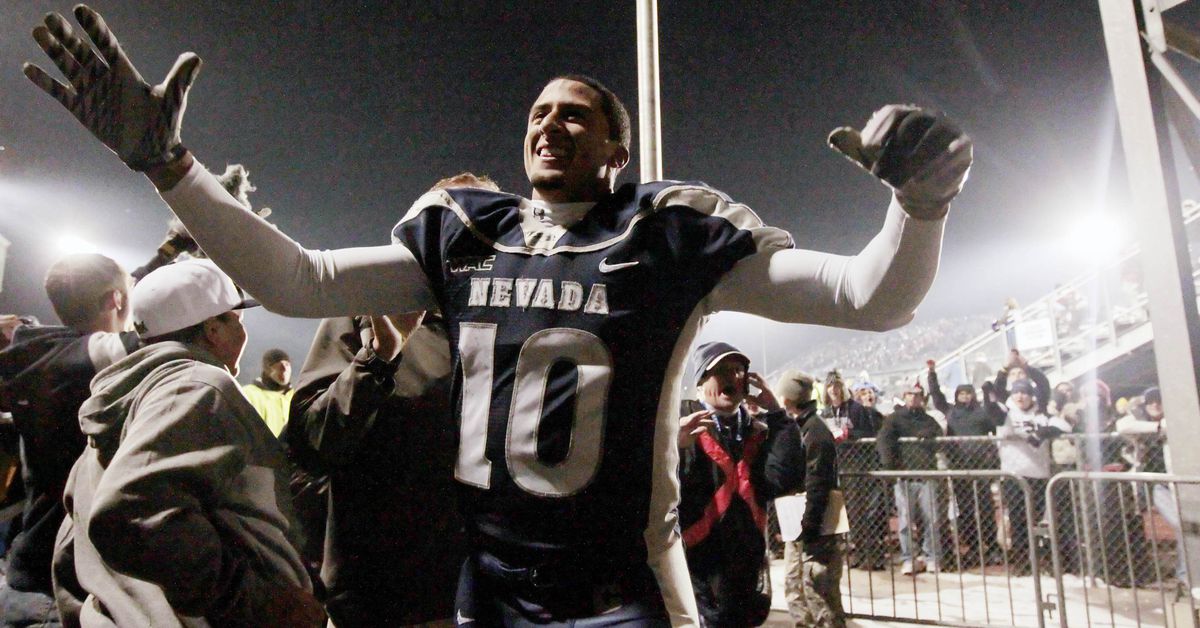
Colin Kaepernick, 2007-2010
Few players have electrified Nevada’s fanbase and altered the program’s national profile like Kaepernick. The dual-threat QB was given the Pistol Offense, created by legendary Nevada head coach Chris Ault.
Under this, Kaepernick became the first player in NCAA history to pass for over 10,000 yards and rush for over 4,000. His signature moment came in 2010, when he led the Pack to a 13-1 record, including a dramatic overtime win against No. 3 Boise State at Mackay Stadium.
He went on to play in the NFL as the starting QB for the 49ers, making a Super Bowl appearance and playing in meaningful games. He quickly became a hero and a villain after his civil rights stance of America after he kneeled during the National Anthem during a game. Love him or hate him, he’s done incredible things both on and off the field, leaving his name sprinkled everywhere.
2. Marion Motley, 1940-1942
Motley is far more than just a Nevada star. Many see him as a national hero, fighting for his country and civil rights.
He broke the scene was Nevada as a fullback and linebacker, sitting at 6’1 and 240 pounds. He also returned several kickoffs for touchdowns, including a 105-yarder in 1941 that was a school record.
Motley spent three seasons with the Pack until he left in 1942, when he was inducted into the U.S. Navy for WWII.
Then, in 1946, after trying out for the team, Motley made the Cleveland Browns, and alongside three other African American football players, broke the color barrier in modern professional football.
He amassed 4,720 rushing yards in his career and averaged a staggering 5.7 yards per carry. Motley was inducted into the Pro Football Hall of Fame in 1968.
3. Frank Hawkins, 1977-1980
Known as “The Hawk,” Frank Hawkins tore through defenses from 1977 to 1980, rushing for over 5,300 yards and scoring 56 touchdowns. He was a three-time All-American and the second-leading rusher in NCAA history at the time of his graduation.
Hawkins went on to play for the Raiders, winning a Super Bowl with them in 1984. He’s also a member of the College Football Hall of Fame.
4. Trevor Insley, 1996-1999
Trevor Insley was one of the most prolific wide receivers in college football history. From 1996 to 1999, he shattered records with 5,005 career receiving yards, breaking the NCAA record at the time and remains the second-best. In his senior year alone, Insley hauled in 2,060 receiving yards, a single-season record at the time and still the highest today.
While he wasn’t the most flashy receiver, he was still the go-to target, the deep threat, and of course, a record breaker.
Basketball Mount Rushmore
Nick Fazekas, 2004-2007
Nick Fazekas was a foundational piece in Nevada’s history. Standing at 6’10, Fazekas was named the Western Athletic Conference Player of the Year three times, becoming the second player in league history to earn the award three consecutive years. He earned All-America honors in each of his last three seasons, including first-team selections by ESPN, USBWA and Sports Illustrated as a senior.
He led Nevada to four consecutive WAC regular-season titles and NCAA Tournament berths and is one of the winningest players in school history with a 106-27 record in his four years. Fazekas finished his career as Nevada’s all-time leader in scoring (2,464), blocked shots (192), field goals (901), and free throws made (546) and was second in career rebounding (1,254.)
He was drafted in the second round by the Mavericks in 2007, but spent most of his long career overseas. His jersey number was also retired by Nevada in 2019, being only one of two retired numbers in Nevada men’s basketball history.
2. Edgar Jones, 1975-1979
Remember how I just said there have only been two numbers retired for the men’s basketball team? Jones is the other.
He finished his career as Nevada’s all-time leading scorer with 1,877 points in 101 games (18.6 points a game), a record he held until Fazekas surpassed it in 2006. He still ranks third all-time in rebounds with 1,116 and fourth in career scoring. During his four years with the team, the Wolf Pack was 67-41, including a 21-7 record in 1978-79.
Jones was drafted in the second round by the Bucks in 1979, becoming the first Nevada basketball player to make it to the NBA.
3. Ramon Sessions, 2004-2007
Sessions did a lot in his short time with Nevada and went on to have a long NBA career as well. He was named the 2005 WAC Freshman of the Year and helped Nevada to Western Athletic Conference championships and NCAA Tournament appearances in each of his three seasons at Nevada.
That freshman year is also when Nevada upset Michigan State in the first round of the NCAA Tournament. He finished his career ranked second in the Nevada career record book with 478 assists.
Sessions left after his junior year to declare for the NBA Draft, where he was selected 56th overall by the Bucks in 2007. He went on to have an 11-year career in the NBA between eight teams, playing 691 games and averaging 10.3 points per game.
4. Caleb Martin, 2017-2019
It’s our first modern era player on this list, and Martin is more than deserving of it. Alongside his twin brother Cody, Martin helped put Nevada in a national spotlight behind head coach Eric Musselman.
In 2017–18, he led the Wolf Pack to a 29–8 record and a dramatic run to the Sweet 16, which included a come-from-behind victory over No. 2 seed Cincinnati in the second round. That year, he was named Mountain West Player of the Year.
He was also Nevada’s first AP and ESPN preseason All-America selection. He shot 40.4 percent from beyond the arc and 45.4 percent from the field.
Nevada reached the NCAA Tournament twice with Martin, and those years are arguably among the best teams in Nevada basketball history.
There are definitely tons of other players I could’ve picked for this, and it was extremely hard to just pick four for each sport. I went off impact, whether it was with Nevada, in the pros, or off the field.
But all eight of these players are more than deserving. Do you agree? Do you think another player should’ve been on there? Let me know!