
In Brian Gutekunst’s tenure as general manager of the Green Bay Packers, the team has had very few true whiffs when opening up the checkbook in free agency, but to what extent do players improve when coming to Green Bay from other NFL teams?
Looking at strictly second contract players who were awarded multi-year contracts with the Packers, here’s how their six major free agent signings in the Gutekunst era have fared compared to their previous standard according to PFF’s grades:
Adrian Amos
Amos signed a four-year, $37 million contract with the Packers after four years playing for the rival Bears, where he had an average PFF grade of 79.1.
Advertisement
In Green Bay, his overall body of work was worse, with an average grade of 73.3, but this is mostly due to a poor final year in which Amos was clearly on the decline and earned a grade of just 53.4.
Removing that season, Amos averaged an 80 grade in the first three years of his deal, ever so slightly better than his tenure with Chicago
He also had a season with the Packers which was essentially equal to the ceiling he showed with the Bears. Amos posted an 89.9 grade in his best season in Green Bay compared to a 90.9 in his most effective campaign in Chicago.
His first year with the Packers was not as good as his last with the Bears, posting a 75.7 grade compared to 82.7, but he was still a strong performer from the get-go in green and gold. Green Bay absolutely got what they wanted from the Amos signing.
Preston Smith
Including only the full seasons he played with the Packers – he was traded to the Steelers at the deadline in 2024 – Smith’s overall performance after signing a four-year, $52million contract, was right in line with his previous play with the Commanders.
Advertisement
His average PFF grade of 68.1 slightly improved on his 67.1 in Washington, but Green Bay got five and a half years out of Smith, who got two contracts with the team, signing an extension in 2022.
With grades of 66.5 and 55.5, Smith fared worse in first two years with the Packers compared to his final season with the Commanders, in which he scored a 76.5 grade, but he did enjoy the best season of his career in Green Bay when he received an 81.5 grade in 2021.
Za’Darius Smith
Smith is the poster child for the improvement players have often undertaken after signing with the Packers. After averaging a 60.6 grade with the Ravens, highlighted by a 69.6 grade in his final season, Smith was incredible in his first year in Green Bay, posting an 89.7 grade.
Advertisement
His second campaign with the Packers did not hit the same heights, but with a 76.3 grade, was still better than anything he did in Baltimore. Smith then endured an injury-riddled third year in Green Bay and after some conflict with the team, was released.
It was relatively short-lived and did not end ideally, but Smith’s time with the Packers was explosive and absolutely worth it.
Billy Turner
Much like Green Bay’s signing of Aaron Banks this offseason, Turner was the first addition the team made after the new league year began, and it raised some eyebrows, as he was not a particularly well-known player.
Advertisement
The Packers knew what they were doing though, as Turner played considerably better for them over three years than he did for the Broncos in two years as a starter. His average PFF grade improved from 59.8 to 67, or average to solidly above average.
Turner was marginally worse in his first year in Green Bay than his last year in Denver, posting a 63.4 PFF grade as opposed to 64.4, but his signing was another win for the Packers
Josh Jacobs
It was quite some time before Gutekunst had legitimate money to spend in free agency again, but five years after the spending spree of 2019, he appeared to knock it out of the park by bringing in Josh Jacobs from the Raiders.
Advertisement
Jacobs was coming off the worst season of his career in Las Vegas, and he immediately flipped the script, playing his best football in year one with Green Bay, earning a 92.3 PFF grade, slightly better than his best mark of 91.6 with the Raiders.
It may be a little early to declare the Jacobs signing a victory after just one year, and it will be interesting to see if, or for how long he can sustain the high level of performance he established in 2024 as he enters his late twenties, which can be a danger zone for running back production.
For now though, Jacobs seems to have hit new heights in Green Bay, and is another example of how players can improve in a more ideal situation.
Xavier McKinney
It remains a mystery how the New York Giants let McKinney go, but the Packers have been the beneficiaries, and the four-year, $67 million deal Green Bay inked him to looks to be well worth the money right now.
Advertisement
After receiving an 84.7 grade, his first year with the Packers was more impressive than the overall body of work he posted in three years in New York, although it was not quite as good as his final season with the Giants, in which he earned an 87.5 grade.
Still only 25 years old, McKinney still has room to develop and beat the high bar he has already set.
On average, second-contract free agents have improved in Green Bay, even when taking out the small sample size examples of Jacobs and McKinney.
Four of the six major free agents the Packers have signed between 2019 and 2024 went on to have their career-best season in Green Bay, and the only two who did not, Amos and McKinney, were close, and the latter still has time to achieve the feat.
Advertisement
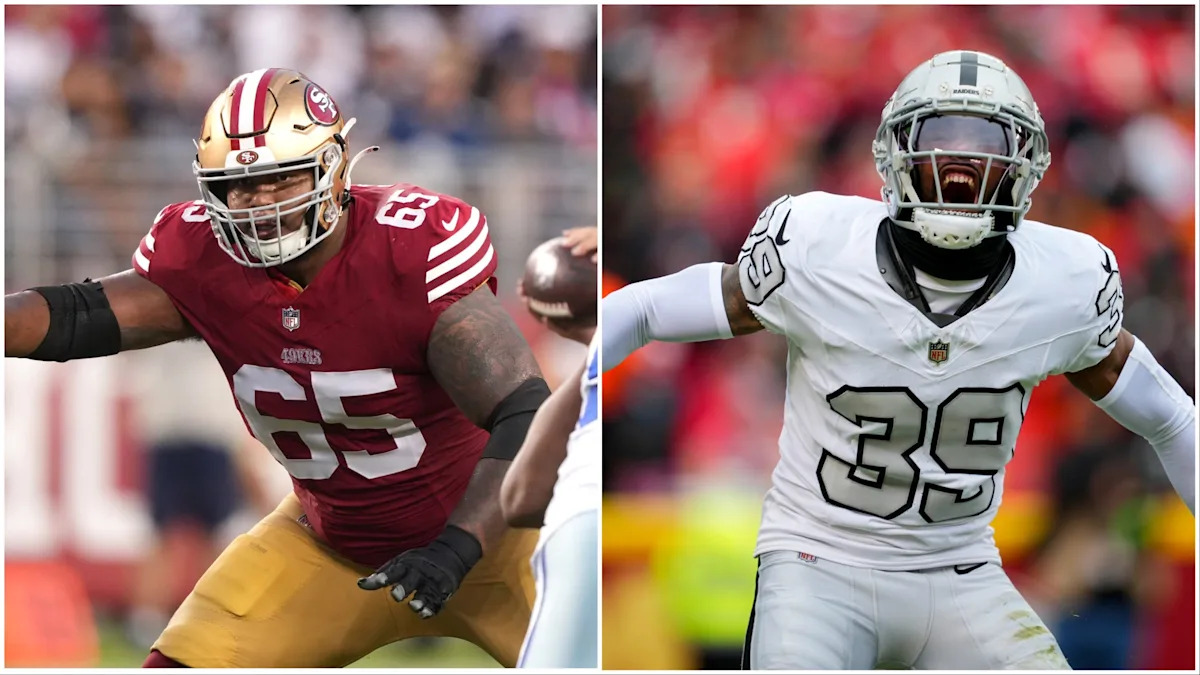
How does this information help to project what to expect from this year’s marquee additions, Aaron Banks and Nate Hobbs?
In terms of average PFF grade in years they played enough snaps to qualify, Banks is the worst second-contract free agent Gutekunst has signed, with his 59.2 average grade just worse than Turner and Za’Darius Smith.
But the Packers generally have had success in betting on the ascension a player showed in the last year of their rookie contract, and Banks could be another success story in that regard.
He had the best season of his career in 2024, and the Packers may be looking to follow the Turner blueprint, who had similar grades to Banks as a starter before coming to Green Bay. They will be hoping, or rather projecting, to get consistently above average guard play from Banks.
Advertisement
Of the six high-priced free agent additions by Green Bay, four of them performed better in their final season with their last team than in the previous years of their rookie contract. The two exceptions are Jacobs and Hobbs.
Hobbs had the worst final year from a PFF grade standpoint of any big free agent the Packers have signed recently at 61.4, but from an overall standpoint, was slightly superior to Preston Smith and markedly better than Za’Darius Smith with a 67.9 grade across four seasons.
Green Bay’s vision for Hobbs may be similar to how the Jacobs situation played out, where getting him out of Las Vegas and into a more stable environment was the key to recapturing his previous form.
There is no guarantee the deals for Banks and Hobbs will hold up well in hindsight, but based on Gutekunst’s track record, there is cause for optimism they can play their best football with the Packers.
This article originally appeared on Packers Wire: Do free agents improve in Green Bay? Expectations for Banks and Hobbs