
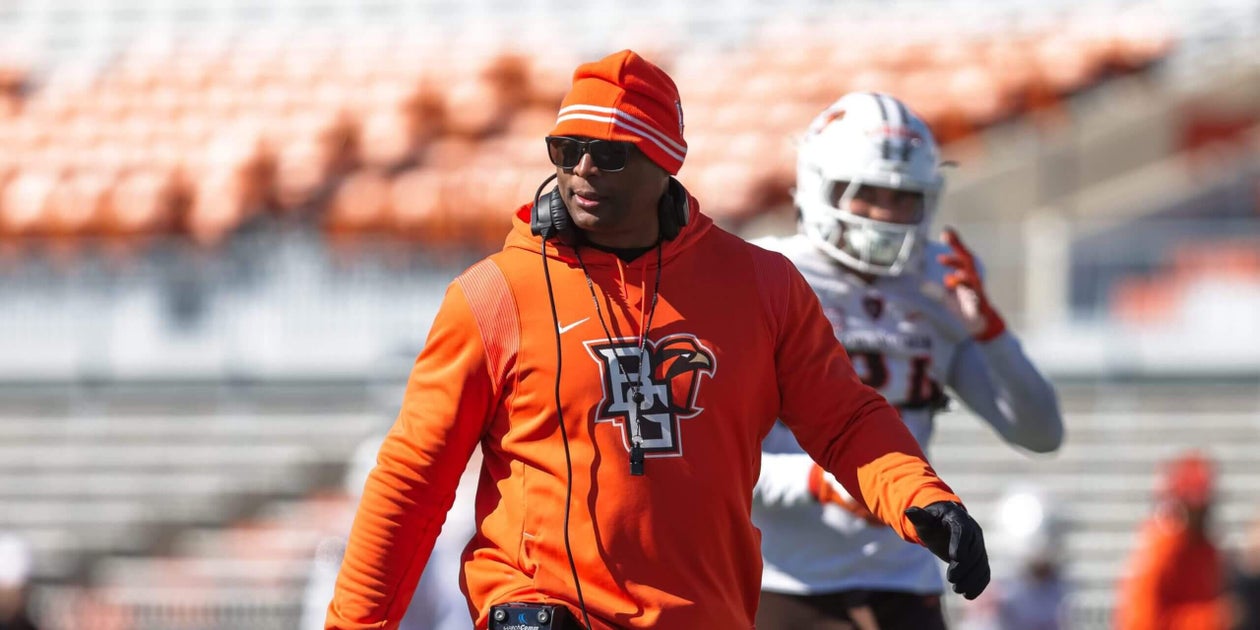
The whispers could be heard as he walked down the street to Urban Meyer’s restaurant. When he stood on the sidewalk speaking to a small group of reporters, more passersby began noticing.
“That’s Eddie George, a famous Ohio State player,” one woman told her kids.
Some across the street tried to get a good angle to take a photo. Once he moved inside the restaurant, fans took pictures of George through the glass that led to a closed-door fundraiser event for his latest venture: coaching Bowling Green football.
Thirty years ago, George won the Heisman Trophy as a running back at Ohio State. Since then, he’s starred in the NFL, started businesses and even dabbled in acting. Now he’s wearing a brown suit with a Bowling Green pin on his lapel, bringing attention to an unexpected location.
Unlike most Mid-American Conference football coaches, George is a celebrity everywhere he goes, no matter what color he wears. He can’t help but attract attention. It was the case when he was in Nashville, where he played for the Titans and spent the past four years coaching Tennessee State in the second-highest level of college football, in the FCS. It’s even truer in Ohio. On this day last month in Dublin, outside of Columbus, George talked to Bowling Green boosters and football alumni to get to know them and encourage donations to his new program.
He talked about his vision for Bowling Green and what allowed him to go from zero coaching experience to the FCS playoffs in four years at Tennessee State. What made him the right person for the Tigers’ rebuild is why Bowling Green bet on him: He has the name to attract attention and resources to a program in need of a jolt, but he doesn’t go out of the way to draw attention to his fame, either.
And that’s what he’s leaning into in his first FBS coaching job in the same state where his football hero status began.
“I’ve been a celebrity in this state for over 30 years. That’s not going anywhere, but when it comes down to it, when I put that whistle around my neck, we are in the heat of battle, I’m training guys or pushing them beyond their comfort zone, that’s a different animal,” George said. “That? I’m back to my old playing days. That’s the spirit and that’s not to be played with.”
When George retired from the NFL in 2005 after rushing for more than 10,000 yards, he wanted something different. Tired of the games, the practices and the late nights, he left the sport entirely. His pursuit of other interests led him to unexpected places.
During his playing time, George had become interested in acting, but he didn’t start taking it seriously until after he retired. He hired an acting coach and earned roles in multiple plays, making it all the way to New York in 2016 with the long-running musical “Chicago.”
On top of acting, he earned his master’s degree in business administration at Northwestern and started businesses in Nashville and Ohio, including a restaurant with multiple locations and the Edward George Wealth Management Group. He was inducted into the Nashville Entrepreneurs’ Hall of Fame in 2023.
He had a good life with his wife, Tamara, and two sons, Eriq and Jaire. The only time he thought about coaching? When building dynasties in the “NCAA Football” video game.
That changed in April 2021 when Tennessee State let go of longtime coach Rod Reed and called George. Another HBCU (Historically Black Colleges and Universities), Jackson State, had hired Deion Sanders the previous fall despite his lack of college coaching experience. Now Tennessee State needed some life breathed back into the program after finishing below .500 three years in a row and winning more than seven games just twice in 11 years.
At first, George was hesitant to entertain interest because he didn’t see himself as a coach and didn’t want to be a prop to sell tickets. If he was going to take over the Tigers, he wanted it to be about the players.
“I wasn’t going to do a reality show tied to it,” George said. “It’s not about the camera, my hits on Instagram, my content or any of that. There’s a place for all that, but it was important, especially in the beginning, that it not be about me, it be about them.”
The administration committed to George as the coach, not the celebrity, and he considered the job. He talked with his wife about it and thought more about what type of culture and philosophy he wanted to imprint on the team.
Everyone knows George was a talented football player, but his journey beyond football was one worth telling and one he thought he could use to help athletes at Tennessee State.
“It meant sacrificing a lot of things I had been working on prior to that, acting and business,” George said. “But the gratification that I got from helping young people and giving them guidance and seeing the light bulb go off — challenging them and developing them to become leaders is really God’s work.”
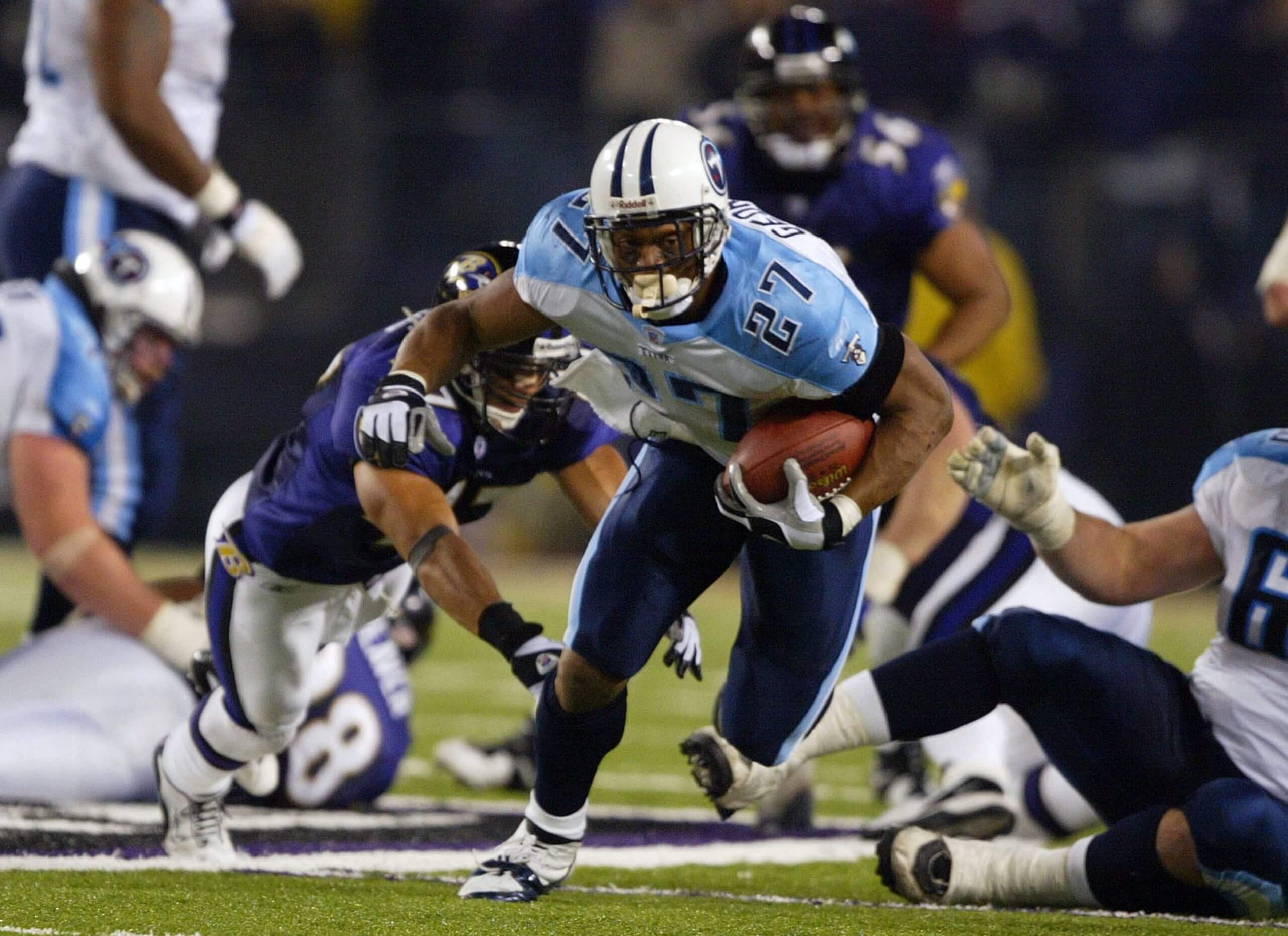
Eddie George was a four-time Pro Bowl selection with the Titans. (Al Bello / Getty Images)
After 15 years away, George loved getting back in the locker room, putting a game plan together and pushing players beyond their limits. He loved returning to the grind of football. But being a first-year head coach with no experience as an assistant isn’t easy. George took over a Tennessee State program with limited resources and got a reality check with all of the off-the-field responsibilities, especially at an FCS school with budget constraints.
Once he got his bearings, the program started trending in the right direction. Though Tennessee State lost three of its first four games under George, it went on a four-game winning streak after that and finished 5-6 in the fall of 2021.
“There were a lot of moving parts at TSU, from compliance to the players to equipment, making sure lines are on the field, the scheduling — all of it was overwhelming,” George said. “I had to organize my thoughts, but once I got a rhythm of it and I realized where I needed to spend my time, it was, ‘OK, the culture has to be felt from top to bottom, period. Excellence all the way through.’”
George’s words still come to Rodell Rahmaan’s mind before each of his professional indoor football games with the Omaha Beef.
No mas.
The first time he heard those words in a football setting was days before Tennessee State traveled to Eastern Illinois for a midseason game. The Tigers had won two in a row when George walked into a team meeting and relayed the message of the week.
“He wanted us to dominate them, have them saying no more, like they’re done,” Rahmaan said.
Tennessee State embraced it and beat Eastern Illinois 28-0, the largest win in George’s first season. With about four minutes left, Rahmaan heard a “no mas” chant break among players.
“I could remember the looks on their faces with our whole team yelling,” Rahmaan said. “Everybody rallied together.”
A graduate of Beechcroft High, 20 minutes from Ohio State, Rahmaan was well aware of who George was when he graduated from Bowling Green in 2020 and transferred to Tennessee State to play for George with his final year of eligibility.
“To have a legend from your hometown college hold me in that high regard, I felt like I was in heaven getting a call from him,” Rahmaan said.
Rahmaan spent one year with George, who displayed natural coaching instincts despite his inexperience. His playing experience gave him the ability to show players how to do things rather than just telling them. George kept everybody calm, even in high-intensity moments, and found ways to bring out confidence in his team.
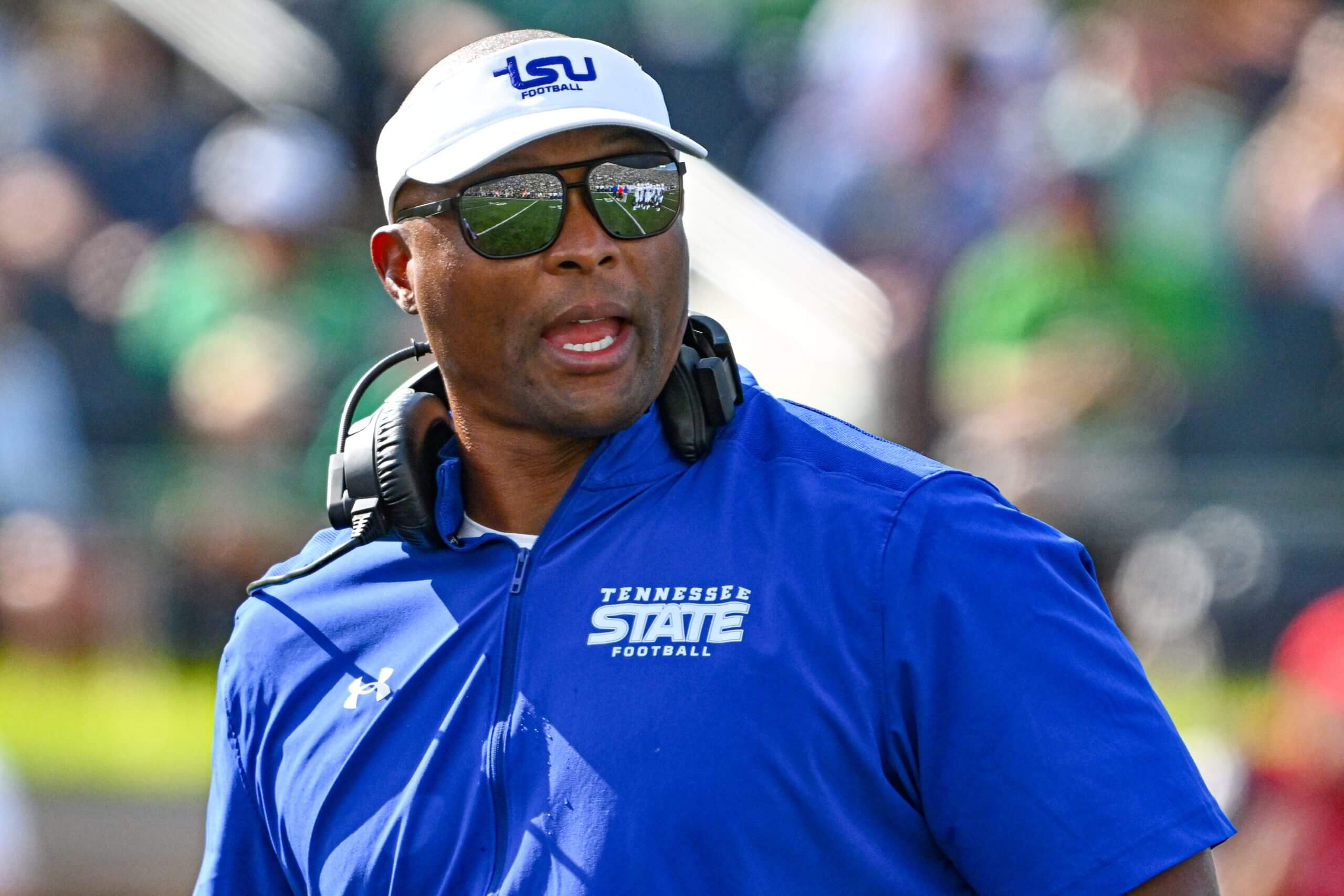
Eddie George went 24-22 in his first coaching job, at Tennessee State. (Matt Cashore / Imagn Images)
Still, it wasn’t a straight line of success. The team ended his first season on a three-game losing streak and then backtracked to a 4-7 record in 2022. George saw discipline issues he had to address on his roster and coaching staff. His focus was getting his culture under control as he learned how to coach on the fly.
“The first year was like, ‘Do I like this? Do I love it? I don’t know,’” George said. “But seeing the small wins, I got addicted to it. All the years of preparation and the life after the game prepared me for this.”
The Tigers started 6-2 in 2023 but ended on a three-game losing streak. So in the 2024 offseason, he implemented a new mindset called “nine strong,” which became a phrase used around the facility. George focused on making sure all nine position groups were strong from top to bottom so that at the end of November they were playing their best football.
Last fall, Tennessee State won seven of its final eight games before losing to Montana its first FCS playoff appearance in 11 years.
Three months later, George was watching ESPN when news came across the bottom ticker that caught his eye. Bowling Green head coach Scot Loeffler had left to be the Philadelphia Eagles’ quarterbacks coach, an early-spring move that put the Falcons in a precarious position long after the coaching carousel slowed.
“That’s a bad situation to be in right now,” George remembered thinking to himself. “I wonder what they’re going to do.”
“Lo and behold, it’s me,” he said recently.
When athletic director Derek Van der Merwe began his search to replace Loeffler, he reached out to former coaches Meyer (2001-02) and Dave Clawson (2009-13). Both told him he had to find a coach who could embrace the community.
Meyer gave Van der Merwe the 51-year-old George’s name.
“I was a little bit skeptical about a Heisman trophy winner and the Titan,” Van der Merwe said. “He said, ‘No, do you know Eddie as a person?’ I would say the first phone call I went in thinking how does an individual who has done what he’s done translate into the leader of a college football team? Does he have that heart of service?”
It took one conversation to realize that George was different.
“You saw a humble spirit, one who understood the value of higher education,” he said. “It was clearly evident to me that this was a man who spent his life learning, viewed the future and was committed to growth.”
George, who also interviewed with the Chicago Bears last winter, worried because he wasn’t actively trying to leave Tennessee State. There were challenges in the Tigers’ athletic department with an expiring contract coming up for George, some bad financials and other things that George said he and the administration were working out, but he intended to stick it out. He didn’t want word getting back to his team that he was interviewing at Bowling Green if he had no interest in leaving the program he just rebuilt.
He got assurance that nothing would leak and began talking to Meyer, his wife, former Ohio State coach Jim Tressel and others. He started to believe it was right for him.
“We talked over the pros and cons and led to a decision that it was the best decision for me, not from a financial standpoint, but a support standpoint,” said George, who signed a five-year deal with a base salary of $600,000. “We could really build this brand in a conference that is well established and going places.”
Bowling Green made the hire official on March 9.
“Eddie talked about his journey and how hard work defined who he was, how he just kept working and was going to get better at everything whether as a player or on Broadway or as a head football coach,” Bowling Green president Rodney Rogers said. “That is a great fit at schools like BG, because that is in essence who we are.”
Before George found a house in Bowling Green, he moved into a Best Western, eating waffles for breakfast in the lobby and going to dinner at local restaurants. He had to put a program together while intertwining himself with the alumni base and a small, tight-nit community.
“I have a hard time envisioning Eddie in a Best Western,” Meyer said. “But it’s important he acclimates to that town.”
The town of Bowling Green has a population of just over 31,000 nestled amid northwestern Ohio farm land. The state university has an enrollment of under 20,000. It’s the type of place where somebody of George’s stature can’t go into a restaurant or store without somebody stopping him.
“Bowling Green is big enough to be a Division I athletic program, but we’re small enough where everybody kind of knows everybody and you can kind of do things and see the results of what you do,” Rogers said.
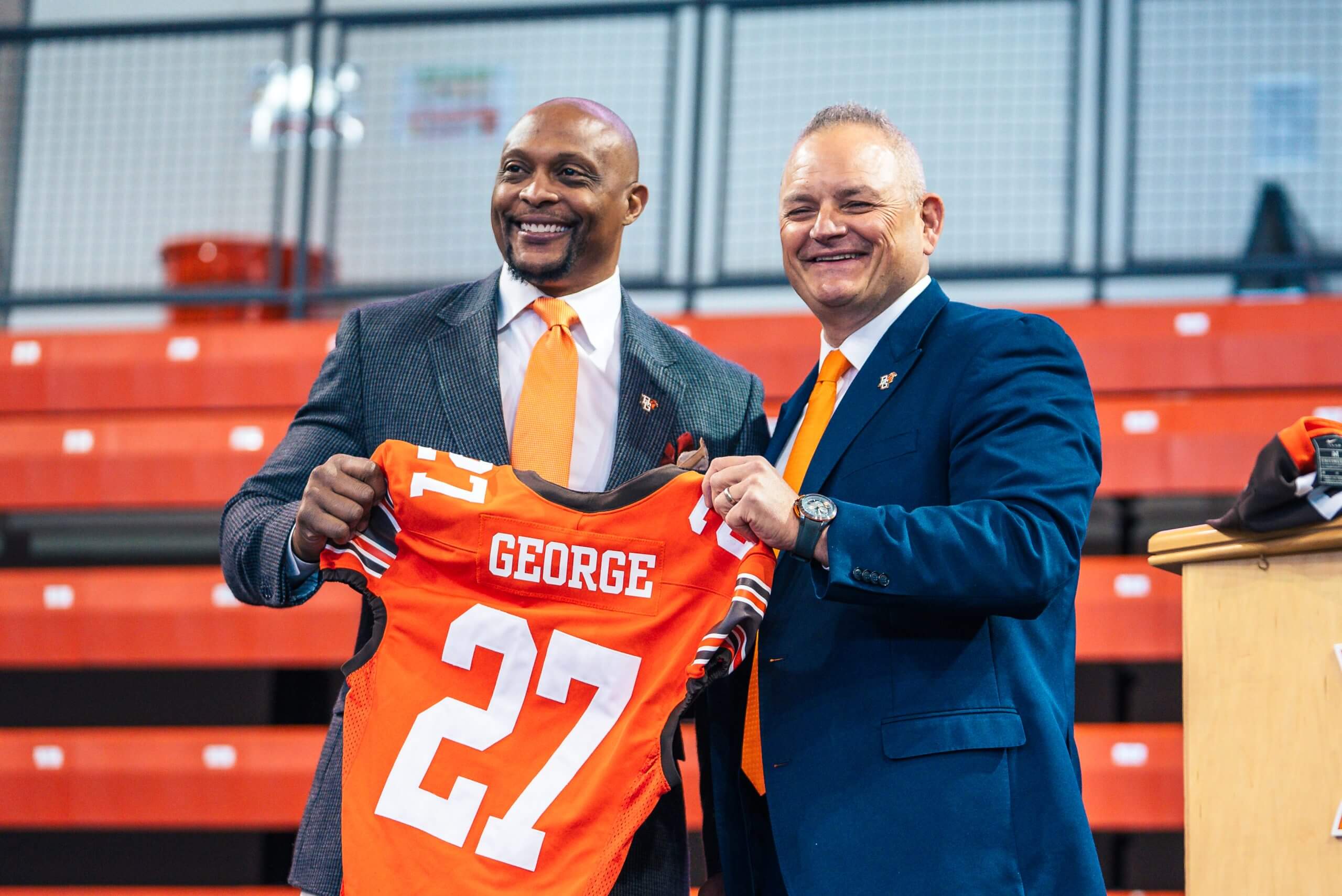
Eddie George will try to lead Bowling Green to its first MAC title since 2015. (Owen Fink / BGSU Athletics)
Meyer, who went 17-6 with the Falcons before leading Utah to an unbeaten season and winning a total of three national championships at Florida and Ohio State, still raves about the Bowling Green community, which is why he hosted a fundraiser at his Columbus-area restaurant in May.
Clawson, who recently retired as the head coach at Wake Forest, still visits Bowling Green and holds fond memories of the patience and support he received. After winning seven games to begin his career, he won two the next year and finished 5-7 in Year 3.
“Everybody had my back,” Clawson said.
Two years later, he won the MAC title, beating Northern Illinois 47-27 in front of a sea of orange that made the trip to Detroit to see the program’s first conference title since 1992.
“I still get goosebumps thinking about that game and how much orange was in the stands,” Clawson said. “It felt like a big deal that we were in that game. The amount of students, the amount of community members, the amount of buses that came up, it was awesome.”
The Falcons won another MAC title two years later under Dino Babers, who left for Syracuse. But the past decade has been a struggle to reach those heights.
Bowling Green made a surprise move to replace Babers with Texas Tech running backs coach Mike Jinks, who went just 7-24 before being fired in his third season. In came Loeffler, whose slow build eventually led to a pair of 7-6 records in each of the past two years to end the program’s streak of seven consecutive losing seasons, only for Loeffler to leave to become an NFL position coach.
“People who embrace this campus and build this program with the community beside them have had success, because they view this exercise of success through building the community around the program,” Van der Merwe said. “The community has helped the coaches solve programs. Then they move on and we celebrate that and we find the next person. Where we’ve made mistakes is when we fail to bring somebody in who embraces that.”
The Falcons were just one win away from the MAC championship game last season, but a loss to Miami (OH) in the last week of the regular season cost them a trip to Detroit.
Despite the program’s struggles over the past decade, upward mobility in the conference is readily available. There are a lot of similarities between MAC schools, and 10 programs have won at least one conference title in the past 20 seasons. Roster turnover in the transfer portal age has now made the conference even more fluid.
“It’s good to see teams clumping at the top, that’s what you want to see. You hope that continues,” MAC commissioner Jon Steinbrecher said. “We are an evolving enterprise. You used to be building a program for three or four or five-plus years, but now you’re rebuilding a program year after year.”
Though George didn’t arrive until March — long after the first transfer portal window in December — he made a splash in the April portal window. Bowling Green’s transfer class over the two windows is ranked No. 1 in the MAC by 247Sports, including an April commitment from ex-Notre Dame, Arizona State and Missouri quarterback Drew Pyne after George arrived.
Bowling Green had an average announced attendance of 13,358 last year, seventh out of 12 MAC teams. According to a Bowling Green spokesman, season ticket sales have risen 40 percent from last season so far, while sales for single-game and group tickets have risen 2,000 percent since they opened on June 2.
“(Tennessee State) is not an easy position, but he did a nice job there and I look forward to him continuing to build the BG program,” Steinbrecher said. “I expect there will be a buzz around BG road games this year, not that there wasn’t before, but this is another element that comes with it.”
George’s celebrity isn’t going anywhere, especially in Ohio, where he’s a hero to people like Rahmaan and many of the BG players who grew up in the state. There’s little doubt his name recognition has already worked in his favor when it comes to community support in Ohio and putting Bowling Green on the college football map nationally.
But that’s just one side of George. The side that fell in love with the grind of being a head coach and teaching is who Van der Merwe fell for. It’s also the one George can’t wait to show as the next stage of his unexpected new career begins.
“I lived the entertainment world,” George said, “but this has to come from a real place.”
(Top photo: Daniel Carlson / BGSU Athletics)