
Barring trades, the Winnipeg Jets will pick 28th at this year’s draft. There’s pressure to do well with this one: Winnipeg didn’t have a first-round pick last year and 2021 first-rounder Chaz Lucius recently announced his retirement due to Ehlers-Danlos syndrome. The Jets’ prospect pool does have exciting players — Elias Salomonsson, Brayden Yager, Brad Lambert and Colby Barlow most of all — but it’s thinner than Winnipeg is used to.
So, who is likely to be available when they pick at 28? Who should Winnipeg choose?
Here are 12 options, with analysis from Corey Pronman and Scott Wheeler — plus my view on how each individual player could fit into the Jets’ future success.
Please note that this piece borrows heavily from the deep, detailed reports provided by Pronman and Wheeler. Their latest top prospects pieces are linked below; use them for an even deeper look at Winnipeg’s potential draft options.
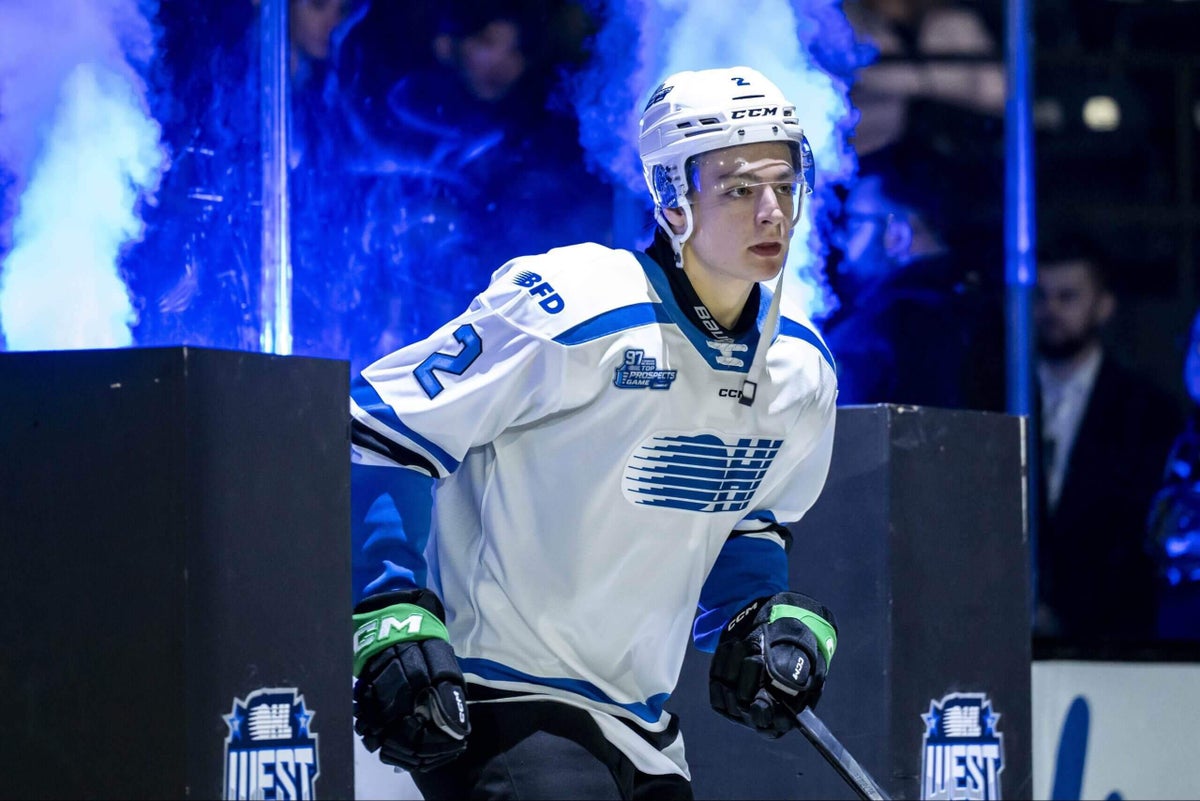
Henry Brzustewicz, RHD, London (OHL), 6-foot-2, 203 pounds
Pronman’s report (27): Brzustewicz played a notable role on a strong London team this season, appearing at times on both special teams. He’s a tall right-shot who skates well and doesn’t shy from using his feet to jump up into the attack … I could see more offence coming from him with more opportunity.
Ates’ angle: A big, mobile, right-handed defenceman sounds so much like the ideal Jets draft pick that Pronman chose Brzustewicz for Winnipeg in his most recent mock draft. The connections get closer, still, with Brzustewicz teaming up with Jets 2023 fifth-round pick, Jacob Julien, to win the Memorial Cup. The Knights are a dominant OHL team known for leaning heavily on their stars, sometimes inflating their draft year projections — but Brzustewicz didn’t get that treatment. That’s why both of our analysts see room for him to grow with a bigger role.
Bill Zonnon, LW/RW/C, Rouyn-Noranda (QMJHL), 6-foot-2, 185 pounds
Wheeler’s report (31): Nobody works harder. He can play both center and wing … He’s competitive and has a good stick on lifts and disruptions. He makes plays quickly. He can be a menace on the forecheck. But he’s also got some vision, with an ability to find the secondary wave on the ice and get pucks off the wall and to the interior.
Ates’ angle: Again, with Florida’s second straight Stanley Cup on everybody’s mind, I’m guessing elite forecheckers who play with NHL size and speed and can play all three forward positions will have extra cachet on draft day. Zonnon plays the kind of all-around game with a lot of subtle strengths and relatively few weaknesses that gives him a high floor and a playoff-ready middle-six ceiling. If I’m right about teams’ draft day thinking, Zonnon may be off the board before the Jets pick — despite our experts’ rankings of 31 and 41.
William Moore, C, U.S. NTDP (USHL), 6-foot-2, 180 pounds
Pronman’s report (42): Skates well, has good puck skills and can make creative plays with the puck. I wouldn’t describe him as a top-tier playmaker, but he sees the ice well enough. Moore’s compete has come into question at times this season, and he’s certainly inconsistent, but he has the ability to be effective down low and can kill penalties.
Ates’ angle: It’s tough to watch Florida win the Stanley Cup and get fired up about players whose “compete” gets listed as a weakness. That said, Moore seems capable of getting to the danger areas and improved his play enough down the stretch to feel projectable as an NHL centre. He’s a wiry, big-framed player who Wheeler believes will add yet more muscle and power to his game. Even if he tops out as a bottom-six centre, the Jets do need some insulation beyond 30-plus stalwarts such as Mark Scheifele and Adam Lowry. Yager is the only blue-chip centre in the system; I’m still thinking Lambert’s best bet is on the wing.
Cole McKinney, C, U.S. NTDP (USHL), 6-foot-0, 200 pounds
Wheeler’s report (40): He finished the year above a point per game as their top scorer and he’s a centre who has been counted upon to play an important role on both special teams (he tracks and angles well on the PK, is strong, protects pucks well and took on defensive assignments) and is credited for his well-rounded game on and off the puck.
Ates’ angle: The more I look into U.S. NTDP players, the more I prefer McKinney to Moore, although critics of McKinney’s game point to a “vanilla” skill set without a clearly identifiable NHL strength. I tend to like it when the Jets make ambitious swings at the end of the first round (such as Lambert, whose explosive talent and precipitous draft day fall made him feel like a high-risk, high-reward type of pick.) McKinney feels more like a David Gustafsson type of pick — probably “safer” and probably with a bottom-six NHL ceiling.
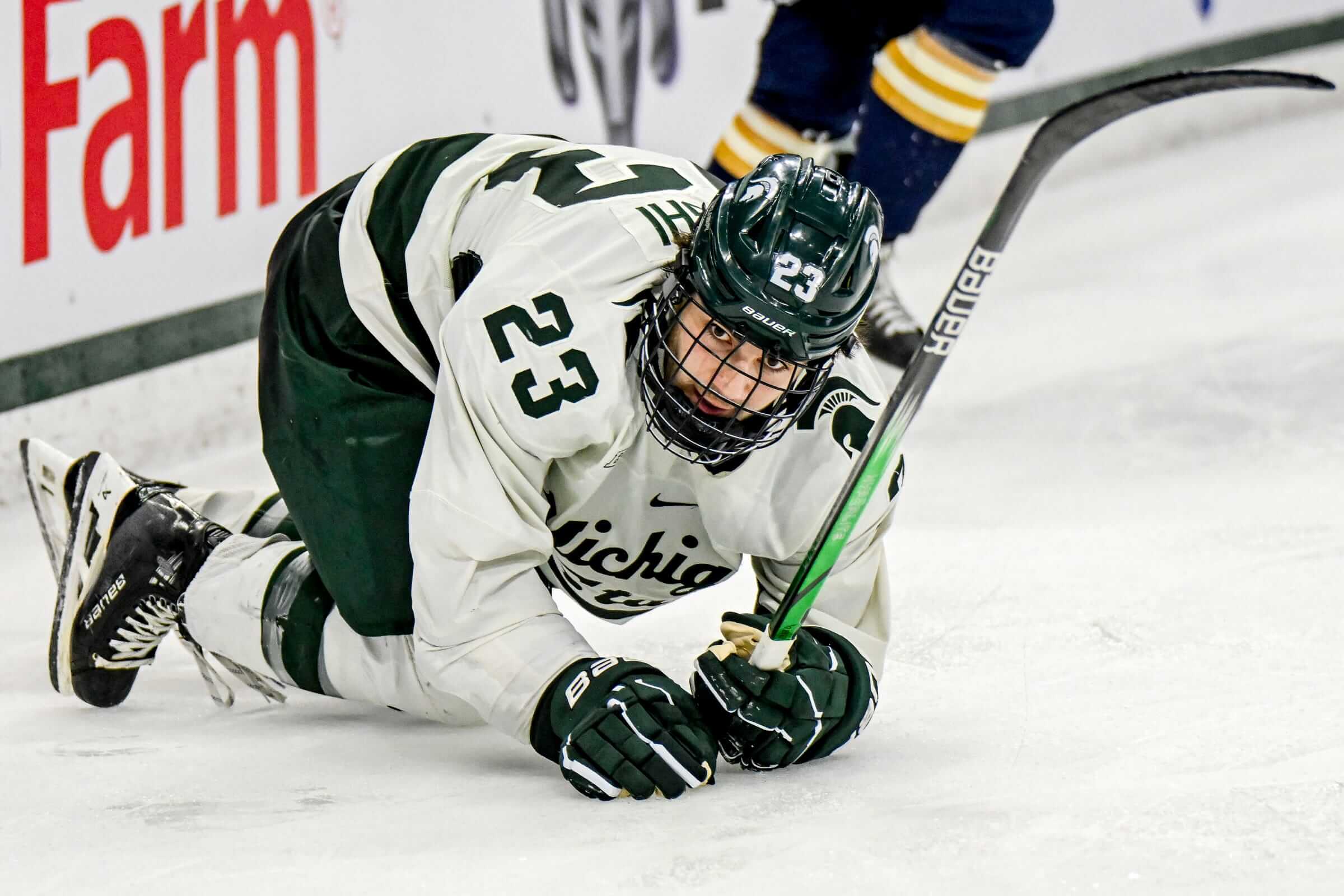
Michigan State’s Shane Vansaghi gets up off the ice after falling against Notre Dame during the second period in the Big Ten tournament on Saturday, March 15, 2025, at Muni Arena in East Lansing.Shane Vansaghi, C, Michigan State (NCAA), 6-foot-3, 212 pounds
Pronman’s report (35): Vansaghi played limited minutes on a top NCAA team in Michigan State this season. Despite his role, he still showed a lot of traits that will appeal to NHL teams. He’s got a very high skill level, especially for a forward of his size. He beats defenders one-on-one routinely and has a ton of imagination with the puck.
Ates’ angle: Wouldn’t you know it: Right after I complain about low ceilings, we get to discuss Vansaghi, whose physical tools give him a chance to pop — if he can add a bit of footspeed or if he can learn to make his reads with more of an impact player’s pace. I tend to be wary of players with below-average footspeed unless they have high-end hockey sense to make up for it. (For a perhaps unwelcome example: Rutger McGroary gives up footspeed to most NHL players, but his read of the game does imply middle-six possibilities to me.) Thus, I get concerned when I see Pronman rate Vansaghi’s hockey sense as “below average.”
Haoxi ‘Simon’ Wang, LHD, Oshawa (OHL), 6-foot-6, 222 pounds
Wheeler’s report (44): Wang’s an extraordinarily mobile player for his size, with impressive skating technique through his inside and outside edges laterally and flowing mechanics going north or back to pucks. And while his handling still needs a little refinement, he’s got some skill, can play with fearless confidence (which I wanted him to show more of and skate more pucks in the OHL instead of deferring), and has the heavy shot you’d expect.
Ates’ angle: I’m sorry, but you’re telling me that Wang is 6-foot-6, 222 pounds, and is “extraordinarily mobile” and a “premium” athlete? That’s the kind of long term bet I’m willing to make — despite the questions about Wang’s hockey sense. He’s still 17 years old and has just played half a season for Oshawa in the OHL — if he’s going to become an NHL player, he’s going to need many, many more reps against elite players his own age. His size, mobility, backstory and late-blooming status remind me of Johnathan Kovacevic as a Jets comparable — years away from pro impact, but has the tools to be helpful if his college career goes well.
Mason West, C, Edina (Minnesota High School), 6-foot-6, 218 pounds
Pronman’s report (32): He’s huge at 6-foot-6 and quite athletic in how easily he gets around the ice. That athleticism is also why he is being recruited as a D-1 football player. … The speed and skill for his size are very unique. … The team that drafts him will bank on him not being fully developed yet, and ideally, him picking hockey full-time.
Ates’ angle: Another 6-foot-6 prospect with great athleticism and good mobility, another player I view as worth investing in — if it’s clear that West wants to pursue NHL hockey as opposed to college football. To be clear, he’s not a burner — he’s mobile for his size more so than a top-end skater — but West has good hockey sense and is seen as a “true” centre (that is: not someone who will immediately get moved to wing by his NHL team.) It’s possible that he picks football or that West’s relative lack of offence compared to other players on this list make him a second-round pick as opposed to Winnipeg’s choice at No. 28. I wouldn’t be put off by a “draft and follow” if the same scouting staff that picked Kieron Walton in the sixth round last year believed in West this time around.
Ryker Lee, RW, Madison (USHL), 6-foot-0, 181 pounds
Wheeler’s report (24): They called him “The Wizard” at Shattuck, and he lives up to it. The lightning-quick, puck-on-a-string hands. The shiftiness. The clairvoyant vision and eyes on the back of his head. The touch and finesse on passes. The feel. The natural release … Not that long ago, he was 5-foot-7, and now he’s closer to 6-feet, and he still has room to grow and get stronger. If he can improve his skating, he’ll become a top offensive player in college.
Ates’ angle: I recently argued for the Jets to choose Lee in our staff mock draft, likening a bet on the silky-mitted Madison product to the play Winnipeg made on Lambert in 2022. (The difference in that year’s case was that Winnipeg had two first-round picks and had already made a “safe” bet on McGroarty at No. 14.) In Lee’s case, the appeal is in his elite hands and the idea that he’s in the midst of a dramatic growth spurt; Lee is a below average skater but the idea is that his wheels may catch up once he stops growing quite so quickly. If the Jets have any reason to believe his feet will catch up to his hands, I think Lee would be a bet worth making late in the first round.
William Horcoff, C, Michigan (NCAA), 6-foot-5, 203 pounds
Pronman’s report (28): He’s a very skilled big man who can make small-man-type plays in tight areas. He sees the ice at a high level and has a creative offensive mind. Horcoff is also good enough in the hard areas and can play the body when he needs to.
Ates’ angle: Horcoff left the U.S. NTDP to join Michigan partway through last season, making a more impressive impact for his college team than he did for the American program. He has good puck skill for his size and plays an athletic, competitive game that makes him hard to play against. His dad, Shawn, was not a burner when he was drafted but went on to win the fastest skater competition at the 2008 NHL All-Star Game — for this potentially irrational reason, I read Horcoff’s highly athletic but medium-paced scouting reports without a lot of concern. He strikes me as the kind of player who will be a productive version of a bottom-six centre if he doesn’t make it further up the lineup.
Milton Gastrin, C, MoDo Jr. (Sweden J20), 6-foot-1, 194 pounds
Wheeler’s report (26): Gastrin’s habits and details are there at an early age. He’s not a dynamic offensive player, but he handles it well, makes plays around the net and below the goal line, and seems to really understand timing and spacing. He’s also got a natural shot and release that I expect him to show more of as he learns to attack for himself more.
Ates’ angle: Gastrin is the captain of his age group for Team Sweden and had some spectacular moments at the Ivan Hlinka tournament last summer, including an eight-point game against Team Switzerland. I think he’s the kind of big, responsible centre brimming with intangibles that the Jets would love to draft — if he’s still available to them at 28. He’s one of the hardest-working players in this draft class, shoots well and doesn’t have any real holes in his game.
Daniil Prokhorov, RW, Dynamo St. Petersburg (MHL), 6-foot-5, 209 pounds
Pronman’s report (30): Prokhorov is a huge winger with very good hands. He can make a lot of skilled plays in open ice, at full speed and in traffic. He’s a very physical forward who leans into guys with his big body and plays a direct style. Prokhorov isn’t blazing fast, but he moves well for his size and can skate at the higher levels.
Ates’ angle: There are a ton of big players on this list — I’m sure you’ve noticed — but it’s more about the quality of the prospect than hunting for size with the Jets specifically in mind. Prokhorov may have less appeal than big centres such as Horcoff and West, given the Jets’ relative strength on the wing, but he makes great use of his size in the danger areas in front of the net. It’s a little odd to think of the Jets picking a winger without high-end skating — their homegrown stars, Kyle Connor, Nikolaj Ehlers are great skaters — but then I think of Vilardi and Perfetti’s effectiveness and the idea doesn’t seem so absurd.
Benjamin Kindel, C, Calgary (WHL), 5-foot-10, 180 pounds
Wheeler’s report (21): He’s a worker with legit skill and smarts. That combination of effort, sense and talent really blends well together at the junior level, and though he looks a little lean, it doesn’t present itself in his game because of his work rate off the puck. I do find he can slow the play down a little too much at times, but he thinks it at a very high level.
Ates’ angle: Kindel is skilled, he’s fast, he’s lauded for his compete level and he can create offence in a lot of different ways. It’s the sort of profile that would dazzle were he not listed at 5-foot-10 and will almost certainly make him a first-round pick regardless of that caveat. Talent plus work ethic is a dangerous combination and I’ll admit I’m biased toward any prospect with “hard to play against” as a realistic descriptor of their play — as long as they score well, which Kindel definitely did: 99 points in 65 WHL games despite being 17 for most of the season.
(Top photo of Henry Brzustewicz: Kevin Sousa / Getty Images)