
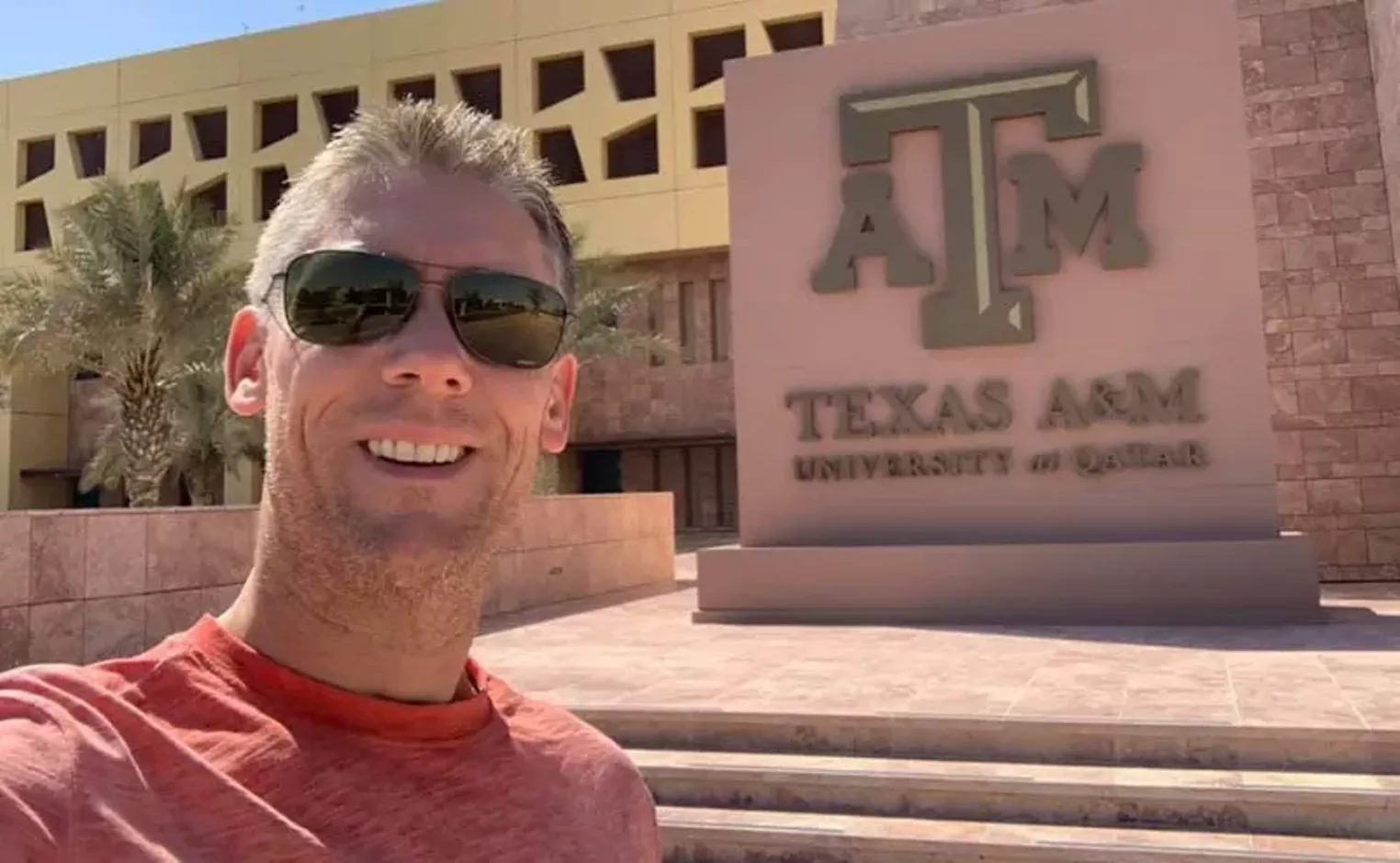
Monday’s missile attack on a U.S. air base near Doha, Qatar, didn’t surprise Dana Davis — Iran had to show its people that it wasn’t weak, she says — but she worried for her friends in the small Middle Eastern community, who told her they felt the ground shake when the projectiles struck their town.
Davis and her husband Kevin, who worked at the Texas A&M University at Qatar campus about 20 miles from the Al Udeid Air Base where the missile strike occurred, lived in Qatar for 13 years and returned home to Texas last summer.
American officials were reportedly warned about the attack and the air base had been evacuated. Nineteen missiles were fired with no deaths or injuries reported. The attack was a response to President Donald Trump stepping into the conflict between Israel and Iran. Just one day prior, Trump ordered an attack on Iran that he claimed “completely and totally obliterated” Iran’s nuclear enrichment facilities.
Later reports suggested the American attacks on three of Iran’s nuclear facilities did not destroy the program’s core components and likely only set it back by a few months.
“It’s still unfolding,” University of Houston political science professor Brandon Rottinghaus said Monday morning, after the American attack on Iran but prior to Iran’s missile strike in Qatar. “It certainly marks a demarcation point for President Trump, with respect to his political globetrotting. Exactly how that plays out, we don’t know.
“There’s a real risk in confronting Iran in this way, not just from a foreign policy international security point of view but also from a domestic political point of view, not just from Democrats but also from Republicans who are worried this will drag the U.S. into another endless war.”
But Trump congratulated himself Monday night as he announced a ceasefire between Iran and Israel, bringing an official end to what he’s calling “the 12-day war.”
“This is a war that could have gone on for years, and destroyed the entire Middle East, but it didn’t, and never will!” Trump wrote on X. Then reports came that Iran and Israel were ignoring the ceasefire and, as Rottinghaus says, the situation is still unfolding.
More than 500 engineering students resumed classes at the Texas A&M Qatar campus on Wednesday after the U.S. Embassy there issued a shelter-in-place alert Monday afternoon and shut down classes Tuesday.
Davis has fond memories of living in Doha with her husband, who served as the chief information officer for Qatar’s Texas A&M campus, and their four children, who ranged in age from 6 to 13 when they moved to Qatar and are now all in their 20s.

A sign in Doha advertises a camel underpass.
Photo by Dana Davis
She said she expected Iran would retaliate. “They have to save face,” she said. They have to be the last one to do anything. In fact I told my sister Iran was going to do something, even if it was small. They don’t want to appear weak to their people.”
It doesn’t look like Iran intended to harm Americans or anyone else, she added.
“Qatar has close ties to Iran,” she said. “They share the second-largest gas reserve in the world under the Arabian Sea. We always called it the Persian Gulf from the U.S. side, but the Persian Gulf is the ancient name for Iran. On the Qatar side, Saudi Arabia, Qatar, Kuwait, they all call it the Arabian Sea. They don’t want to call it by Iran’s name. They want to have their own name for it.”

Dana and Kevin Davis rode camels on a desert safari.
Photo by Dana Davis
On Monday when the missiles hit Qatar, Davis said her phone lit up with messages.
“They said they heard it and they felt it,” Davis said of her former neighbors. “They felt the shaking and their windows were rattling with the explosion. They didn’t see it, they just felt it. We were not too far from the Al Udeid base that was the target. We lived much closer to a smaller base where Afghan refugees are held until they are fully vetted before going into the U.S.”
Davis said she takes comfort in knowing that the people of Qatar weren’t being targeted. The Al Udeid base is somewhat isolated in the desert southwest of Doha, she said.
“I never felt unsafe [in Qatar], even at night by myself,” she said. “There are places I wouldn’t go here in the U.S. by myself at night. However, I think because of this, it’s kind of shaken that sense of security. One of my American friends there — she happens to be Muslim — she said her kids are really shaken up. I have other friends who are planning to fly out and come to the United States.”
A spokesman for Houston’s Iranian Cultural Foundation said Tuesday that the nonprofit is focused strictly on Iranian culture.
“We have no political or religious affiliations or activities, nor do we comment on world events as it pertains to Iran,” he said.
Jon Buchanan, who headed up registration at the Qatar campus for three years and returned to College Station in January, echoed a similar sentiment. Buchanan and his wife Amy have three sons who are now 14, 12 and 6.
“We looked at each other many, many times and said we feel much safer [in Qatar] than we do in the U.S.,” Buchanan said. “After we got there, the school shooting happened in Uvalde. When that happened, we were like, wow, nothing like that will ever happen in Qatar. There were times like that, when we were thankful we were there and not in the U.S.”
Over the last couple of days, Buchanan said he’s talked to several friends in Doha.
“For the most part, they’ve said it was kinda scary but that Iran notified the military there that they were going to send the missiles,” he said. “They weren’t super, super scared. It was loud. It sounded like thunder. I don’t know how we would have felt if we were there, but I can tell you that during the time we were there, we felt incredibly safe.”

Kevin Davis goes sand surfing in Qatar.
Photo by Dana Davis
Both Davis and Buchanan, who were next door neighbors when they lived on a compound in Doha, said the Qatari people pride themselves on being negotiators who resolve conflict.
“They’re kind of like the Switzerland of the Middle East in that they try to stay on the good side of their neighbors,” Davis said.
Buchanan agreed that the Qatari government likes to facilitate peace talks and be known as friendly to surrounding countries.
“To hear that Iran actually launched missiles, even though it was at a U.S. air base in Qatar, I was really shocked that they did that,” he said. “I never would have thought that would have happened. I don’t think there was ever any real danger, but the last few hours have been pretty tense. Who knows what’s going on and who knows what’s going to happen?”
Both Davis and Buchanan said Qatar was a welcoming place for young families.
“It was a great experience because we got to meet people from all different cultures,” Davis said. “Only about 20 percent of the population is Qatari so we got to meet people from all over the world.”
About 62 percent of those enrolled at the Texas A&M campus are Qatari and about half of the engineering students are female, an unusually high number in an engineering program, Davis said. The university, which has offered undergraduate degrees in chemical, electrical, mechanical, and petroleum engineering since 2003, is slated to close by 2028, officials announced last year.
Its intent when the university opened was to “import elite higher education from the United States to Doha using the oil and natural-gas riches of the tiny Persian Gulf nation.” A Qatari university will take over the engineering courses but A&M, which was the largest and most successful university there, will no longer have a presence there, Davis said.
That means it’s likely that the presence of Americans in Doha may also decline. Davis said she wouldn’t live there again but she’d definitely visit in the cooler months (it’s probably about 115 degrees in Doha this week, she said).
A direct flight from Houston to Doha is about 14 hours, and once there, the Davises were able to buy a car and do routine tasks such as grocery shopping, although most of the stores are in large, opulent indoor malls, she said.
“Arabic was the official language but in business they used English,” Davis said. “There were people who couldn’t speak English but it hindered them in their jobs.”
The Buchanan kids and the younger Davis kids went to the American School of Doha, which was a diverse cultural experience, Buchanan said.
“There were 80 different countries represented in the student body there,” he said. “It was really cool to see our boys learn how to interact and make friends with people who look different than them and have different beliefs from them. We lived in, like, a compound that was very conducive to all of our boys making good friends and being outside all the time, swimming and playing games and having fun. It was cool.”

A man taught the Buchanan boys to fish at the beach on the Persian Gulf.
Photo by Jon Buchanan
Americans in Qatar occasionally had to fact-check some of their new friends who had a skewed perception of the United States, Davis said.
“It’s much more modern than people expect,” she said. “It’s an affluent country. They have lots of stereotypes of America based on what they’ve seen in the movies. They think we’re very immoral. For the Muslim families, they think we are a Christian nation but we all behave like Hollywood. We had to explain to them that our government isn’t tied to religion like it is in the Middle East.”
Many Qatari people will make special trips to the United States to give birth so their children can be American citizens, she added.
“They like the freedoms and the opportunities that we have here,” she said.

The courtyard area at Vendome Mall hosts live entertainment every hour, except during Ramadan.
Photo by Dana Davis
Texas A&M University president Mark Welsh III issued a statement Monday evening advising that university officials were closely monitoring the conflict “with deep concern.”
“We are grateful for the resilience and professionalism of our Qatar campus during this uncertain time,” he wrote. “Our entire university stands with them in solidarity, and we will continue to adapt and respond as the situation develops.”
The university president also sent an email to the “Aggie family” acknowledging a deep sense of concern and uncertainty as global events continue to unfold in the Middle East.
“We are and will continue providing resources and support for those affected, and we will also work to maintain the continuity of academic operations should we need to pivot to alternative delivery options,” Welsh said in the email.

The Corniche skyline on a boat cruise.
Photo by Dana Davis
Buchanan said he’ll continue to keep an eye on what’s happening in Qatar. He’s more invested now that he’s lived there, he said.
“I’m more invested in Qatar and I’m more invested, even, in Gaza, even though Gaza is 1,000 miles away from Qatar,” he said. “We were in that region. It’s interesting to have that perspective, kind of learning about Middle Eastern culture and the religions that are there and the belief systems that are there, it changes your worldview.”
Buchanan said he wasn’t sure what the rest of the world thinks of the Trump administration but he said he is admittedly a little dumbfounded by some of the president’s recent decisions.
“I’m scratching my head a little bit, like what is going on?” he said. “I can only imagine that there are lots of other people that are thinking the same thing that I am, whether they’re Americans who voted for Trump or didn’t vote for Trump or they’re not Americans and they’re just watching from the outside looking in.”
Despite the uncertainty throughout the world, based on a group chat with other faculty members in Qatar, Buchanan says it appears his old friends were back to business as usual within 24 hours.
“I think people are probably still tense. I don’t think they are scared or worried that Iran is going to drop a nuclear bomb on Qatar,” he said.