
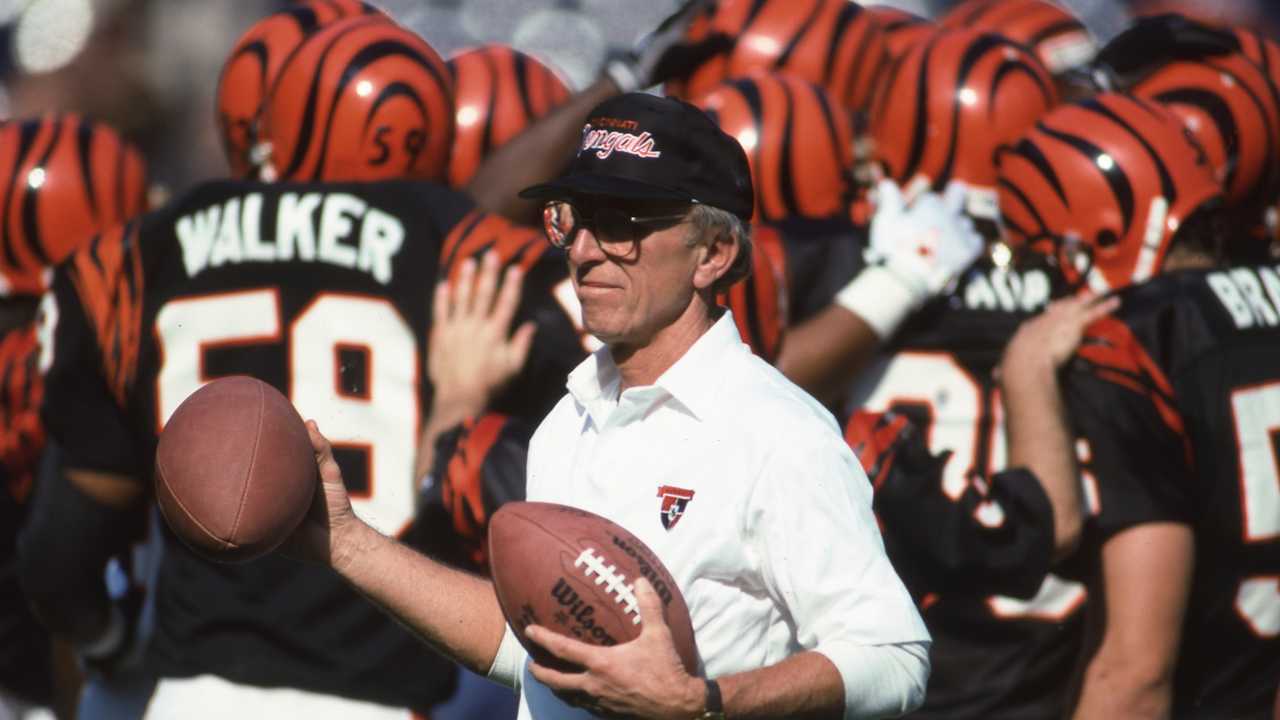
HOBSON: Bengals president Mike Brown says back then, the equipment room was kind of a gathering place because Tom was a popular figure.
TRUMPY: Yes, yes, absolutely, it was. Yes. When Tim Krumrie broke his leg in the Super Bowl, I was already retired. Go to training camp the next summer, and as you remember, Krumrie didn’t miss a game even with that badly broken leg. And when I walked into Tom Gray’s office, there was Krumrie sitting there talking to him. I said, ‘Timmy, you’re sitting in my seat.’ And he says, ‘Now my seat.’ Tom Gray always attracted a crowd.
HOBSON: What was it about him?
TRUMPY: His connection with Paul. I think that was a part of it. He just loved being around the players, and eventually I had the guts to smoke in front of him. He smoked too, so we would sit there and he would put up a mirror so nobody could see us smoking when they walked into his office down at Spinney Field, and we would just sit there and shoot the breeze. He was all for us, and I was in love with him. If you’re my first ally, we’re buddies forever.
CONNELLY: Lou Weiland had a little bar down the street from Spinney on Gest Street. Tom never had to buy his lunch, because the players would always, if they’re going out to get themselves sandwiches, they would always ask Tom, well, what kind of sandwich do you want? They would always bring him a sandwich back. It was definitely a gathering place. Tom kind of ruled it like the Chief Justice of the equipment room.
My first year, when I was an assistant trainer (1976), we got back from Tampa one preseason game at like two or three in the morning, and Tom had arranged for three-way coneys to be delivered at 2:30 to Spinney. He was just one of those guys who without asking, he sort of knew what to do. He knew what was going to be needed.
And it’s one of those positions where you have to prepare. You can’t go into a game in Denver and not prepare for snow. You have to prepare for everything, every possible weather condition.
Tom and Marv and I would ride the equipment truck out to the airport when I first got here. Our plane was delayed once, and Tom and Marv, and I are hanging out at the fire department at the airport because the equipment truck would go in there. Tom would help load the bags on the airplane, just to make sure nothing was ever left in the truck. He said, ‘The worst thing I could ever do is leave something behind that I know I packed and I can’t find it.’
He wanted to make sure that there was never any chance of something being left in that truck. There are some unwritten rules. You don’t want anything to bite you in the ass. I’m sure (current Bengals equipment czar) Adam Knollman does the same thing now.
HOBSON: He had to work some magic in the Freezer Bowl. No modern equipment to speak of in the 1981 AFC title game at Riverfront in minus-59 wind chill.
CONNELLY: The Freezer Bowl, from a player safety and health standpoint, was a consortium of, I would say, Marv and Tom, along with (team doctors) George Ballou and Wally Tipperman. Those four. And (head coach) Forrest Gregg had played and coached in cold games.
But like today, it’s not one person making a decision. It’s getting a consensus of other people that have input. And, I mean, nobody was so braggadocio that they had to, well, ‘This is the way we’re going to do it because I say we’re going to do it.’ George and Wally from a medical standpoint. And then there are the players, too, who came in and said, ‘We’re going to get through it and go out there in short sleeves.’
And I know Tom was searching the city for, I think they were called Leggs (pantyhose). They were looking for the extra largest of those they could fine. And between that and Vaseline on their arms to keep body heat in, which you couldn’t do today because it’s banned.
He had the dedication to following league guidelines, a la footballs. That was back in the era where receivers would wear those gloves that had so much Stick Em on them before that was banned that they would drip.Players would always want to try and push the envelope.
Tom would rein them in. He would say, ‘You know what? This is my watch, and I’m not going to get fined because you’re breaking the rules.’ So he was a stickler. He was doing what Paul wanted him to do. Paul wouldn’t want us to have a player get fined or something like that.
TRUMPY: Now (my first) season ends, and I’m down to 198 pounds, and (ends coach) Bill Walsh walks up to me while we’re flying back from playing the final game that season against the Jets. And he said, ‘You had trouble today.’ I said, ‘Hell yes I had trouble. I’m blocking guys who weigh 280 and I weigh 198, and he says, ‘You what? That’s not what your weight is listed as.’
I said, ‘I cheated on the weight. I weighed in every week with a 10-pound weight.’ Well, the net result of that story is Tom Gray remained my ally, and for the next two seasons I had to weigh in naked. No towel, no nothing, no T-shirt, no nothing. He was my first ally.
CONNELLY: Tom Gray, Jr. called me a few months ago and said his dad was going into the equipment managers’ wing. And I told Tommy I wanted to go to Canton.
It’s just a respect that an equipment manager had. I mean, he was an integral part of the team, and knew his position and knew his job. If the mandate is to do what Paul would want to be done, it’s kind of black and white. It was clear.
Marv was my mentor, but he was a mentor in his own right.
TRUMPY: He would say, ‘Check ’em and zip ’em.’ Everything you are or might wear over the weekend for this game, get it in your bag, get it zipped up so we can get it on the truck. He was moving a thousand miles an hour to accommodate everybody, and he did it beautifully. I don’t know anybody who ever had a complaint about Tom Gray. Anybody.
He was an amazing guy. What he did for me and the manner in which he did it. I’m sure as thorough as Tom Gray was in his job, he knew that I had a 10-pound plate in the back of my locker. And he said nothing. That’s a friend, isn’t it?