
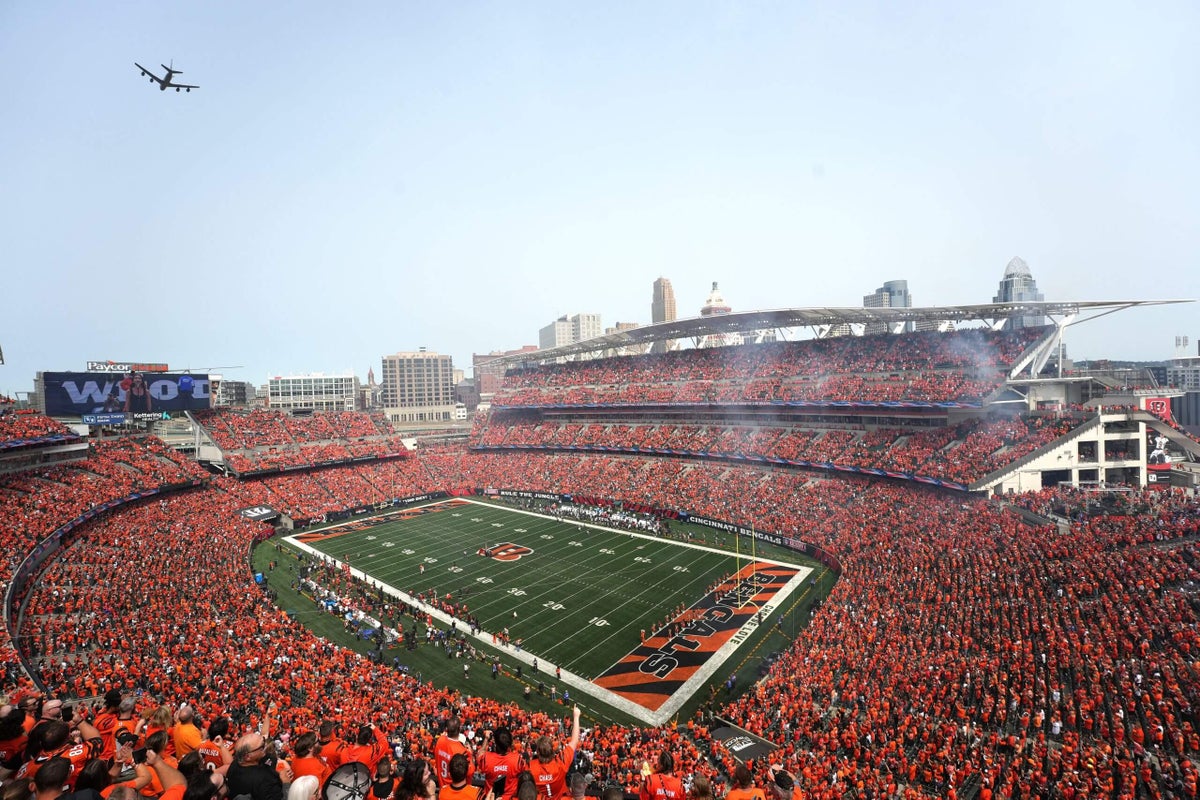
CINCINNATI – The Hamilton County commissioners voted 2-0, with one abstention, on Thursday to approve the framework of a new lease keeping the Bengals downtown in Cincinnati through at least 2036.
The new agreement calls for a $470 million renovation of Paycor Stadium, of which the county will contribute $350 million and the Bengals/NFL will contribute $120 million, as well as agreeing to begin paying rent for the first time.
In 2036, a new set of five-year, rolling extensions will be available as options to extend the agreement.
The improvements are expected to take two to three years and currently involve no state funding. Both sides still must negotiate the final details of the agreement.
Bottom line: The Bengals are expected to continue playing downtown and the potential to explore other options in the coming years is taken off the table.
“This is a significant day for the Bengals and Hamilton County as we secure the team’s future in Cincinnati,” Bengals Executive Vice President Katie Blackburn said. “We thank the Hamilton County commissioners for supporting this agreement to ensure Paycor Stadium remains an excellent venue and a focal point for Cincinnati’s riverfront. We are proud to call Paycor Stadium our home and to keep our future here in Cincinnati, where it belongs.”
It’s quite an accomplishment to reach this point considering the state of negotiations in previous months and years.
“I really didn’t think we’d be here today. At all,” Commissioner Stephanie Dumas-Summerow said. “Things were going in different ways. I’m just really happy about being here.”
Here are five things you should know about the agreement:
Capped contribution: ‘We are limiting the exposure of the county’
The word used to summarize the tone of the negotiations by multiple parties in the commissioners’ meeting on Thursday was the same: Spirited.
The county hired David Abrams, of Inner Circle Sports, who has taken part in negotiating stadium renovations and construction in markets across the country. The commissioners and their team called it one of the smartest things they did.
Abrams entered the fray of the challenging negotiations and distanced the county from the previous lease that put an undo amount of liability on the taxpayers. By capping the amount the county pays at $350 million and eliminating provisions for future maintenance, it eliminates the risk and unknown future maintenance costs of the previous lease.
“There’s predictability to the investment the county is making, which is something that did not exist in the current lease,” Abrams said.
This goes a long way in the mind of Commissioner Denise Driehaus to allow confident allocation of resources to the rest of the county’s needs.
“The old lease allowed the Bengals to come in and ask for enhancements relative to the market, so we always had this undefined liability,” Driehaus said. “That is something that keeps you up at night. This is capped. That is a great benefit to the county.”
Kicking the can down the road
This deal essentially delays this debate for another decade. Making a deal for 11 years with the same two-year extension structure will have everyone right back at this same spot in 2035, minus $350 million from Hamilton County.
It does include a provision for the first two-year extension to be guaranteed, which made Driehaus even reference this as a 13-year lease in her mind.
This plays out similarly to what the Ravens have done in Baltimore, which was a $489 million renovation of M&T Bank Stadium, though that is through the Maryland Stadium Authority, not a county.
The county would have preferred a longer deal, which was illustrated in the earliest exchanged offers, but this shouldn’t be viewed as a long-term fix, rather a more temporary solution.
This deal connects to the Bengals’ stance that clashed with the early visions and renderings of this project. They didn’t want a bigger project that made a massive overhaul of the interior and exterior of the stadium or addition of offices or outside projects — those that more directly impact The Banks and downtown. They merely wanted to keep the stadium infrastructure maintained and up to current standards. This allows that, and then all sides can revisit it in a decade.
An interesting point by Commissioner Alicia Reese, who was vocal about her concerns with the proceedings, was that the Reds’ lease will be coming up at about the same time, and that could make for a very complicated and burdensome situation for taxpayers. The good news is the county, Bengals and Reds have 10 years to prepare for that as countless variables change.
Fresh lease: ‘This is a new era’
Tearing up the old lease was a win for the county. Driehaus spoke with joy about accomplishing that, and there are a few major alterations that will help the stadium have a bigger impact in the community than with the old lease.
For one, the Bengals would now pay rent. They will pay $1 million over the next three years and then $2 million each year of the final eight years of the agreement, as well as for any extension years.
The $120 million put toward the project is a 75-25 split of total costs, plus the addition of rent. That moves in a better direction than the 88 percent taken on by the county in the previous lease.
“This is probably a lower cost of initial capital than just about anywhere I’m working in the NFL,” Abrams said.
More events: ‘The people’s stadium will be used by them, for them and with them.’
Look for more events at Paycor Stadium, one of the county’s biggest wins in the negotiation.
A bigger impact will be that the county will be able to give control of outside events in the building over to a third party.
“The taxpayers are going to have access to their stadium,” Driehaus said. “We are going to be in charge of what happens in the stadium. We will bring in concerts. We will bring in games. I’m excited taxpayers can use this game to their benefit.”
The stadium traditionally had held one or two major concerts, plus the Cincinnati Music Festival and other minor events. If the county can execute booking the building, that could serve as a significant difference in the stadium’s usefulness.
Not done yet: ‘These are core pillars on which the lease will be built’
While this framework was agreed upon on all the major elements of the deal, it is not yet finalized. The Bengals are pushing back their June 30 deadline for a letter of intent on a two-year rolling option to allow time to conclude all the details of the deal.
As we’ve seen with Shemar Stewart and other Bengals negotiations, it’s not over until it’s over — no matter how few words are left to be agreed upon.
Yet, by all accounts, this is as close to a done deal as it can be at this moment. All the consequential matters are agreed upon and keep the Bengals in Cincinnati for at least another 11 years.
Now, instead of fretting over stadium negotiations and threats to explore other locations, Bengals fans can get back to worrying about the defense.
(Photo: Dylan Buell / Getty Images)