
Let’s look at some overvalued players based on early 2025 fantasy football ADP, according to 47 NFFC drafts this past month. I’m using positional rankings, not overall rankings, as you should too, because formats are highly variable. Flex 9 (two WRs and a Flex) is an RB-first format. Flex 10 (three WRs and a Flex) is a WR-first format. I’ll have more on this later in the draft season, but it is what it is. You don’t have to draft accordingly, but (if you don’t) you won’t have an ideal structure regarding expected value.
QuarterbackPatrick Mahomes, KC (QB6)
From 2020-22, Mahomes averaged 384 fantasy points per year — his range was 361 to 416. He averaged 16.3 games played, so that’s 23.6 points per game. Let’s call it about 6 points per game over the average starting fantasy QB. I would not spend a premium pick for that, but I get it. It’s defensible. But the past two years, he’s tallied 280 and 282 points in 16 games per year — a replacement-level 17.6 points per game. You can stream that off waivers in your league, if it’s a one-QB format and not every team drafts two QBs (but almost every team in every league does). If you draft two QBs, you will likely find a 17.5-point-per-game QB very late.
There is no way Mahomes is worth QB6 with these numbers. He’s just a name now. If you think he’s more than 75% of what he was, or even 90% of his 2020-22 level, fine. But what evidence is there of that? He’s a middle-of-the-pack scoring QB on a middle-of-the-pack offense (15th in yards, 15th in points in 2024). There’s dissonance because he’s obviously elite in real life, but this is a case where the points just aren’t there. It happened to Dan Marino. He’s also like Troy Aikman was a generation ago — great in real life, a sure-fire Hall of Famer, but a fantasy dud. He had 11 games of 30+ fantasy points from 2020-22 and, in the two years since, just one 30-point effort (none in 2024).
Running BackChristian McCaffrey, SF (RB6)
How many second acts are there for running backs? His fantasy production wasn’t just impacted by his injury; McCaffrey did nothing in the four games he played (4.0 yards per carry and no rushing or receiving touchdowns on 65 touches). He was 28. Let’s look at Hall of Fame running backs who played less than half the season at age 28 with 4.0 yards or less per carry and see if there were any bounce backs. We only have three players: John Riggins, Terrell Davis and Gale Sayers.
Riggins was a fullback at age 28 and had subsequent big years following his setback (knee), basically securing his Hall of Fame status — an incredibly unique career. Davis was injured in 1999 and 2000 (age 28), played for one more year (2001) and did not score a TD in eight games (179 touches). Sayers retired after his age 28 season. We’re reading that McCaffrey is healthy after his injuries to his Achilles and knee in 2024. But the fact is, there are only three comps, and two of them were busts.
If we expand to non-Hall of Famers who were top players, we add Wilbert Montgomery, Larry Johnson, Clinton Portis, Lawrence McCutcheon and Ahman Green. How did they do at age 29 (or at any point after)? The only one who did anything was Green, but only in his age-29 season — RB20 production at 215 PPR points. So I’m giving McCaffrey a 0-to-25% chance to come close to returning value on the investment. I want no part of him anywhere near this price.
Breece Hall, NYJ (RB13)
Hall has talent, as his career yards per carry mark (4.6) indicates. But he’s not a bell cow. He’s never rushed for 1,000 yards, a number hardly worth celebrating. He offers value as a receiver, but I can’t see Justin Fields dumping off much, given he considers himself the dump-off option. What is guaranteed with Hall? Not rushing yards, receptions or even touchdowns, given that the Jets are one of the NFL’s worst short-yardage conversion teams during Hall’s tenure. Braelon Allen has proven much better in short-yardage situations, converting 12 of 14 short-yardage runs on third and fourth downs last year versus 6 of 10 for Hall (15 of 26 in his career). I’d rather draft Allen with one of my last picks than Hall at this ADP.
Wide ReceiverJustin Jefferson, MIN (WR2)
We have only two examples of a top returning fantasy receiver playing with a new starting QB who has never thrown an NFL pass. Larry Fitzgerald was 23 years old in 2006 when he was paired with rookie Matt Leinart (for 11 starts — Kurt Warner started the first four games of the season and Week 17). And Randy Moss was age 23 when Daunte Culpepper, in his second year, took over behind center for Minnesota in 2000. That works out to one miss (Fitzgerald) and one hit (Moss). Both Fitzgerald and Moss were drafted in the top three at the position in the year with the new quarterback. Jefferson, playing his age-26 season, is being drafted as the No. 2 WR (and often the No. 2 pick).
So, is J.J. McCarthy going to be more like Leinart or Culpepper? We think we know, but we do not. Let’s call it a 50% chance that McCarthy is at least average and Jefferson doesn’t skip a beat. Do you like those odds at this price? How is Jefferson being drafted ahead of CeeDee Lamb, who will play with the same QB (Dak Prescott) who made him the top-scoring WR in 2023-24? It makes zero sense. And Jefferson is not a TD maker, scoring once every 12.4 catches. So he needs 120 catches for 10 TDs. His price only makes sense if you think McCarthy will match Sam Darnold’s 35 TD tosses. At best, I give that a 5% chance.
Tee Higgins, CIN (WR14)
The Bengals’ ADPs are all irrational. We know players regress and top scorers have difficulty repeating, but we’re expected to draft the previous year’s top scorers highly. The Bengals are extremely unlikely to repeat their pinball scoring of 2024 because their 2025 defense will surely be better, and likely much better. I’m not making judgments based on offseason moves or draft picks; I’m just looking at how historically good and bad defenses hardly ever repeat.
So, can this offense support two top-15 WRs? You know Ja’Marr Chase will get his. But Higgins is behind him in the pecking order. So he will be more the 2021-23 version of himself than the 2024 one. We’re talking about a line of 75 receptions, 1,150 yards and 7 TDs, not the 103/1,300/14 pace he played at last year. And he’s played in 12 games in each of the past two seasons, and had a combined four DNPs the two seasons before that, so expectations that he misses at least two games should be priced in. Higgins is more WR20 than WR14. Even so, I’m still suggesting that the Bengals have two top-20 receivers and giving them a boost for the overall shape of the team and offense. I’m just not projecting the offense to be the super-charged 2024 version of itself.
Tight EndSam LaPorta, DET (TE4 — Round 5-6)
LaPorta is fine. He’s a 100-target, 8.0 yards per target player with a TD every 12 targets. So the projection should be 800 yards and eight TDs. That’s fine, but you can probably find a player who does this at the end of the draft or on waivers, though it will likely take a few tries. And if you don’t find it, who cares? This is not difference-making scoring. How out of your way will you go on draft day for this?
There are potential top-20 WRs on the board in the sixth round. Starting RBs still remain in that draft range. Why am I drafting a TE who is this close to the average bucket when I can get one of the last guys in this bucket at the end of every draft? LaPorta’s been volatile, ranging from 120 targets as a rookie to 83 last season. So maybe you’re shooting a shot at that target ceiling (120). That means the Lions will again have to be in or around the bottom 10 in defense, like they were in 2023 and the end of the 2024 season (due to injuries), which is highly unlikely.
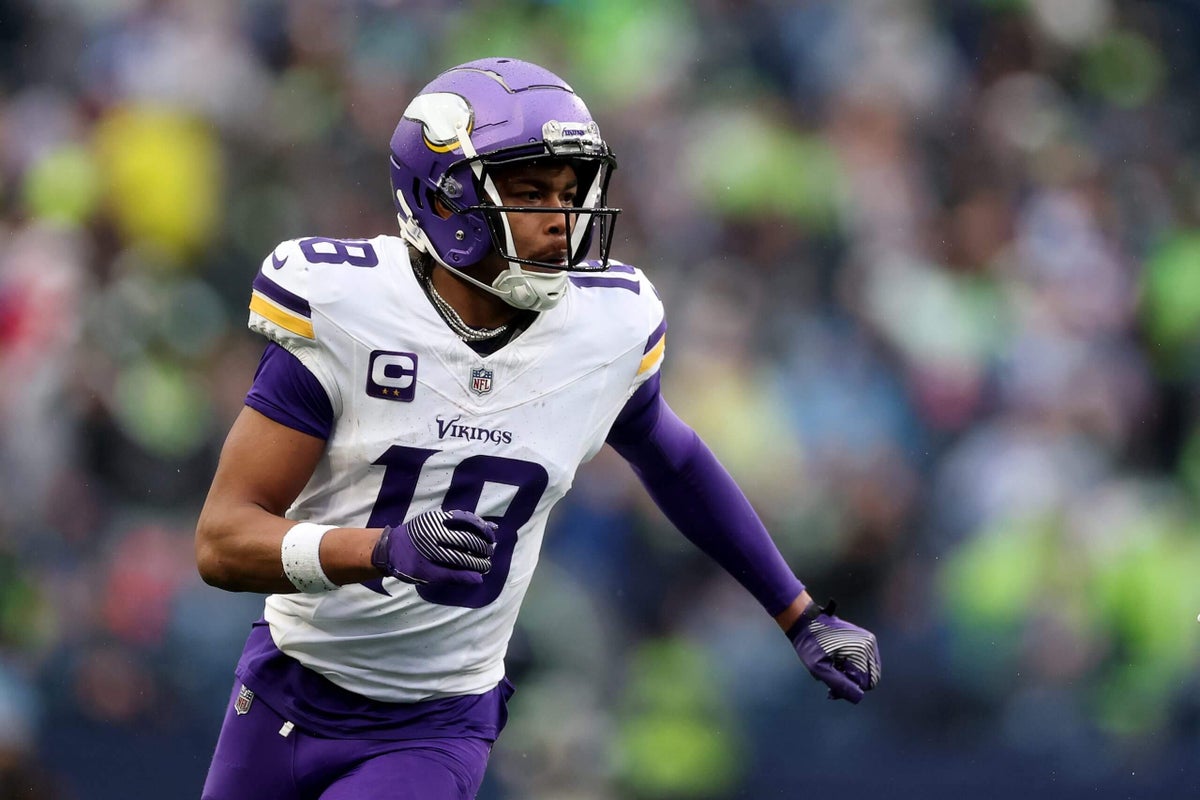
(Photo of Justin Jefferson: Steph Chambers / Getty Images)