
With the FTN Football Almanac 2025 nearing its release date—pre-order here!—it’s time we finish up our preview of the league’s advanced passing stats. We’ve already covered passing and receiving plus-minus, as well as YAC+, all from the offensive side of the ball. We’ll wrap things up by looking at how the league’s defenses performed in each stat.
In all honesty, defensive numbers here bounced around more than offensive ones do, because these are primarily offensive stats. It’s not that a defense can’t be particularly good at tackling and stopping teams from wracking up tons of YAC, or that there aren’t shutdown corners out there that can make catching a pass all that much more difficult, but the defensive versions of these numbers are less consistent year to year. From 2023 to 2024, defensive plus-minus had a -0.07 correlation, and defensive YAC+ had a +0.07 correlation. That’s a bit low, historically speaking, but it’s rare we see anything above +0.15 here; there’s plenty of noise in the data. The offensive versions had correlations of +0.45 and +0.48, respectively, in 2024, and those numbers rise if you limit it to teams which kept the same quarterback from year to year. For these particular stats, it matters far more who is throwing the ball and who is catching it than the coverage trying to prevent that from happening. If you were unlucky enough to draw the AFC North last season, you had a much harder time stopping receptions than if you drew the AFC East.
That doesn’t mean this data is meaningless. Nor does it mean defenses that did particularly well shouldn’t be applauded, as a good season is a good season regardless of what it means for the future. What does it mean if your team was near the bottom of the league? Well, have hope—these things often bounce back just as the schedule turns. A bad score here wasn’t good for your defense in 2024 but could mean you’re primed for a rebound in 2025.
As a refresher on these two statistics, plus-minus is essentially “completions above expected,” while YAC+ is essentially “yards after catch above expected.” Plus-minus allows us to provide context to completion percentage allowed by comparing completion percentages in each area of the field to historical baselines. These statistics do not include passes listed as “Thrown Away,” “Batted Down,” “Miscommunication,” “Hit in Motion,” or “Quarterback Drops Ball” by FTN Data charting. Metrics are based on how often a pass is completed based on the pass distance, the distance required for a first down and whether the ball was thrown to the left, middle or right side of the field. YAC+, on the other hand, estimates how much YAC a receiver gains relative to the YAC expected from an average receiver. We do not specify YAC+ based on particular routes, but the statistic provides a holistic approach to understanding which defenses allow more or less yards after the catch.
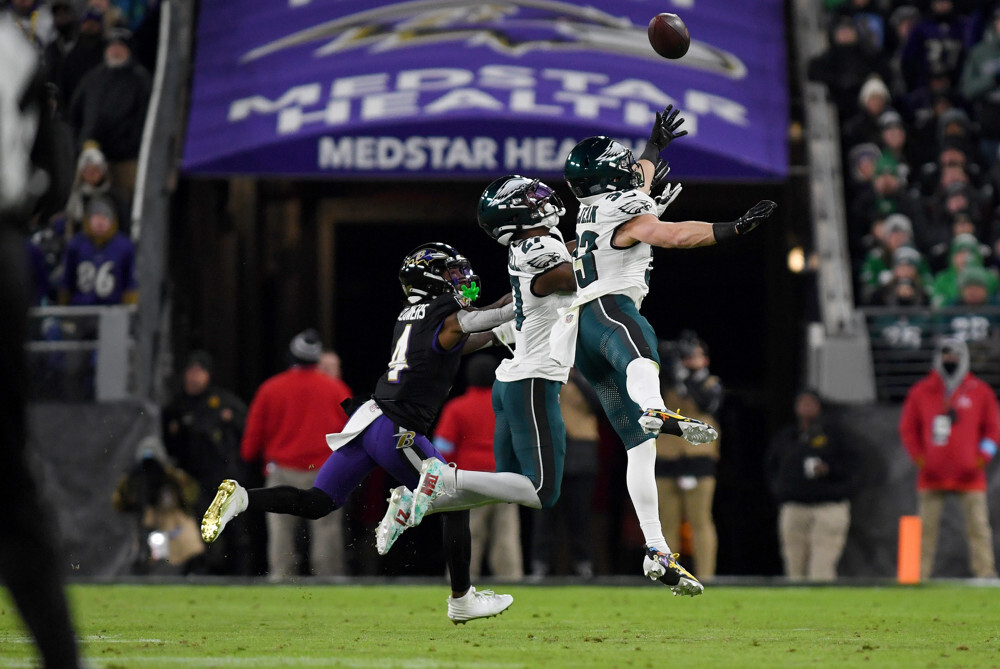
The Eagles take home the twin crowns of plus-minus and YAC+ champion, as their secondary shut everyone down a year ago on their way to the Super Bowl. Especially considering how poorly they ended 2023, we can’t give enough credit to Philadelphia’s secondary when we’re talking about how dominant its defense was last season. Cooper DeJean was outstanding, finishing 11th with a -25.8% coverage DVOA. Quinyon Mitchell, C.J. Gardner-Johnson and Darius Slay weren’t far behind, either. When your secondary’s weak link last year was Reed Blankenship, you’re doing pretty damn good for yourself.
The last team that pulled off the double, leading in both plus-minus and YAC+, was the 2017 Vikings. That’s mostly remembered for being the Case Keenum miracle year, but they had a -21.7% pass defense DVOA that year and had Xavier Rhodes and Harrison Smith as All-Pros in their secondary. They fell from first to 13th in plus-minus and first to 18th in YAC+ the next season as the year-to-year variance hit them. It turns out, it’s tougher to stop Tom Brady, Russell Wilson and Aaron Rodgers than it is to stop Joe Flacco, Brett Hundley and DeShone Kizer. This is one of those deep insights you’ve come to expect from the experts at FTN.
The Eagles secondary, as good as it is, is likely to be more challenged this season. While the Eagles had to take on both Lamar Jackson and Joe Burrow in 2025, both of whom are tough draws, their 2024 slate includes Josh Allen, Patrick Mahomes, Jared Goff and Justin Herbert, none of whom exactly scream “easy out.” And even the teams they played in both years are bound to be better, as they’re not likely to get two Cooper Rush games again when they play Dallas. It’s not a murderer’s row all the way through or anything, but it would be reasonable to expect Philadelphia to allow more catches and yards after the catch next season, simply because the Eagles are facing better offenses.
That doesn’t mean that the Eagles defense is bound to collapse or anything—we still have them projected to be very good, even against a tough schedule. And those 2017 Vikings, while they fell in these numbers the next season, still had a top-three passing defense in 2018. It’s a low correlation, not a negative one. And it’s usually a little stronger than it was in 2023-2024, so we’d expect better defenses to be stickier going forward than they were last year, rather than jumping all around our rankings. But part of winning a Super Bowl is having everything go right, and a healthy shut-down secondary is another one of those things the Eagles had work out for them a year ago. I’d personally be more concerned about losing Gardner-Johnson and Slay than I would be about seeing a stat that might regress toward the mean, but if the 2025 Eagles end up failing to repeat, worse secondary performance is likely to be part of it.
Here are the 2024 numbers for plus-minus and YAC+ allowed, sorted from best plus-minus to worst. Remember that the numbers are from the offensive point of view, so negative numbers are better.