
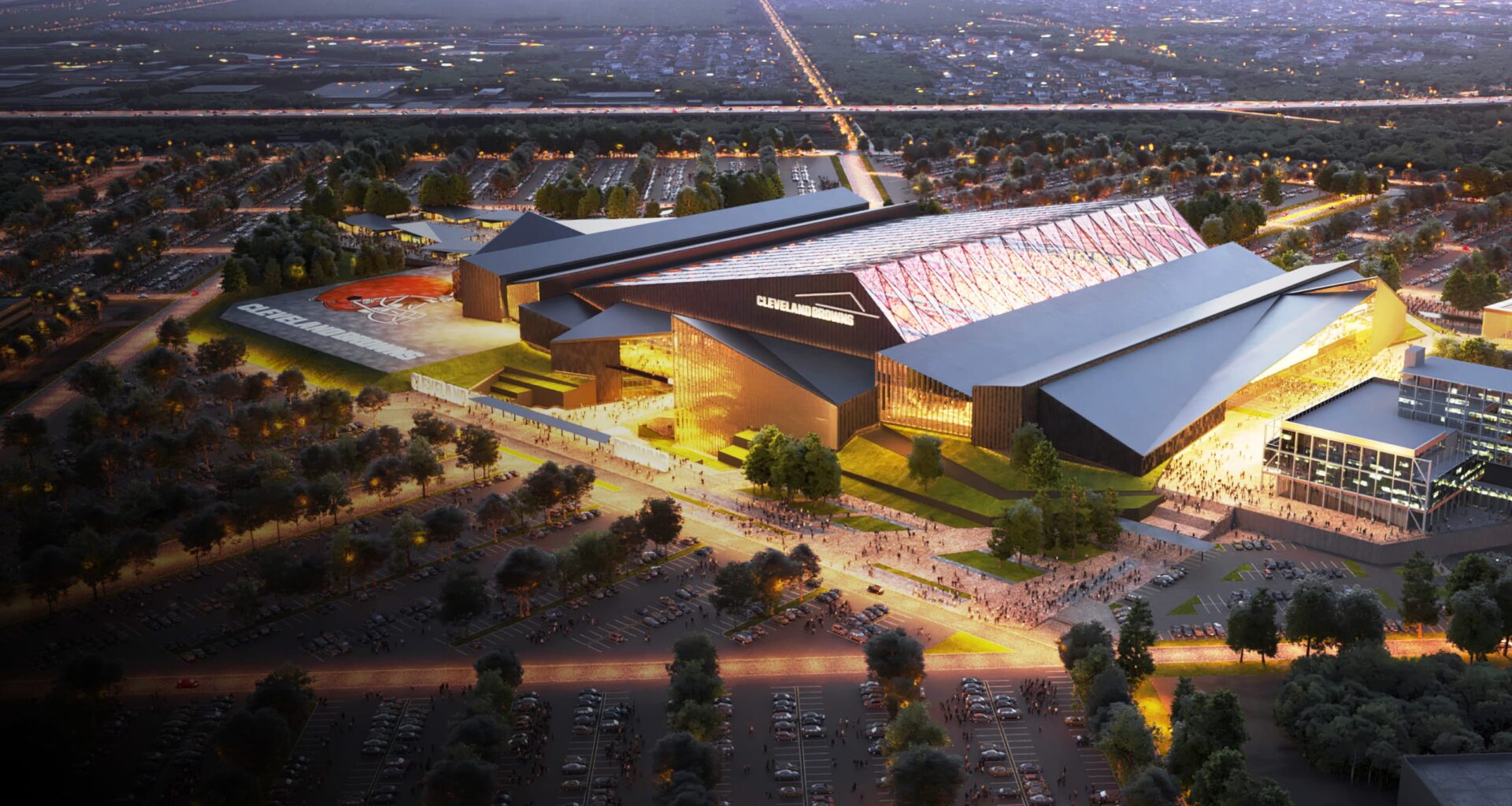
Gov. Mike DeWine’s office has released details of the governor’s proposal to fund the Cleveland Browns’ planned dome in Brook Park and other proposed stadium projects around the state.
The breakdown is contained in House Bill 96, the just-released legislation containing DeWine’s full budget proposal. The 4,063-page, $60.9 billion spending call for doubling the state’s tax on sports betting to 40% and using the proceeds to fund future pro sports stadium projects. DeWine has estimated this tax would raise $130 million to $180 million a year.
You can find the full bill text here. To help guide you, Signal Ohio is offering this summary of elements pertaining to the stadium funding plan, including page citations:
The bill creates a legal definition for “major sports facilities,” describing them as at least a $100 million renovation or a $1 billion new construction of a professional sports facility (pages 167 through 169 of the bill). It also creates a special category of stadium project that includes housing, hotels, parking garages and other elements of a mixed-used development. These mixed-use stadium projects must receive at least 60% of their funding from non-state sources to be eligible for state money.
Teams that operate state-funded major sports facilities must commit to playing the majority of their home games at this site for at least 30 years (page 167).
These projects would be funded by the newly created Sports Facilities Construction and Sports Education Fund, which would get its proceeds from taxes on sports gaming (page 3,517).
Minor league stadiums also could receive money from this fund, although the teams building them must either be directly affiliated with a major-league team, or be committed to playing the project of their home games at that site for 15 years. These minor-league projects must cost at least $10 million for renovations or at least $50 million for new construction (page 169).
The fund would be overseen by the newly-created Ohio Advisory Committee for Sports Facility Construction and Youth Sports Education (page 175). This committee would have seven members. Two of them would be appointed by the governor, two by the Republican leaders of the Ohio House and Senate, two by the Democratic leaders of the Ohio House and Senate. The last member would be an executive director hired by the full commission. Commission members who are members of the public would be paid $500 plus expenses on days when the committee meets. Team employees and people with financial interests in a professional sports franchise wouldn’t be allowed to serve.
The commission would be required to prioritize funding facilities or programs that promote economic development, support youth sports education and encourage training in team or individual sports. It also would be allowed to award grants helping communities in the state attract major sporting events or create tax credits to promote youth sports education (page 177).

Stadium fund plan part of state budget bill
DeWine, a Republican, announced the stadium funding plan when he rolled out his budget proposal. He described the gambling tax hike as a way to make sports gambling companies – whose marketing he described as “extremely aggressive” – to pay their fair share. He said the new fund would be a permanent way for the state to consider future requests to fund stadium projects. But he made clear that he had the Cleveland Browns stadium project and a separate proposal to renovate the Cincinnati Bengals stadium in mind.
DeWine’s budget proposal contains other “sin taxes” to pay for new initiatives. A big tax increase on tobacco products would finance a refundable $1,000 per-child tax credit for eligible families, and a tax increase on products sold in state-licensed marijuana stores would pay for jail construction and police training.
State lawmakers would have to approve the plan. Republican leadership has publicly expressed skepticism about the project, although it likely will end up getting rolled up into broader budget negotiations.
Browns ownership has tried to drum up support for public stadium funding
Browns owners Dee and Jimmy Haslam announced in October they want to leave the lakefront when the stadium lease is up at the end of 2028.
Browns ownership has been trying to win popular support for building a $2.4 billion roofed stadium in Brook Park. The team is asking for the public to take on half of the cost – though it wasn’t clear which public entities would be on the hook for $1.2 billion. For months, state lawmakers have fielded questions about the possibility of contributing $600 million to the stadium’s cost.
Cleveland Mayor Justin Bibb and Cuyahoga County Executive Chris Ronayne have insisted the Browns stay in Cleveland to preserve and build upon the hundreds of millions of dollars in public and private development. The city recently produced a study that said it would suffer a financial loss if the Browns left the city.
Next steps in the state budget process
The Ohio house currently is reviewing DeWine’s budget bill. Major changes are likely.
State Rep. Brian Stewart, the chairman of the House Finance Committee, has said he wants to pass a House budget bill sometime in March. It then would go to the Ohio Senate for a new set of rewrites. The House and Senate, which both are controlled by Republicans, then would work out their differences to pass something before a June 30 legal deadline. DeWine could veto parts of the final budget bill he doesn’t like.
Signal Cleveland Government Reporter Nick Castele contributed to this story.